
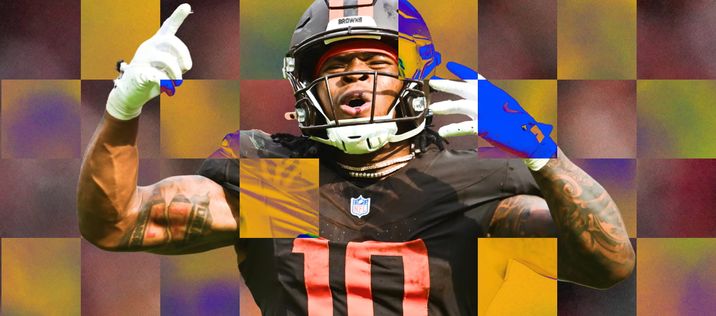
We’ve talked about fantasy football busts for 2026 throughout the summer. There are overvalued players that we’re likely to avoid at ADP, but if they drop a bit they could still land on a few of our teams. However, there are a few players who we’re likely not touching anywhere close to current cost. We feel these landmines could blow up your season before it even begins. Here are a few fantasy football draft landmines our experts avoid.
- 2026 Fantasy Football Expert Rankings
- Fantasy Football Dynasty Rankings
- Fantasy Football Trade Analyzer
- Best Fantasy Football Rankings

Fantasy Football Draft Landmines Experts Avoid
Here are players our fantasy football experts avoid at nearly all costs in 2026 drafts.
Consensus Landmines
Fantasy managers naturally covet high-volume running backs, and Quinshon Judkins could average 18 or more touches per game this season. He averaged 18.3 touches as a rookie despite missing training camp, the preseason and Week 1 because of legal issues stemming from a battery arrest. Judkins ran for at least 75 yards in six of his 14 games and scored seven touchdowns, but he was only the RB26 in fantasy points per game from Weeks 2-15 while averaging 18.7 touches and 72.8 total yards. That profile suggests his production could be volume-driven, replaceable and heavily dependent on touchdowns.
Judkins also wasn’t particularly efficient as a rookie. Among 49 qualifying running backs, he ranked 40th in explosive run rate, 33rd in missed tackle rate and 26th in yards after contact per attempt, according to Fantasy Points Data. He also ranked 38th in juke rate, 55th in yards per touch, 52nd in yards created per touch and second-to-last in rushing success rate at 33%. Cleveland’s offensive line deserves some of the blame, as 62.2% of Judkins’ rushing yards came after first contact and he had the fourth-fewest yards before contact per attempt. Only Cam Skattebo, Ashton Jeanty and Zach Charbonnet had less room before contact.
The situation doesn’t look dramatically better entering 2026. Judkins is recovering from the dislocated right ankle and fractured fibula he suffered in Week 16, and the four most recent players to return from fibula fractures averaged 6.7 fewer fantasy points per game than they had the previous season, according to Fantasy Points’ Ryan Heath. He’ll also be running behind a completely rebuilt offensive line that has never played together and could need time to gel. Cleveland is expected to have one of the league’s most anemic offenses, and the Browns open the season on the road against two strong run defenses in Jacksonville and Tampa Bay.
Dylan Sampson is also a capable back who could emerge as Cleveland’s preferred pass-catcher, leaving Judkins at risk of being limited to early-down work and touchdown-dependent production. Judkins’ current fifth-round ADP isn’t egregious, but the range is loaded with appealing alternatives, including Christian Watson, Rome Odunze, D’Andre Swift, Bucky Irving and Bhayshul Tuten. Judkins could still finish as an RB2 on volume alone, but his injury, limited efficiency and unfavorable offensive environment make him a player to avoid at his current price. Sampson offers a more appealing bet roughly 100 picks later.
Chuba Hubbard followed his RB15 finish in 2024 with a massively disappointing 2025 season, falling to RB40 in fantasy points per game and losing his starting job to Rico Dowdle. A calf injury contributed to his struggles, but Hubbard was also arguably the least efficient running back in the league. Among 49 qualifying backs, he ranked last in missed tackle rate and explosive run rate, 47th in yards after contact per attempt and 40th in yards per touch, according to Fantasy Points Data. He failed to produce a single run of at least 15 yards on more than 140 carries, something no other running back in PFF’s dataset had done over the previous 15 years. Hubbard also ranked sixth-worst in rushing yards above expectation per attempt and was PFF’s sixth-lowest-graded running back from Weeks 9-18.
Hubbard’s late-season decline wasn’t entirely new, as his performance also deteriorated down the stretch in 2024. His receiving usage declined sharply when Jonathon Brooks was healthy that year, and Brooks immediately earned valuable red-zone and receiving opportunities. In limited NFL action, Brooks caught all three of his targets for 23 yards across only 23 offensive snaps. Including the preseason, he has drawn four targets on 15 routes for a 27% target rate.
Carolina has moved on from Dowdle, but the team has been vocal about allowing Brooks to compete for the starting job if healthy. The current regime selected Brooks 46th overall in the 2024 NFL Draft, giving it plenty of incentive to find out what the 23-year-old can do with a larger role. Head coach Dave Canales has already said Brooks will have an opportunity to compete and that the backs could split work if Hubbard is healthy for Week 1. Hubbard has also missed time with a hamstring injury, adding more uncertainty to his outlook. After watching him lose his job once and struggle badly with efficiency, I’m unwilling to bet on Hubbard rebounding. Brooks could establish himself as Carolina’s RB1 sooner rather than later, making Hubbard a strong fade in fantasy drafts.
Pat Fitzmaurice’s Draft Landmines of 2026
There is only about a half-round difference between the ADPs of Pittsburgh’s top two running backs. Jaylen Warren is being selected as the RB30 and 80th player overall, while Rico Dowdle is going as the RB32 and 86th overall. Some fantasy managers prefer Dowdle because he became Dallas’ lead back during Mike McCarthy’s final season with the Cowboys and could theoretically fill the same role in McCarthy’s first year coaching the Steelers.
But Aaron Rodgers should be the prism through which we evaluate this backfield. The 42-year-old quarterback is now immobile and seems less willing than ever to remain in the pocket and absorb hits, making it important for Pittsburgh to use a running back who can protect him and serve as a receiving outlet. Steelers running backs drew 25.4% of the team’s targets last season, the NFL’s second-highest rate behind only the 49ers and Christian McCaffrey.
Warren has averaged 2.6 receptions per game and 1.41 yards per route run during his career, compared with 1.4 receptions and 1.05 yards per route run for Dowdle. The gap is even wider in pass protection. Warren earned a strong 72.0 PFF pass-blocking grade last season, while Dowdle received a poor 24.6 grade. Warren is the better bet to serve as Pittsburgh’s primary running back, leaving Dowdle at risk of handling a smaller role than many fantasy managers expect.
Trey McBride has a top-20 ADP after catching 126 passes for 1,239 yards and 11 touchdowns last season. That touchdown total was more than double his previous career high, while his 169 targets were 51 more than the next-closest tight end. Only two wide receivers, Ja’Marr Chase and Amon-Ra St. Brown, drew more targets than McBride.
That level of volume will be difficult to repeat. Arizona led the NFL in pass attempts last season, but that is unlikely to happen again after the Cardinals used the No. 3 overall pick on running back Jeremiyah Love. The team is also highly motivated to involve third-year receiver Marvin Harrison Jr. more heavily following two disappointing seasons. The Cardinals could easily attempt 100 fewer passes, and some of those opportunities will likely go to third-round rookie Carson Beck, who could receive a multi-game audition that may not produce pretty results.
McBride shouldn’t be expected to flop, but his target volume and touchdown total are both strong candidates to regress. He may still play well without delivering the type of production needed to justify selecting him in the middle of the second round.
Derek Brown’s Draft Landmines of 2026
I faded D.K. Metcalf last year, and I’m getting back aboard the “Fade D.K.” train in 2026 because I don’t see much upside at his current draft price. Although Metcalf finished as the WR21 in fantasy points per game last season, his underlying metrics and inconsistent weekly results tell a less encouraging story. Across his 15 games, he finished outside the top 36 wide receivers in weekly scoring seven times. Among 109 qualifying receivers, Metcalf ranked 25th in yards per route run, 26th in red-zone targets and 37th in first downs per route run, according to Fantasy Points Data.
Metcalf’s performance against two-high coverage is another concern in a league where 16 teams used it on at least 50.1% of their defensive snaps. Among those same 109 receivers, he ranked 41st in yards per route run against two-high coverage compared with 19th against single-high looks. That substantial split isn’t a new issue, either, as it has appeared in Metcalf’s analytical profile for several seasons. I’ll happily draft other players around his ADP instead of investing in Pittsburgh’s pseudo-alpha receiver.
Andrew Erickson’s Draft Landmines of 2026
Christian McCaffrey led the NFL with 413 touches in 2025 and reached 450 when including the playoffs. History suggests that chasing a running back the year after such an enormous workload is a losing bet. Over the last 13 years, only one running back has produced a top-five fantasy finish in the season after recording more than 400 touches. Only two backs have finished as RB1s the year after leading the league in touches since 2013, with Ezekiel Elliott the only one to crack the top five. The other 10 were derailed by injuries, regression or reduced volume. Among running backs aged 27 or older who led the league in touches, there have been zero top-five finishes the following season.
McCaffrey is now 30, and his rushing efficiency declined last year despite his ability to force missed tackles. Among 58 qualifying running backs, he was PFF’s second-lowest-graded rusher, averaged a career-low 3.8 yards per carry and ranked fourth-lowest in rushing yards over expectation per attempt. He has led the NFL in touches twice before, and his fantasy finishes in the following seasons were RB53 and RB71. Saquon Barkley provided another recent warning after finishing as the RB13 in 2025 following his massive 2024 workload.
McCaffrey has also experienced tightness during the preseason, while the 49ers enter the year with the NFL’s second-oldest projected starting offensive line. The team will open its season in Australia with a game beginning at 10:30 a.m. ET, adding another concern to what already feels like a fragile situation. Investing the No. 1 overall fantasy pick in a 30-year-old running back coming off 450 touches and declining rushing efficiency carries too much risk. Fade McCaffrey in 2026.
Brian Thomas Jr. endured a disappointing, injury-affected sophomore season, finishing as the WR43 overall and WR47 in fantasy points per game across 14 appearances. He averaged 8.2 half-PPR points on an 18% target share while producing 50.5 receiving yards per game, three total touchdowns and only seven red-zone targets. Thomas never approached the standard established during his electric rookie campaign, as another setback seemingly followed whenever he began putting together positive performances.
It’s difficult to be overly optimistic about Thomas returning to his rookie form as long as Trevor Lawrence remains Jacksonville’s quarterback. Thomas averaged six catches on 9.5 targets for 76.2 yards per game with Mac Jones in 2024. Across his other 21 games with Lawrence, those averages fall to 3.6 catches, 6.1 targets and 58.4 receiving yards. Lawrence has worked better with tight ends and receivers such as Jakobi Meyers and Parker Washington, much as he previously did with Evan Engram and Christian Kirk. In five games alongside Washington and Meyers last season, Thomas averaged only five targets and three receptions while ranking fourth in the target hierarchy behind those two receivers and tight end Brenton Strange, who posted a 14% target share and averaged 4.4 targets per game.
Jacksonville’s early schedule adds another reason to fade Thomas. As the Jaguars’ X receiver, he could draw difficult matchups against cornerbacks such as Denzel Ward, Patrick Surtain, Christian Gonzalez, DJ Turner, Quinyon Mitchell, Derek Stingley and Sauce Gardner during the first half of the season. If you still believe in Thomas’ profile, it may be better to acquire him cheaply after a slow opening month than to pay his draft-day price. A trade away from Jacksonville before the end of the 2026 season could also help his outlook.

Subscribe: Apple Podcasts | Spotify | SoundCloud | iHeartRadio


