
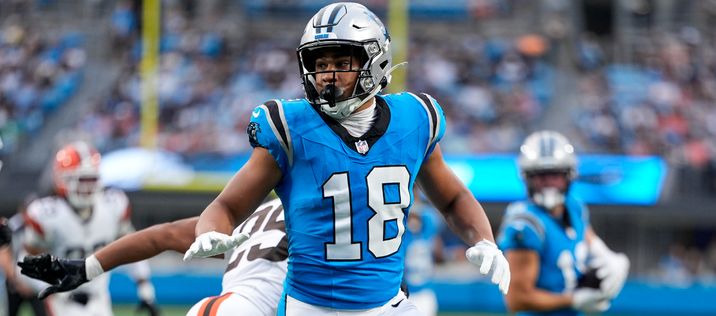
Start em or sit em? Fantasy football start or sit decisions can be excruciating. While it feels great to make the right call and cruise to fantasy glory, it hurts just as much when you have someone erupt while on your bench. You can use our Who Should I Start? tool to gauge advice from fantasy football experts as you make your lineup decisions. And you can also sync your fantasy football league for free using our My Playbook tool for custom advice, rankings and analysis.
Let’s take a look at a few polarizing players and what fantasy football expert Derek Brown advises. And you can find all of DBro’s fantasy football outlook in this week’s fantasy football primer.
- Waiver Wire Picks
- Weekly Fantasy Football Expert Rankings
- Fantasy Football Start/Sit Advice
- Fantasy Football Trade Tools

Fantasy Football Start’em, Sit’em Lineup Advice: Week 2
Here’s DBro’s start/sit advice for fantasy football Week 2.
Strong Starts
In Week 1, Parker Washington operated as Jacksonville’s WR1, finishing as the WR11 for the week. Washington had a 26.1% target share, 83 receiving yards (5.53 YPRR), zero red zone targets, two deep targets, and a 27.8% first-read share. The target share and first-read share easily led the team. The last time these two teams met, Washington had a 25% target share, 145 receiving yards, two red zone targets, a 23.8% first-read share, 26.5 PPR points, and a WR3 finish for the week. I expect Trevor Lawrence to lean on Washington again this week in this matchup, with Patrick Surtain likely shadowing Brian Thomas Jr. It won’t be an easy matchup, though. Last year, Denver allowed the third-fewest fantasy points per target and the eighth-fewest yards per target to slot receivers.
Deebo Samuel was also only a part-time player in Week 1. Samuel finished as the WR13 for the week, but he had only a 44.4% route share. He made the most of it with a 20.6% target share (tied for the team lead), 48 receiving yards (3.0 YPRR), and a 20% first-read share (tied for second on the team). Samuel got in the end zone while leading the team with three red zone targets. He also got his customary rushing usage, adding a carry for 12 yards on the ground. I expect Samuel to have another strong game in Week 2 against a hapless Miami defense.
The 49ers’ usage of their players was weird in some aspects in Week 1 because of the one-sided nature of the game, as they crushed the Rams. Mike Evans finished as the WR14 in weekly scoring, but he had only a 63.9% route share. This could also be related to the fact that Evans dealt with some nagging soft tissue stuff during camp, and San Francisco didn’t want to run him out there for a 90% route share in Week 1. Evans still tied for the team lead with a 20.6% target share while producing 49 receiving yards (2.16 YPRR) and seeing a team-leading 24% first-read share. Evans was second on the team with two red zone targets. I don’t expect the Miami Dolphins’ youthful secondary to be able to contain Evans in Week 2. The Raiders didn’t have to test them much in Week 1 and don’t have the players to do so even if they wanted to. If Evans had his way with the Rams, I don’t expect the Dolphins to be much of a problem.
Terry McLaurin had a horrible Week 1 against a stout Philly secondary. McLaurin finished with only two receptions and 14 receiving yards. He drew an 11.8% target share with 0.40 yards per route run, one red zone target, and a 17.4% first-read share. This is a wonderful bounceback spot for McLaurin in Week 2. Last week, Dallas utilized single high with 54.5% of their defensive snaps. Last year, against single high, McLaurin’s target per route run rate rose from 20% (against two high) to 28% as he churned out a stellar 2.49 yards per route run. I’m not scared of this Dallas secondary after they allowed the 13th-most fantasy points per target to perimeter wide receivers in Week 1 and ranked 19th in yards per target against the position.
Luther Burden had a quiet week, considering his team put up 59 points in Week 1 as the WR37 in fantasy. Burden had a 17.2% target share, 63 receiving yards (2.42 YPRR), zero red zone targets, zero deep targets, and a 27.8% first-read share (second on the team). Burden ran 53.8% of his routes from the slot. We’ll see if his usage increases in Week 2, but the matchup is solid. In Week 1, Brian Flores continued his heavy usage of two-high coverage, deploying it on 67.4% of their defensive snaps (fifth-highest rate). Last year, against two-high, Burden led the team with a 25% target-per-route run rate while posting 1.88 yards per route run (second-best). Burden could be called upon more this week. Another staple of Flores’ defense is the blitz. In Week 1, Flores dialed up blitz at an insane 73.9% clip. Last year, against the blitz, Burden was fourth on the team with a 21% target-per-route run rate, but he was only a part-time player. That could change in 2026. Burden won’t have it easy, though. Last year, Minnesota allowed the sixth-fewest fantasy points per target and the seventh-fewest yards per target to opposing slot receivers.
Stefon Diggs had a solid start to his Washington career as the WR17 in Week 1. Last week, Diggs had a 26.1% target share, 55 receiving yards (2.20 YPRR), one red zone target, a deep target, and a team-leading 26.1% first-read share. Diggs ran 60% of his routes from the slot. Diggs could follow up his productive Week 1 with another solid showing in Week 2 against a Dallas secondary that allowed the seventh-most fantasy points per target and the ninth-most yards per target to slot receivers in Week 1.
Rome Odunze entered last week’s game at less than 100% and it showed in his production and playing time. He had a 48.6% snap rate and 55.3% route share. I hope both of those numbers climb this week, but we’ll have to monitor his practice reports. Odunze finished with only a 10.3% target share, 52 receiving yards (2.48 YPRR), two deep targets, and a 5.6% first-read share. If Odunze is healthy enough, he could see a substantial workload against Brian Flores’ two high coverage and blitz heavy nature. In Week 1, Brian Flores continued his heavy usage of two-high coverage, deploying it on 67.4% of their defensive snaps (fifth-highest rate). Last year, against two high, Odunze was second on the team with a 24% target per route run rate and he led the team with 1.89 yards per route run. In Week 1, Flores dialed up blitz at an insane 73.9% clip. Last season, against the blitz, Odunze led the team with a 27.8% target share, 30% target per route run rate, and a 32.1% first-read share. My fingers are crossed that Odunze has a big game in Week 2. Last year, Minnesota allowed the second-most yards per target and the third-most fantasy points per target to perimeter wide receivers.

Fantasy Football Flex & Deep Plays to Consider
HELLO HELLO HELLO Jalen Coker! Cokeheads unite! Week 1 was our day. It was wonderful to see Coker balling out as the WR1 overall in fantasy for Week 1. Among all wideouts in Week 1 with at least 20 routes, Coker was tenth in separation score and 15th in route win rate. Coker has the talent to succeed this season. That much is very true. Will he be Carolina’s leading receiver all season? Eh, let’s pump the brakes on that, but Week 1 was a standout performance. Coker led the team with a 23.7% target share while tying Tetairoa McMillan with a 27.3% first-read share. Coker also had three deep targets and one red zone target, which tied or exceed McMIllan’s usage in Week 1. Coker finished with 138 receiving yards (3.94 YPRR) and two scores. We’ll see if Coker can keep the party bus rolling in Week 2, but Atlanta’s secondary could bring him back down to earth some if their Week 1 showing was indicative of how we should view them for the rest of the season. Last week, Atlanta allowed the fourth-fewest fantasy points per target and the seventh-fewest yards per target to perimeter wide receivers.
Well, Dontayvion Wicks made the most of his opportunities in Week 1 as DeVonta Smith‘s running mate. He was the WR21 in Week 1 while seeing a 16% target share (third on the team) with 73 receiving yards (2.70 YPRR), an end zone target (one score), and a 23.5% first-read share. Wicks also led the team with two deep targets (21.5 aDOT). If Hurts is looking to go deep again this week, Wicks could have another nice day. Last week, Tennessee allowed both of their deep targets to be secured while giving up 62 deep passing yards (tenth-most). In Week 1, Tennessee allowed the eighth-most fantasy points per target and the second-most yards per target to perimeter wide receivers. Cordale Flott and Alontae Taylor weren’t a formidable outside duo for Tennessee in Week 1, allowing a 118.8 passer rating and a 75% catch rate combined.
Chris Godwin disappointed me in Week 1 considering the matchup. Godwin had only a 14.3% target share, 40 receiving yards (1.33 YPRR), zero red zone targets, zero deep targets, and a 20% first-read share. It was only one game, but it’s possible Godwin is cooked at this point in his career. In Week 1, among 72 qualifying receivers, he ranked 69th in separation and 52nd in route win rate. That’s horrible no matter how you slice it, but it’s only one game. We’ll see how Godwin does with some more games under his belt. Godwin has another nice matchup in Week 2, as Cleveland allowed the most fantasy points per target and yards per target to slot receivers in Week 1.
In Week 1, Devaughn Vele finished as the WR10 in fantasy as Tyler Shough passed early and often, trying to keep up with Detroit. Vele’s nine targets look nice on paper until you realize that Shough chucked it 56 times and Vele had a 16.1% target share with 69 receiving yards (1.25 yards per route run). Vele was second on the team with a 22% first-read share with one red zone and one deep target. The inflated passing volume helped puff up Vele’s box score, but his per-route numbers were just okay. Vele is a decent flex this week, but the matchup is tougher. In Week 1, Baltimore allowed the 12th-fewest fantasy points per target to slot receivers while ranking 17th in yards per target allowed to the position.
Caleb Douglas had a strong Week 1 as the WR22 in fantasy. He was second on the team with a 22.2% target share, producing 94 receiving yards, a STRONG 3.13 yards per route run, and seeing a team-leading 35.3% first-read share. He didn’t have a red zone target, but he did see a deep target. I don’t expect Douglas to produce as a WR2 weekly, but his usage could easily make him a WR3/flex moving forward until he has to fight with Chris Bell for the target throne weekly. The 49ers aren’t a frightening matchup for perimeter wide receivers, ranking 16th in yards per target and receiving fantasy points per game allowed to the position after Week 1.
Last week, Matthew Golden came out firing as the WR17 for the Week with a 26.2% target share, 95 receiving yards (2.38 YPRR), three red zone targets, one deep target, and a 30.3% first-read share. This week, he’ll face a Jets’ pass defense that utilized two high at the tenth-highest rate in Week 1 (59%). Last year, Golden was more utilized against two high, with his target-per-route run rate climbing from 14% (against single high) to 21% and his yards per route run increasing to 1.60 (1.34 vs. single high). He won’t have an easy matchup, but it’s one that he can possibly overcome. Last year, the Jets allowed the eighth-fewest yards per target to perimeter wide receivers while ranking 16th in fantasy points per target allowed to the position.
Concerning Starts & Players to Fade
Drake London will be a tough player to depend upon with Cooper Rush under center. In Week 1, with Cooper Rush operating as Captain Checkdown, London had only a 13.6% target share, 29 receiving yards (1.21 YPRR), zero red zone targets, zero deep targets, and a 21.4% first-read share. There’s nothing good to see here. Nothing at all. Rush is a below-league average passer and it showed in Week 1. We’ll see if he can bounce back in Week 2 against a Carolina secondary that was leaky in Week 1. Last week, Carolina allowed the sixth-most yards per target to perimeter wide receivers while ranking 15th in passer rating allowed.
Jaylen Waddle had a horrible beginning to his Denver tenure in Week 1. He led the team with a 78.8% route share but saw only a 10.7% target share and 14.3% first-read share as he finished with one reception for two yards. Bo Nix played terribly in Week 1, and Davis Webb stumbled out of the blocks as a playcaller. I’m not laying this pitiful performance at the feet of Waddle. The entire Denver offense was on life support in Week 1. It won’t get any easier in Week 2 for them, but I expect (or hope) that they will look at least serviceable this week. In Week 1, Jacksonville utilized two high with 56.7% of their defensive snaps. In 2024-2025, Waddle, against two high, had a 21% target-per-route run rate and 1.87 YPRR. If Nix can get him the ball, Waddle should have a bounce-back week, but I don’t expect it to be a massive stat line. Last year, the Jags allowed the third-fewest yards per target and the second-fewest fantasy points per target to slot receivers.
Kalif Raymond popped off with a surprising stat line in Week 1 as the WR15 in fantasy. He had only a 60% snap share and 57.9% route share, but he saw a 31% target share and 33.3% first-read share. Raymond finished with 84 receiving yards, 3.82 YPRR, one red zone target, and one deep target. I don’t know if he will or can repeat this type of production, especially with a limited route share, but it’s possible that he can. In Week 1, Brian Flores continued his heavy usage of two-high coverage, deploying it on 67.4% of their defensive snaps (fifth-highest rate). Last year, against two-high, Raymond had only a 14% target per route run rate and 1.28 yards per route run, but this was with Detroit. In 2024, with the Lions and Ben Johnson against two-high, Raymond had only a 12% target-per-route-run rate and 0.67 yards per route run. The analytics aren’t in Raymond’s favor to continue his hot start to the 2026 season. If you’re in a deep league or desperate for a flex, I get it, but in most formats and leagues I’m not starting Raymond in Week 2. The matchup could be fruitful if you do decide to turn to Raymond, though. Last year, Minnesota allowed the second-most yards per target and the third-most fantasy points per target to perimeter wide receivers.

Subscribe: YouTube | Spotify | Apple Podcasts | iHeart | Castbox | Amazon Music | Podcast Addict | TuneIn
If you want to dive deeper into fantasy football, check out our award-winning slate of Fantasy Football Tools as you navigate your season. From our Start/Sit Assistant – which provides your optimal lineup based on accurate consensus projections – to our Waiver Wire Assistant, which allows you to quickly see which available players will improve your team and how much – we’ve got you covered this fantasy football season.


