
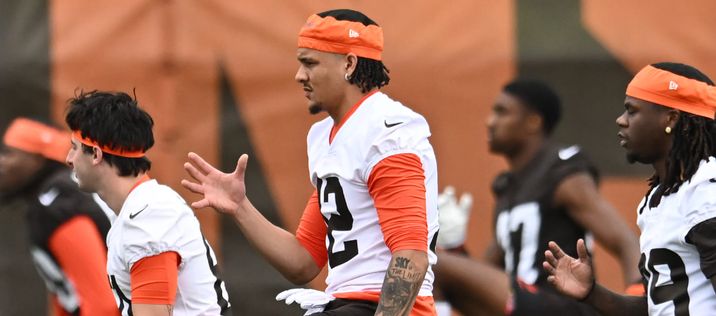
Start em or sit em? Fantasy football start or sit decisions can be excruciating. While it feels great to make the right call and cruise to fantasy glory, it hurts just as much when you have someone erupt while on your bench. You can use our Who Should I Start? tool to gauge advice from fantasy football experts as you make your lineup decisions. And you can also sync your fantasy football league for free using our My Playbook tool for custom advice, rankings and analysis.
Let’s take a look at a few polarizing players and what fantasy football expert Derek Brown advises. And you can find all of DBro’s fantasy football outlook in this week’s fantasy football primer.
- Waiver Wire Picks
- Weekly Fantasy Football Expert Rankings
- Fantasy Football Start/Sit Advice
- Fantasy Football Trade Tools

Fantasy Football Start’em, Sit’em Lineup Advice: Week 5
Here’s Derek Brown’s fantasy football Week 5 outlook for a few players to help with lineup decisions.
Strong Starts
After last week’s surprising dud, Parker Washington is the WR23 in fantasy points per game. Last week, Washington had only a 13% target share and a 14.3% first-read share as Trevor Lawrence was locked onto Brenton Strange. In the three previous weeks, Washington was the team’s unquestioned alpha with a 27.2% target share, 3.25 YPRR, 0.132 FD/RR, and a 32.8% first-read share. This feels like an outlier instead of a signal to panic. Washington also faced DJ Turner with 63.6% of his routes last week. Turner held him to one target and zero receptions. Washington could bounce back this week against a secondary that could be without Quinyon Mitchell. Even with Mitchell, Philly ranks 17th in yards per target and 19th in fantasy points per opportunity allowed to perimeter wide receivers, so this is more of a neutral matchup for Washington.
Denzel Boston is the WR20 in fantasy points per game, while commanding an 18.3% target share with 2.39 YPRR, three red zone targets, seven deep targets, and a 22.5% first-read share (second on the team). Boston has excelled so far this season, ranking 17th in separation and YPRR while sitting at seventh in route win rate among 77 qualifying receivers. This week, he’ll tangle with a Jets’ secondary that has the fifth-highest two-high rate (62.2%). Against two-high, Boston leads the team with a 21% target-per-route run rate against two-high while logging 4.47 YPRR. This is a tougher matchup for Boston, but I think he can overcome it. The Jets have allowed the tenth-fewest yards per target to perimeter wide receivers while ranking 15th in fantasy points per opportunity allowed to the position.
Matthew Golden continues with his sophomore breakout season as the WR16 in fantasy points per game. Among 77 qualifying receivers, Golden is 19th in separation and 30th in route win rate. Golden leads the team with a 22.7% target share and 27% first-read share with 2.03 YPRR, five red zone targets, and seven deep targets. This week, Golden faces a Chicago pass defense that has the fifth-highest single high rate (62.9%). Against single high, Golden has seen a strong 25% target per route run rate but his YPRR has slipped to 1.27. That’s not great at all, but he should still see the volume this week with that strong target per route run rate. Golden and Christian are the team’s top targets against single high. Golden should have a strong week against a secondary that has allowed the second-most yards per target and fantasy points per opportunity to perimeter wide receivers.
Fantasy Football Flex & Deep Plays to Consider
Bo Nix and suspect play-calling have capsized this offense in most weeks so far. Jaylen Waddle is the WR34 in fantasy points per game. Waddle has a 19.3% target share, 1.70 YPRR, two red zone targets, four deep targets, and a 28.2% first-read share. It has been tough when you can see Waddle getting open on film, but he can’t toss the ball to himself. If Bo Nix can get himself together this week, Waddle could have a nice game, but that’s a huge question mark. The Chargers have allowed the seventh-most yards per target and the fifth-most fantasy points per opportunity to perimeter wide receivers.
After a massive Week 4 performance, Carnell Tate is the WR27 in fantasy points per game. Carnell Tate has been commanding alpha-level volume, and now we’re starting to see it pay off. Among 79 qualifying receivers, Tate is seventh in target share (26.9%), 17th in YPRR (2.39), third in air-yard share (50.1%), 20th in FD/RR (0.098), and sixth in first-read share (36%). Tate has only one red zone target and three deep targets this season. Tate could be a strong WR3/flex again this week if Cam Ward can provide him catchable targets. Houston has allowed the third-most yards per target and the fourth-most fantasy points per opportunity to perimeter wide receivers.
Devaughn Vele has been a beneficiary of the Saints’ pass-happy offense as the WR20 in fantasy points per game. Vele’s per-route numbers are nothing impressive. He has a 17.2% target share, 1.30 YPRR, and a 22% first-read share, but the passing volume has helped him have some big box scores along with his six red zone targets and six deep targets. The high cholesterol usage has been wonderful, as he has two scores this season. This week, he faces a Minny defense that has utilized two high with 65.6% of their defensive snaps (fourth-highest rate). Against two-high, Vele has seen his target-per-route run rate drop to 16% with a dip to 1.03 YPRR. These numbers aren’t great, and the matchup is tougher, but he could still see enough volume to have a nice flex day. Minnesota has allowed the eighth-fewest yards per target and the sixth-fewest fantasy points per opportunity to slot receivers.
In Jalon Daniels‘ first start, Emeka Egbuka found himself as the third option in the passing attack, finishing third on the team with a 14.8% target share and 19% first-read share behind Cade Otton and Chris Godwin. Egbuka finished with only 13 receiving yards and one red zone target. It was a disappointing showing for Egbuka. With Daniels still finding his footing, I’d love to craft a narrative that Egbuka immediately bounces back; I don’t know if that happens, but it’s possible. Dallas has been tougher against perimeter wide receivers, though, allowing the eighth-fewest yards per target and the 11th-fewest fantasy points per opportunity to the position. Egbuka is just a risky flex with upside this week.
Last week, Darius Cooper finished as the WR13 for the week as he secured two touchdowns. Cooper had a 25.9% target share with 33 receiving yards (1.18 YPRR) and a 27.8% first-read share. Cooper had three red zone targets and two deep targets. Some of Cooper’s high-volume usage could be related to the fact that Dontayvion Wicks was dealing with Trent McDuffie for more than half of the game. Cooper only had to deal with McDuffie for 25% of his routes. Cooper is an interesting deeper league flex this week. In three of the Jags’ four games, they have utilized two-high with 56.7-56.9% of their defensive snaps. Against two-high, Cooper has had a massive 28% target-per-route run rate in his limited playing time with 1.44 YPRR. The Jags have only given up one receiving touchdown to perimeter wide receivers while surrendering the tenth-most yards per target to the position. Cooper is a desperation flex that could pay off this week.
Jakobi Meyers is the WR37 in fantasy points per game with two outings with 12 or more PPR points. Meyers has a 14.4% target share, 1.85 YPRR, three red zone targets, one deep target, and a 17.7% first-read share. Trevor Lawrence has leaned on Meyers more over the last two games, as he has had a 23.1% target share, 2.16 YPRR, and a 29.3% first-read share during that span. Meyers is a viable flex this week with the increased usage. Philly ranks 17th in yards per target and 19th in fantasy points per opportunity allowed to perimeter wide receivers.
Last week, with DeVonta Smith sidelined, Dontayvion Wicks was third among Philly’s starting wide receivers in target share with 14.8%, as he also tied for second among the group with a 22.2% first-read share. Wicks finished with 18 receiving yards (0.58 YPRR), zero red zone targets, and one deep target. He did have to deal with Trent McDuffie last week, with 51.6% of his routes. Against McDuffie, he had only one target, which he secured for seven receiving yards. In the previous three games, Wicks was involved with a 17% target share, 2.29 YPRR, and a 23.2% first-read share. This could be a nice bounceback spot for Wicks. In three of the Jags’ four games, they have utilized two high with 56.7-56.9% of their defensive snaps. Against two-high, Wicks has an 18% target-per-route run rate and 2.31 YPRR. The Jags have only given up one receiving touchdown to perimeter wide receivers while surrendering the tenth-most yards per target to the position.
Concerning Starts & Players to Fade
Deebo Samuel has been balling this season as the WR16 in fantasy points per game. Samuel has had some rushing production, padding his fantasy stats with seven carries and 74 yards on the ground. He has touchdowns in three of the 49ers’ four games this season. Samuel has a 14.2% target share with 2.31 YPRR, five red zone targets, zero deep targets, and a 15.1% first-read share. This week, he’ll face a Seattle secondary that has utilized two high at the ninth-highest rate in the NFL (59.1%). Against two high, he has seen his numbers suffer this season, with Mike Evans and George Kittle leading the way against this coverage. Samuel has only a 15% TPRR and 1.11 YPRR against two high this season. With a tough matchup incoming this week, temper your expectations. Seattle has allowed the sixth-fewest yards per target and the seventh-fewest fantasy points per opportunity to perimeter wide receivers.
DK Metcalf has had a predictably rough start to the season as the WR35 in fantasy points per game. He has rebounded somewhat over the last two games with at least 12.1 PPR points in each week. Metcalf has a 21.3% target share with 1.33 YPRR, one red zone target, ten deep targets, and a 29.6% first-read share. Metcalf has had some tough corner assignments to begin the season, but he has been woefully inefficient with his targets. We’ll see if that changes this week against an Indy pass defense that has held perimeter wide receivers to the ninth-fewest yards per target and the fourth-fewest fantasy points per opportunity. I’m not hopeful for Metcalf this week.
Josh Downs had a quiet week last week with a good matchup, but I think the blame should be laid at the Achilles of Daniel Jones and not placed upon Downs. Jones has been quite limited as a passer so far this season. Downs is the WR48 in fantasy points per game with two games with at least 12.7 PRR points this season. Downs has a 20.5% target share, 1.67 YPRR, four red zone targets, three deep targets, and a 26.8% first-read share (leads the team). Among 45 qualifying receivers, Downs leads all of them in separation and ranks sixth in route win rate. We’ll see if he can bounce back this week, but the matchup isn’t great. Pittsburgh has allowed the 14th-fewest yards per target and the seventh-fewest fantasy points per opportunity to slot receivers.

Subscribe: YouTube | Spotify | Apple Podcasts | iHeart | Castbox | Amazon Music | Podcast Addict | TuneIn
If you want to dive deeper into fantasy football, check out our award-winning slate of Fantasy Football Tools as you navigate your season. From our Start/Sit Assistant – which provides your optimal lineup based on accurate consensus projections – to our Waiver Wire Assistant, which allows you to quickly see which available players will improve your team and how much – we’ve got you covered this fantasy football season.


