Is Tyler Eifert better than Rob Gronkowski?
Recapping the Week 9 installment of Burning Questions:
| Player | Outlook | Result |
| Antonio Andrews | Flex/RB2 | RB2 on 20 touches |
| Seattle’s offense | Concern is warranted due to protection, red zone issues | Week 9 bye, but expect some offensive tweaks |
| Cardinals’ WRs | Larry Fitzgerald WR1 John Brown WR2 Michael Floyd WR3 |
Bye |
| Green Bay’s offense | Hard to trust anyone besides Aaron Rodgers | Rodgers was a top-3 QB and spread the fantasy wealth |
| DeMarco Murray | Hope he gets turned loose in Jerry World | Got turned loose in Jerry World |
NOTES: Antonio Andrews was available in nearly half of ESPN leagues last week, but he’s now up over 70-percent ownership entering Week 10…I had faith in Aaron Rodgers despite the tough matchup against Carolina, and while logic suggests that when Rodgers has a good day then at least one of his pass-catchers will also shine, the point was that it’s been tough to predict exactly who he’ll lean on in a given week. In Week 9, Randall Cobb, Davante Adams, Richard Rodgers and James Starks all happened to reward fantasy owners via the passing game, while James Jones turned in a dud. I didn’t envision that level of success, but hopefully you heeded my advice back in Week 5 and picked up Richard Rodgers as a weekly TE streaming option…The Seahawks and Cardinals both come out of their bye weeks and we’ll start to get some answers for those offenses.
Get Start/Sit & Waiver Advice with My Playbook 
On to Week 10:
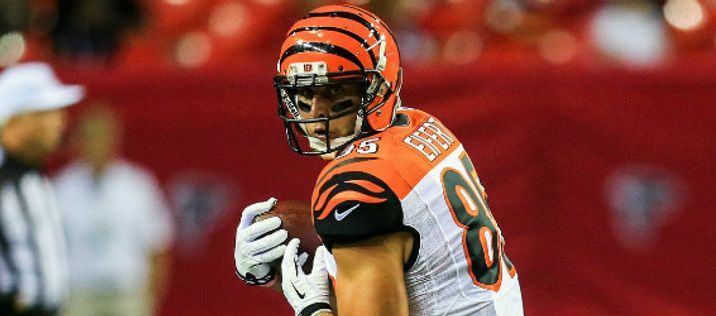
1) Is Tyler Eifert better than Rob Gronkowski?
Yes. There, I said it. And I don’t mean better as in some day, or under certain circumstances. I mean better as in the total package, right now, and moving forward. Yes, Eifert’s nine touchdown catches are two more than the next closest player of anyone in football, but there’s more to the story than just the touchdowns – all nine of which have come inside the red zone, by the way.
Pro Football Focus charts fantasy points per opportunity (pass routes), and Eifert’s 0.41 PPO is tops among 28 qualified TEs, with Gronkowski coming in second at 0.38 PPO. Eifert has 37 catches on 46 targets for an 80-percent reception rate based on targets, whereas Gronk has 44 catches on 65 targets for a 68-percent catch rate. Gronkowski boasts a better overall rating in PFF’s metrics (17.4 vs. 13.1), but Eifert has made strides as the slightly better rated run blocker (4.6 vs. 4.4) and has also been whistled for only one penalty, compared to seven for Gronk. In addition, Eifert’s 73-percent first-down rate is tied with Greg Olsen for tops among tight ends with at least 25 catches.
At the season’s halfway point, Eifert is on pace for 74 catches, 868 yards and 18 TDs in just his second full season. For comparison’s sake, Gronk posted a 90-1,327-17 line during his second pro season in 2011, which was also the year Tom Brady threw for a career-high 5,235 yards (Andy Dalton is on pace for 4,452 yards). PFF’s Sam Monson provided a great breakdown of Eifert several weeks ago, and it’s worth a read.
WEEK 10 AND BEYOND
It has certainly been quite the coming-out party for Eifert, the former Mackey Award winner as the top collegiate tight end who went widely undrafted this summer (but was on my radar, so, yay me!). He’s simply too fast to be covered by a linebacker, too big for corners, and as he proved earlier this season, too good for even a top safety like Kam Chancellor. Like death, taxes, and seeing a DraftKings commercial whenever you flip on the TV, count on Eifert for another TE1 performance on Monday Night Football when Cincinnati hosts Houston.
2) Why hasn’t Blake Bortles gotten more love from the fantasy community?
Having passed the halfway point of the regular season, Blake Bortles ranks inside the top-eight QBs in fantasy points per game. Since Week 4, he has averaged 299 passing yards and is coming off a career-high 381 passing yards – against Darrelle Revis and the Jets, no less. Bortles is on pace for 34 touchdown passes and nearly 4,400 yards, yet he was unowned in roughly half of ESPN leagues this time last week and somehow still remains available in 30 percent of leagues.
Perhaps that is because he is not yet a particularly great real-life quarterback. He takes a lot of sacks (29 through eight games), doesn’t complete a high percentage of passes (57.9 career completion percentage) and throws too many interceptions (he is on pace for 20 after throwing 17 picks as a rookie). Still, this is fantasy football, and Bortles has many of the traits owners covet, including a couple of top-10 fantasy WRs in Jacksonville.
Coming out of UCF, Bortles drew comparisons to Ben Roethlisberger for his size and ability to extend plays with his legs, and for having a big arm. This past week against the Jets, Bortles was 7-of-10 for 200 yards and two TDs on deep passes, which PFF defines as traveling 20 yards or more downfield. As a rookie, he attempted deep passes on only 10.3 percent of his throws, which ranked 30th in the league. But this year, he has just about doubled his frequency of deep passes to a league-high 20.3 percent.
WEEK 10 AND BEYOND
On tap for the Jaguars this week is a Ravens’ defense that has been the second-most generous to opposing fantasy QBs. Yet for some reason, Bortles is being started in fewer leagues than Oakland’s Derek Carr, who gets a Vikings’ defense that has allowed the fifth-fewest fantasy points to opposing QBs under coach Mike Zimmer.
Our expert panel has Bortles as the No. 14 QB for the rest of the season, but aside from name recognition, what exactly have Russell Wilson or Andrew Luck done to deserve their higher ranking?
3) Is DeAngelo Williams truly elite, or just a beneficiary of circumstance?
More than anything else, this question has to do with the fact that Williams is 32 years old and has not been a fantasy difference-maker since 2009. Now that we’ve got that out of the way, let’s dive into his actual performance metrics. Williams was PFF’s top-graded RB against Oakland in Week 9, when he ran for 170 yards and two touchdowns. He was also the only player with three runs of at least 15 yards. In fact, 43.4 percent of his rushing yards this season have come on “big runs” (15 yards or more), second only to Todd Gurley’s 52.0 percent.
There may be some regression to the mean in that regard, but Williams has certainly made his case for weekly RB1 status. He boasts a 4.8 YPC career average, including 5.3 YPC this year. Former Panthers teammate Jonathan Stewart recently opined that by splitting carries all those years in Carolina, he and Williams both have some extra mileage on their tires. Given the recent production from both players, he won’t get an argument from me.
During the four weeks when Williams has seen his most extensive playing time, he posted PFF’s fifth-best elusive rating and averaged 3.1 yards after contact per attempt, second only to Latavius Murray. Williams has also been more involved than usual as a receiver, averaging about three catches per game in that span.
WEEK 10 AND BEYOND
Up next for Pittsburgh this week is a Browns’ defense yielding 4.7 YPC and a league-high 147.6 rushing yards per tilt, making Williams a top-shelf RB1. Williams doesn’t exactly have the most fantasy-friendly schedule for the rest of the season, but I think he’ll outperform his No. 13 ECR and finish as an RB1, particularly with Ben Roethlisberger set to return sooner rather than later.
4) Which Raiders’ WR to own for the rest of the season?
Derek Carr’s solid sophomore campaign has helped yield a couple of fantasy-relevant receivers in Oakland. In standard leagues, Michael Crabtree and rookie Amari Cooper are both tied for 12th among WRs. For purposes of this analysis, we’ll assess each of their outlooks for re-draft purposes only.
In terms of pedigree, both players were unanimous All-Americans and Biletnikoff Award winners in college, and they both were off the board within the top-10 picks of their respective draft classes. Cooper’s biggest detriment, more or less, is that he’s a rookie, albeit one in the running for Rookie of the Year. Crabtree had some up-and-down years across the bay in San Francisco, but mostly, folks wondered whether he would ever be able to fully rebound from the devastating Achilles injury that shortened his 2013 campaign and, ultimately, led to his departure from the 49ers after a disappointing 2014 campaign.
Among the many things Crabtree has proven so far this season is that it takes more than a year to completely rebound from a torn Achilles tendon. He has edged Cooper in targets (77 to 68) and average depth of target (11.1 to 8.3), although they are virtually identical in yards per route run (2.23 to 2.21 in favor of Cooper), per PFF. Cooper has also dropped 8-of-53 catchable targets for a not-so-impressive 15.09-percent drop rate, whereas Crabtree has dropped only 3-of-50 catchable balls for a 6.00-percent drop rate. That trust factor is not to be overlooked. One notable area where Cooper has an edge is with his impressive 116.9 QB rating when thrown to, although Crabtree’s 101.2 rating is not far behind.
WEEK 10 AND BEYOND
Oakland’s Week 10 opponent, the Vikings, have allowed only six touchdowns to WRs this season. If only one of these two is to find pay dirt this week, I’m going with the more targeted and more reliable Crabtree. Cooper no doubt has the look of a generational receiving talent, but in re-draft leagues, the 28-year-old Crabtree is the slightly better bet for consistent fantasy production.
5) What does Jay Ajayi’s emergence mean for Lamar Miller?
Just when Lamar Miller owners started to get excited about finally seeing the Dolphins’ running back see heavy usage under interim coach Dan Campbell, rookie Jay Ajayi comes along and drops 41 yards on nine carries in his Week 9 debut against Buffalo. And, according to Campbell this week, Ajayi has “earned more carries” thanks to that performance. But is this just coach speak, or does he really mean it?
Let’s start with Miller, who last year rushed for more than 1,000 yards and averaged 5.1 YPC despite never getting 20 carries in a game. Although he has seen a slight uptick with an average of 14 carries in four games under Campbell compared to nine carries per tilt in his first four games under former coach Joe Philbin, the fact remains that Miller has yet to crack 20 carries this year despite averaging 5.3 YPC. He is on pace for only 956 rushing yards and 182 carries in the final year of his rookie contract, yet he is currently the No. 3 fantasy RB on the season. One can only wonder what those numbers would look like if he were ever given a workhorse role.
I spotlighted Ajayi back in July as part of my Impact Rookies series, but to recap; his draft stock slipped to the fifth round due to concerns about a knee issue, which may or may not have been overblown or fabricated entirely. Ajayi fell behind in training camp because of a hamstring injury, then cracked his ribs in the final preseason game after averaging 5.7 yards on 16 carries, and he just got activated off injured reserve-designated to return a week ago. In 2014 at Boise State, he became the first player in FBS history to eclipse 1,800 rushing yards and 500 receiving yards in one season. Over his final two collegiate campaigns, Ajayi found the end zone 46 times and rushed for more than 3,300 yards, albeit in the Mountain West Conference.
WEEK 10 AND BEYOND
The Dolphins travel to Philadelphia this week to face an Eagles’ defense that has been the third-stingiest to opposing fantasy RBs. With bye weeks still in full swing, chances are that Miller’s fantasy owners have little choice but to start him and hope for the best. Our expert consensus rankings list him as an RB1 this week, although I have him downgraded to RB2 status. With his usage in question, he really is an ideal sell-high candidate, so it’s worth putting some feelers out there to see what you can get in return. As for Ajayi, he remains more of a stash in keeper and dynasty formats but is no doubt the handcuff to own in Miami.
Import your team for free to get lineup advice
Mike Castiglione is a correspondent at FantasyPros. For more from Mike, you can view his archive or follow him @RickDancin.