
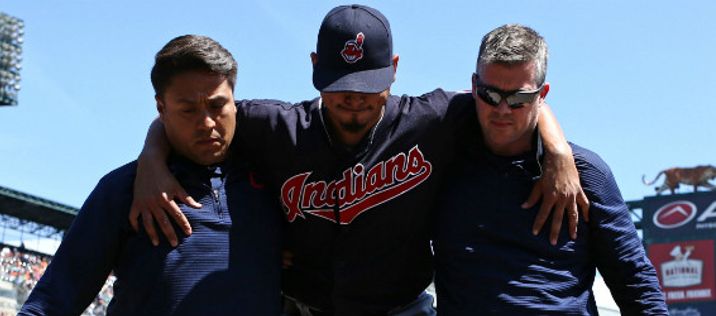

What should fantasy owners expect following Carlos Carrasco’s injury?
Carlos Carrasco is reported to be out for 4-to-6 weeks with a left hamstring strain. You don’t have to be a doctor to know that hamstring strains are all too common and many times end up recurring. I think most fantasy owners can live with this injury if it is simply a six-week absence, but the real question for those invested in Carrasco should be “will this injury become recurrent?” I am not into giving fancy statistics to get my point across, but I would bet that hamstring strains are no lower than No. 2 on the list of injuries most likely to recur. The only injury that I could see coming close is the ankle sprain (i.e. Steph Curry). The risk of recurrence for this injury should at least cause all invested in Carrasco to have a solid plan B in place.
Get free start/sit and waiver wire advice for your fantasy team 
The hamstring muscle is more prone to injury due to the fact that it is asked to work at full capacity, while many of it’s counterparts are allowed to work at partial capacity. For instance, the quadricep muscle group, which are the antagonist (opposite) to the hamstring group, are almost never stretched to their full capacity during activity. In order for the quadriceps to be stretched to full capacity you would have to perform a heel to butt stretch that many of us will do at the end of a workout by bending our knee and trying to pull our heel as close to our butt as possible. If you are not in the best of shape and try to perform this stretch you can appreciate the difficulty of trying to stretch a large muscle group to its full capacity.
The hamstring muscle group does not have to wait for us to try to stretch it by reaching for our toes or throwing our foot up on a high bar; it has the duty of coming to a full stretch with every step that we take. If you have a normal walking pattern, you will notice that your knee has to fully extend or straighten as you place one foot on the ground all the way through your step with the opposite leg. As this happens, your hamstrings are stretching near their full capacity in most cases. When you add some speed to this by going into a running motion, they are now reaching this full capacity at a quicker and more forceful rate which sometimes causes them to either stretch too far or too fast. This is generally the reason that you will see far more hamstring strains than quad strains; as your hamstrings are always a hair away from injury while your quads are very rarely in the range of injury. A move that is too fast, too far, too abrupt, or maybe just affected a little bit by an external force like a base or the infield surface can cause hamstring muscle fibers to strain. Hamstrings also tend to be a tighter muscle group for many and can sometimes be overpowered by the quadricep muscle group, which is a perfect recipe for a hamstring injury. Unfortunately, the hamstring is one of those muscle groups that have many controlled and uncontrolled variables that can lead to injury.
Carrasco’s injury is being called a moderate strain which likely suggest a grade 2 strain. A strain of this nature requires at least three weeks of healing followed by the appropriate rehab. I worry a little with him being a right-handed pitcher which means much of his weight is transferred through his left leg. This transfer of weight while the left knee is extended does require that the hamstrings have eccentric and stabilizing strength to hold their ground. An eccentric contraction is the ability to lengthen a muscle in a controlled manner, while stability requires that the hamstrings match the force of the quads to hold the knee in a particular position. If the hamstring is able to show good eccentric control and ability to not be overpowered by the quads, injury is far less likely. The Wild Card in this scenario is when Carrasco is fielding the ball or covering first base similar to how he suffered his current injury. Because a pitcher’s body is generally asked to repeat the same actions over and over again, an abrupt movement such as running to cover a base or moving quickly to get a ball is the likely time to see an injury occur. Although the act is routine, it is also unpredictable as compared to their wind up and pitching motion.
My feelings are that Carrasco will return within the designated 4-to-6 weeks, BUT owners should be sure to keep a good plan B for at least 1-to-2 months after his return. I tend to worry about hamstring injuries a bit more with the Freaky Talented athletes like wide receivers or maybe a great base stealer, as these athletes are always pushing their hamstrings to the limit. A pitcher is likely one of the safest bets to heal appropriately with this injury and not have it recur.
The good news is that hamstring injuries tend to let you know pretty quickly if they will be pesky and keep coming back. If you hear any of the magic words like soreness, tweaked, tight, etc. once he returns, I would not hesitate to move on. A second hamstring injury puts his chances for re-injury too high for my liking.
Dr. Eric Petty is a Physical Therapist who is taking his talents from the treatment room to help fantasy owners. You can find more of his work at his site, The Injury Report Doctor, and you can follow him @DrPettyIRD.


