
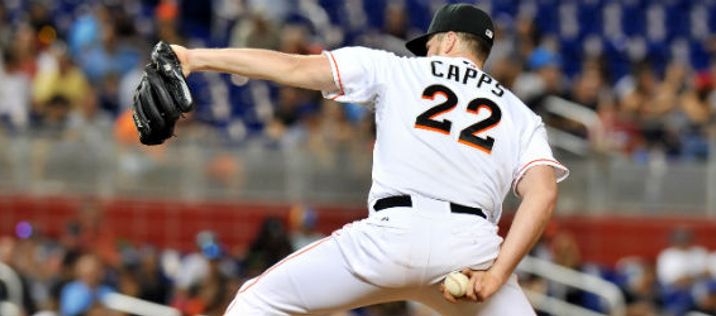

Carter Capps and the rest of the Marlins’ sneaky good bullpen prevent DFS players from maximizing the value of all their hitters’ at-bats
We’re at a point during the fantasy season when enough data has accumulated to make a good number of second half predictions. We’re also close to a number of fantasy trade deadlines, and the playoffs start in a little more than a month. Here are some burning questions I’ve had over the past week.

What are some teams with sneaky good bullpens?
When setting a DFS lineup, there are times when you will pass on a hitter because they face an elite starting pitcher that day. As a result, the chances of scoring a lot of points on that pitcher are slim. When you’re trying to maximize the returns from every spot of your lineup, you want every at-bat for your hitters to return positive value. This brings me to bullpens. You may have a hitter with a good match-up against a starting pitcher, but what if they only get one or two plate appearances against that pitcher before the opposing manager heads to the bullpen? The chances of putting up a historic night of points immediately begin to dwindle. Everybody knows about the elite Royals’ bullpen, and the strong back end of the Yankees’ bullpen, but here are two sneaky bullpens that might limit the value of your DFS plays.
I’m using SIERA to compare starting pitchers with relievers. SIERA attempts to estimate the underlying skills of a pitcher and highly values strikeouts. For more information, visit this link: http://www.fangraphs.com/library/pitching/siera/
- Miami Marlins: Starters’ combined SIERA: 4.25, Relievers’ combined SIERA: 3.06
The Marlins’ bullpen gets a large boost from Carter Capps and emerging closer A.J. Ramos, who combined have pitched 71.1 innings with a 110/18 K/BB rate and a 0.77 WHIP. Remove these two from the Marlins’ bullpen and the matchup is much more appealing. Still, the Marlins’ bullpen owns a 3.25 ERA and should be considered a top-10 bullpen in the major leagues. If you haven’t read or seen anything about Carter Capps and his unique delivery, it’s worth your time if you’re a fan of pitching and baseball in general.
- Milwaukee Brewers: Starter’s combined SIERA: 4.07, Reliever’s combined SIERA: 3.06
The Brewers have had a decent amount of success out of the bullpen. Aside from Jonathan Broxton, six of their regular relievers have ERAs at 3.40 or below. Francisco Rodriguez, Will Smith and Michael Blazek each own ERAs of 1.54, 1.75 and 1.81, respectively. Milwaukee relievers are third in the league with a 24.7% strikeout percentage, and 15th with an 8.6% walk percentage. Kyle Lohse and his 1.81 HR/9 rates can make DFS players salivate, and any hitter standing in the box against Lohse is definitely worth consideration. However, it’s worth remembering that once Lohse leaves the game, your hitter may not see much success for the rest of the contest.
What pitchers are allowing the most steals?
I’ve been listening to a lot of interviews with the current Hall of Fame class. One thing Craig Biggio mentioned that I’ve heard current major league players say is that the opposing pitcher matters more than the opposing catcher when it comes to attempting stolen bases. If a player can figure out the delivery/timing of the opposing pitcher, their chances of attempting and earning a stolen base are increased. Earlier in the year I wrote about catchers and their caught stealing percentages. Here are a few pitchers that lead the league with the most stolen bases allowed.
- Jon Lester – Cubs
26 stolen bases allowed, five caught stealing, CS%: 16 (Lester is notorious for not feeling comfortable throwing over to first base. Six of Lester’s steals allowed have been to league-leader Billy Hamilton.)
- Tyson Ross – Padres
26 stolen bases allowed, nine caught stealing, CS%: 26%
- A.J. Burnett – Pirates
24 stolen bases allowed, eight caught stealing, CS%: 25%
- Ubaldo Jimenez – Orioles
15 stolen bases allowed, two caught stealing, CS%: 12%
- Anibal Sanchez – Tigers
14 stolen bases allowed, three caught stealing, CS%: 18%
Who are some current DFS value plays?
- Stephen Piscotty – OF – Cardinals
Piscotty isn’t a blue chip prospect, but any player in the Cardinals’ organization has a chance of outperforming their projections. Called upon to give the Cardinals some starts at first base and the outfield, Piscotty was hitting .272/.366/.475 at Triple-A before receiving his call to the majors. I think Piscotty is best used when the Cardinals face left-handed pitching. In an EXTREMELY small sample, he’s gone 2-for-4 against lefties with two hits, a run scored and a run batted in. In the last four games he’s started, Piscotty has gone 5-for-15, posting positive DFS scores in each of those games. He’s not going to play every day, but if he’s in the lineup against a lefty I’m finding a way to get him in my lineups.
- Tyler Saladino – 2B – White Sox
Saladino has given the White Sox offense a nice bump since his promotion in the middle of July. He’s normally batting second in the order, which gives him more opportunities to score runs and accumulate at-bats. His price has risen steadily since his promotion, but he’s still towards the middle of the pack in the second base pool. He’s more of a speed prospect than a power prospect, despite hitting two home runs without a stolen base. Going forward, I like him to get on base, steal and score runs for the White Sox as their offense begins to heat up down the stretch.
- Michael Taylor – OF – Nationals
Taylor surged this past weekend, hitting home runs on Saturday and Sunday atop the Nationals’ batting order. His price hasn’t seen the same surge, and he’s a good value play going forward as his price is still among the bottom third of outfielders. He can provide pop (eight home runs this season) and some speed too with 11 stolen bases. He routinely leads off for the Nationals in front of Yunel Escobar, Bryce Harper and the returning Ryan Zimmerman and Jayson Werth. His recent performance over the weekend has surely caught the eyes of many DFS players, but his price suggests that not everybody believes in the recent production. I’m willing to gamble, and I think Taylor is a good DFS target down the stretch.
Which offenses struggled but could emerge down the stretch?
It’s all about who is producing right now in fantasy baseball, especially DFS. Whether you’re deciding what pitchers to start and sit in your roto league to help maintain your standing, or finding a stack target in DFS, most of the time hot teams produce and cold teams stay dormant. Here are two teams whose value has very recently trended upwards after a bad start to the season.
- Chicago White Sox
The White Sox are 6-5 in the second half, with a +15 run differential. They’ve won their last five games with a fantastic +23 differential, scoring more than six runs in four of those games. Players like Adam Eaton, Melky Cabrera and newcomer Tyler Saladino have given the White Sox offense the punch they thought they’d have at the beginning of the season. The team posted a .649 OPS in 91 games before the All-Star break, but the bats have started to wake up with a .774 OPS in 11 second half games. The White Sox offense seems to have shed their label of “AL Central Whipping Boy” and could come along strong in the final months of the season.
- Philadelphia Phillies
The Phillies are the worst team in the major leagues based on a lot of metrics. Their 37-63 record is worst in the majors, and their -139 run differential is 75 runs behind the Red Sox who have the second worst differential of -64. Hitters have feasted on Philadelphia pitching, and will continue that trend for the rest of the season, but what about the Phillies’ hitters? Since the All-Star break, the Phillies have a +21 run differential with an 8-1 record. In these nine games, Phillies hitters have posted a .282/.338/.464 batting line. In 91 games before the All-Star break, their triple slash was .246/.297/.363. Yes, it has only been nine games and it’s entirely possible the Phillies regress to their first half numbers and continue to be a target for pitching success. But right now the team is hitting, and they have a better chance now at ruining your perfect DFS roster than they did earlier in the season.
What are some intriguing splits to explore?
There are so many stats you can use to justify the decisions you make with fantasy baseball, and here are some splits I found intriguing.
- Toronto Blue Jays starting pitchers have a .299 wOBA against them at home and a .334 wOBA on the road.
- Cleveland Indians starters have a .327 wOBA against at home, and a league leading .290 wOBA on the road.
- Yankees hitters have the third best OPS at home with .817, on the road their OPS is .690
- Colorado Rockies hitters lead the league in isolated power against right-handed pitchers with .190 ISO, against lefties, they’re dead last at .093.
- Versus left-handed pitching, the Marlins have the fifth highest wRC+ at 107. Their wRC+ against righties is a league-worst 81.
JP Gale is a correspondent at FantasyPros. To read more from JP, check out his archive and follow him @gojpg.


