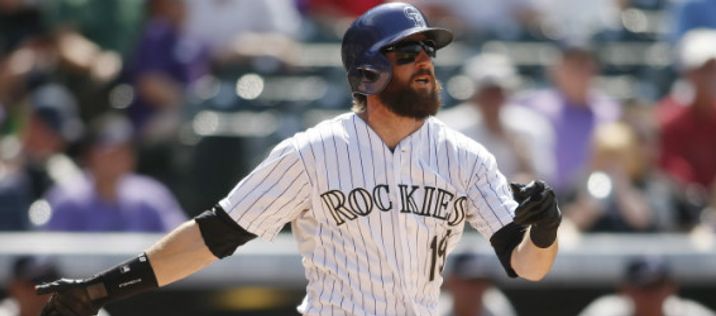

Charlie Blackmon
Charlie Blackmon is on the 15-day disabled list with reports of “turf toe” in his left foot. The Denver Post reports he is in a walking boot which is a great start to allowing this injury to heal. In my opinion, this injury is at least a three-week injury, but for a baseball player with a lot of season in front of him, I would be very cautious and likely plan for up to six weeks.
Get free start/sit and waiver wire advice for your fantasy team 
I say this because managing turf toe is like trying to eat only five chips out of a full bag. The best option is to simply let it heal rather than pushing too hard or too early and getting into a battle that you will likely lose. The science of this injury tells the story:
“Turf toe” can be an awful injury to endure and to rehabilitate. “Turf toe” is a nickname used to describe a strain/sprain injury at the Metatarsophalangeal joint (MTP joint). An MTP sprain/strain is very much like any other joint sprain/strain in terms of the science. The sprain is to the ligaments protecting the joint while the strain is to the muscles that protect the joint. The injury is graded as a 1, 2, or 3:
- 1 – Indicating over stretching with swelling and pain
- 2 – Indicating small tears to the structures with pain, swelling, instability, and some loss of strength
- 3 – Indicating a complete tear

Here’s what happens while walking and running during the push-off phase with a turf toe injury
The factor that makes “turf toe” so difficult to manage is that the joint and its structures are small enough to make adding support very difficult, but important enough to hinder almost everything you do athletically.The functional issue comes down to push-off (Illustrated in the figure below) which is powered at the MTP joint and by the Flexor Hallucis Longus which crosses the joint. Running is just a faster and more forceful version of walking, and push-off is essential. In theory, athletes are creating more force in a shorter amount of time which is why this injury tends to happen to athletes who are fast and explosive.
One of the most important things to understand with this injury is that healing occurs in stages. The three stages of healing are inflammation, repair, and remodeling. With sprain/strain injuries at other body parts, such as knees and ankles, it is not always essential to advance to the remodeling phase before the player returns to play. These other sites of injury allow a player to return to play with a tape job or a brace that will supplement the function of the injured structure (i.e. a knee brace supplements an injured quad muscle to help support the knee joint). In the case of turf toe, I need the entire healing process to run its course as bracing or stabilizing is a far less effective option with this small joint.
One of the hardest things to manage with this injury is that the mechanism of injury occurs during a motion that IS supposed to happen, although not to the degree of force and range of motion that is encountered during the injury. When you compare this to other ligament and tendon injuries that occur during motions that are NOT supposed to happen at all, you can appreciate why stabilizing or bracing against those motions is a more straight-forward approach.“Turf toe”provides the unique task of limiting a joint’s movement to a very precise range that optimizes performance but prevents injury.
When this all sounds confusing to someone, I usually use the analogy below:
Problem: You want to stop eating potato chips.
- Option A: Stop eating them by simply not buying any at all.
- Option B: Stop eating them by buying a bag of chips but only eating five chips per day (for the sake of this analogy, let’s say that eating 6 or 7 would cause an all-out disaster in your body).
Most of us would choose Option A as an easier and more realistic option, as stopping at five chips with an entire bag in front of you is tough (or maybe it’s just me). Option A is my preferred treatment plan for turf toe–put the foot in a boot, leave it alone as long as I can and worry about regaining range and strength when it is healed. Option B represents the early return to activity in which you would be asking the ligaments and tendons of the MTP joint to stop at five chips every time, while six or seven would mean re-injury. Your toe would have to extend to just the perfect point (five chips) and then stop before crossing the threshold of stretching and irritating the ligaments, tendons, and joint (six or seven chips). Option B is typically only something used in a more urgent situation such as a football player heading into the playoffs where it may be one and done. With a larger joint like a knee or ankle, I can simply provide a brace that will stop me at five chips or less and not allow that re-injury to occur.
With this said, it would be wise to watch the rehab plan for Blackmon closely. Right now he is probably a hold in regard to what to do if you are invested in him, but an aggressive approach to his rehab or a return in less than three weeks would be a red flag that would make me strongly consider moving on or at least preparing for re-injury. This may be the unpopular stance as many fantasy owners are happy when their player returns from injury sooner than later, but this is just not an injury that I want to play with.
Early return translates to re-injury in my eyes.
Subscribe: iTunes | Stitcher | SoundCloud | TuneIn
Dr. Eric Petty is a Physical Therapist who is taking his talents from the treatment room to help fantasy owners. You can find more of his work at his site, The Injury Report Doctor, and you can follow him @DrPettyIRD.