The True Fantasy Difference is a useful way to compare players at the same position, like Russell Wilson (left) and Jameis Winston (right)
Draft prep is one of the great joys of fantasy football. Sure, every league has that guy or girl that walks in with a rankings list they printed that morning. For the rest of us, deciding who to target and when is a honed skill.
The True Fantasy Difference (TFD) provides perspective by showing you the difference or similarity between two players in a new meaningful way. It does this by stripping away distracting information like season-long point totals or one crazy 39-point week. Instead, TFD focuses on our primary pre-draft concern: finding players later in the draft that will perform like an early-round pick.
TFD doesn’t make any predictions about future performance. It only provides appropriate perspective to help you make difficult decisions.
There are three steps to finding the TFD between two players. Each step provides a useful piece of information by itself about the difference between those two players.
By doing all three steps, you can compare the past or projected future performance of one pair of players to another pair of players. At the bottom of the article, there is a worksheet that will do steps two and three automatically for you.
Start preparing for your league now with our NFL Draft Simulator
Step One: Eliminate Similar Weeks
In the first step, we ignore season-long point totals and look at the players’ weekly scores. We then eliminate pairs of weeks in which the players scored within two points of each other. This helps us see how many weeks the two players were truly different.
The reason a season-end point total is somewhat useless to a draft prepper is that (as ESPN’s Matthew Berry often reminds his readers) fantasy football is played on a week-to-week basis. One great game from a player only helps you for one week, no matter how great it is.
For example, let’s compare 2015’s third highest scoring QB, Russell Wilson (322 fpts), to the 21st highest, Jay Cutler (217 fpts). On the surface, Wilson is a much more valuable fantasy option.
For 75% of the season (12 weeks), Wilson and Cutler helped you essentially the same amount. In the other four weeks, Cutler was out once and faced the Denver and Arizona defenses for two others. With some smart roster management, you could easily have used a Ryan Fitzpatrick or Kirk Cousins some of those weeks, giving you almost no difference.
Knowing that, how much would it have hurt you to skip Wilson in the draft and take Cutler seven or eight rounds later? A season-end difference of over one hundred fantasy points quickly gets put into perspective when it translates to four weeks of help. Whether you use last year’s stats or next year’s individual-game projections, use this technique to compare players not by points, but by how many weeks they’ll be different. With this perspective, you can decide when it’s wise to take a player early and when you can get similar production later in the draft.
Using this same method, let’s compare Julio Jones (231 fpts; 2015 No. 2 WR) with John Brown (134 fpts; 2015 No. 23 WR). Once you eliminate similar weeks, they were different for five weeks last year. Two of those weeks came when Brown was out or still injured, making the difference closer to three weeks. It is up to you whether you want to consider those weeks, ignore them or replace them with the player’s median score for the season (see below) to imagine what might have happened if they did play at full strength.
Step one tells you how many weeks the two players scored different amounts. Even when two players are only different for a few weeks, there can be a big difference in the number of points they score in those weeks. So, let’s move on to…
Step Two: Compare the median scores in the remaining weeks
As we saw above, season-long point totals don’t reflect what truly matters to fantasy owners: week-to-week scoring. For the same reason, average fantasy points per game (ppg) aren’t helpful either because the average is just another way of comparing season-long points.
An average takes that misleading season-long point total and divides it by the number of games a player played. Often, the result is a number that the player didn’t even score!
From Weeks 8-12 last year, C.J. Anderson averaged 10.4 fppg. Not bad for an RB2, right? His actual points in those weeks were 16, 3, 0, 6 and 27.
That is, he only helped you twice and hurt you three times. That 10.4 fppg average is meaningless. It reflects the point total through five weeks, not a number of points you can expect from the player in a given week.
Instead of average, TFD uses median. Median looks at all of the weekly scores and tells you the one in the middle of all of them. This is a number the player scored (or close to it).
Best of all, it doesn’t let an unusually high or low week skew the result. That’s useful to us because one or two really good weeks or really bad weeks only helps or hurts you once or twice.
Let’s return to the Russell Wilson and Jay Cutler comparison and look at weeks in which they were different—the ones left over after the first step. The median of Russell Wilson’s remaining weeks is 32. The median of Jay Cutler’s remaining weeks is 7.5.
So for the four weeks that they were different, you could expect about a 24.5 point difference between them (32 minus 7.5). That is a big difference, but not for a lot of weeks. If we instead compare Andy Dalton to Cam Newton (accounting for Dalton’s missed games), there was only an eight-point difference between them, but for nine weeks.
At step two, we now can say “If I had selected Jay Cutler, a late-round draft pick, instead of Russell Wilson, it would have only hurt me for four weeks, but by a median score of 24.5 points. If I can get a very reliable WR or RB by waiting on QB, this might be worth it. Alternately, I may want to look seriously at Dalton. He may rarely perform as well as the top QB, but he’ll be consistently above average.” You have a new perspective to help you make this decision.
Step Three: Finding the True Fantasy Difference
The information gained from the first and second steps is useful, but only refers to two players at a time. Step three gives us a single number that represents how similar or different those two players are (the True Fantasy Difference). We can then compare the TFD of one pair of players to the TFD of another pair.
[Just want the results and don’t care how you got them? Skip to Using the Worksheet below. TFD is always a number from 0-100. The lower the number, the more similar the two players are.]
To determine TFD, I use the difference between the best and worst player at that position as a measuring stick. To compare my players to the measuring stick, I divide one into the other. In the example below, I show how I would compare Wilson and Cutler to Cam Newton and an imaginary terrible QB that scored 0 points all season.
By dividing the difference between Wilson and Cutler by the difference between Cam and a 0-point QB, I get a percentage from 0-100%. If the result (the TFD) is closer to 0%, it means that the difference between my two players is nothing like the difference between Newton and a 0-point QB.
That tells us that the two players are interchangeable. If the result is closer to 100%, it means that the difference between the two players is very big, just like Newton and the awful QB.
Step Four: Using the True
Fantasy Difference
How can we use this information? FantasyPros reports that Aaron Rodgers is currently being drafted two to three rounds ahead of Drew Brees. The projected TFD between Aaron Rodgers and Drew Brees based on Yahoo individual-game projections is 0.
Their 2015 TFD was 7.7, favoring Brees. So, I might decide that it’s worth waiting for one or two rounds to take Brees instead of Rodgers since the TFD shows no practical difference. In 2015, the TFD between Wilson and Cutler was 23.8.
If I don’t want to take a QB early, I see that in 2015, the TFD of Wilson/Cutler was only 16 more than the TFD of Rodgers/Brees. If I can find a late-round QB that I think will perform similarly to 2015 Cutler, I could get a big weekly advantage.
TFD also puts the difference between the boom-or-bust TE and the consistent TE in perspective. Let’s compare the 2015 stats of consistent No. 3 TE Gary Barnidge with boom-or-bust No. 9 TE Richard Rodgers, who had five games of one or zero points and five games with double-digit points. After eliminating similar weeks, they only had three weeks of difference with a TFD of 27.
No. 12 TE Jason Witten scored only fourteen points fewer than Rodgers but did not have his highs and lows. However, the TFD between Barnidge and Witten was 40 with six weeks of difference. This suggests that if you are going to wait on TE, someone with a high weekly upside will be more similar to a top TE than someone who rarely has big games but scores four to seven fpts consistently.
TFD doesn’t make decisions for you, but it gives you a more realistic perspective than you would get from simply looking over rankings, stats, or comparing average points scored.
Using the Worksheet
If you only do the first and second steps, you will already have a lot of information about the actual difference between two players. If you want to use the TFD stat to have a number that represents exactly how different your players are, you can use the worksheet below. This worksheet will do most of this work for you if you follow these instructions:
- Choose two players and write down either last year’s weekly stats or next year’s projected stats. You can find these stats on many major fantasy football websites.
- Cross out any pairs of weeks within two points of each other.
- Enter in the remaining point totals under “Player A” and “Player B” on the worksheet. Player A needs to be the higher-scoring player.
- See the results. The lower the True Fantasy Difference, the more similar the two players are. Be sure to look at the correct position.
_______________________________________________________________________
For those interested, here is the formula with an example. The exponents help make the results of step one slightly more important than the results of step two. The worksheet found above will do all of the math for you.
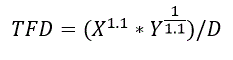
X is the number of weeks different (from step one)
Y is the difference of their median scores (from step two)
D is the difference between the average of the two top scorers at the position and 0
Wilson vs. Cutler
Four weeks different (from step one above)
Median score of Wilson’s remaining weeks – Median score of Cutler’s remaining weeks = 24.5 (from step two above)
The difference between the top two QBs and 0 = 354

Brian Hoffman is a correspondent at FantasyPros. To read more from Brian, check out his archive and follow him @hoffmaba1.