We’ll have you covered with our dynasty rookie draft rankings and advice to help you dominate your leagues. Here’s a look at a dynasty rookie mock draft using our free draft simulator. We dive into a few of the picks below.
Dynasty Rookie Mock Draft
Here’s a five-round, 1QB dynasty rookie mock draft. Here is the full draft board, and we dive into the dynasty rookie draft pick selection below.
Full Dynasty Rookie Draft Board
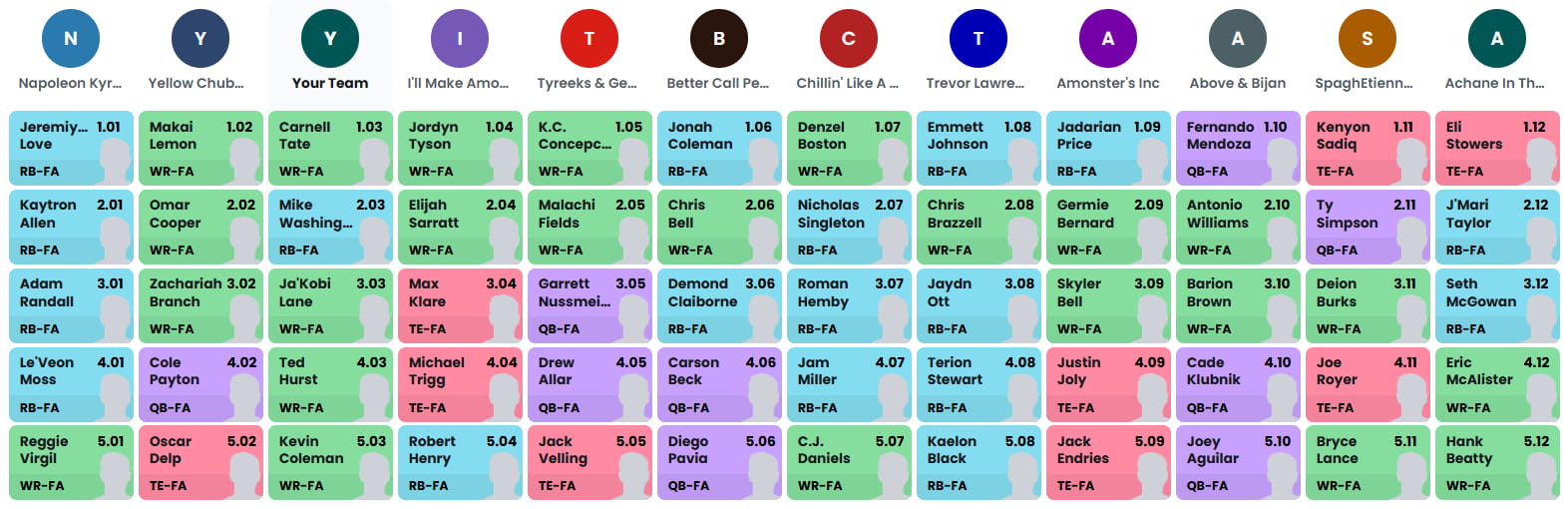
Dynasty Rookie Draft Picks
Derek Brown breaks down a few of these dynasty rookie mock draft picks.
1.03 – Carnell Tate (WR – Ohio State)
Tate is a fluid mover who looks like he’s gliding down the field at all times. He has easy, effortless acceleration and speed. Tate pulls away from corners on crossing and vertical routes. He has no issues stacking corners. Tate can threaten a defense at all three levels. Tate is a savvy route runner with an in-depth understanding of how to manipulate corners with a variety of pacing variations in his routes, head fakes, and jab steps. He loses little speed when linking these separation tools together. The snap at the top of his stems is crisp and sudden. Tate’s play strength shows up during routes and at the catch point. He has incredible body control to make difficult catches outside of his frame look easy and routine with arrogant hands. He snags the ball away from his body with a litany of sideline catches. Tate finishes college with a 68.8% contested catch rate and a 4% drop rate (including zero drops in his final season). One area that Tate will have to improve upon in the NFL is consistently beating press coverage. He can get hung up at times with physical corners that can get into his body and stall him. It’s not a consistent issue as he has plenty of high-level reps against press where corners flail as they attempt to slow him down, but it’s worth noting.
2.03- Mike Washington Jr. (RB – Arkansas)
Washington has a stout, muscular frame. He’s an upright runner with solid contact balance and above-average burst with the long speed to hit a crease and take it to the house. In 2025, he was 12th in runs of 15 yards or more and 17th in breakaway rate. Washington has a starter/three-down skill set. Washington has solid but not outstanding lateral agility. He can make people miss and take advantage of cut-back opportunities with his nimble feet, but his hips are tight, which can limit him at times. Washington runs with power and can lower his shoulder when needed. Washington is a better pass catcher than his yards per route run would suggest. He has a soft set of hands that led to only one drop in his final collegiate season. While he might never be a player that is “featured” in the passing game, he has the necessary skills to operate as a three-down back. Washington is already a solid pass protector. He has the play strength to hold his ground and the foot quickness to adjust to incoming rushers. Over the last two seasons (140 pass blocking snaps), he allowed only one sack and six hurries.
3.03 – Ja’Kobi Lane (WR – USC)
Lane is an athletic, tall drink of water. He can get downfield with deep buildup speed and strong ball tracking skills. Lane flashes body control in the air and the ability to adjust on the fly to back shoulder targets. Lane has a strong understanding of route running with plenty of bells and whistles to get open. He will add jab steps and small intricacies without losing much speed in the route. Lane displays a firm understanding of leverage and when to time his route breaks with the corner’s hips. Lane can’t stop on a dime, but he has adequate deceleration skills for his size when running comebacks and stop routes. He’ll need to continue to improve his ability to sink his hips if he wants to be tasked with a full route tree in the NFL and not just pigeon-holed as a deep threat. Lane isn’t offering much after the catch unless he slips a tackle or sees a busted coverage. He did manage 18 missed tackles over the last two collegiate seasons. His upper body strength allows him to win 50/50 balls. His hands need to improve to turn those into 60/40 balls (8.6% drop rate over the last two seasons).
4.03 – Ted Hurst (WR – Georgia State)
Hurst has a thin but muscular frame. His play strength is surprising for his frame. He doesn’t get pushed off routes and fits through contact well. Hurst has immediate and fluid speed with easy change of direction. He loses little speed when subtly changing directions mid-route. Hurst has a nice homerun gear in the open field. He’s a refined route runner with a varied release package. Hurst can invite indecision in cornerbacks’ heads as he sets them up and dances in their blind spot. He sells the vertical push well and has solid hip sink and deceleration skills for a player his size. Hurst can play above the rim with good adjustment to back shoulder throws and nice body control in the air. He displays a large catch radius. Hurst displays late hands. His drop rate decreased in every year of college, with a 9% rate in his final season. He’s a ball winner at the catch point with a 61.1% contested catch rate for his collegiate career. 50/50 balls become 60/40 balls for Hurst.
5.03 – Kevin Coleman Jr. (WR – Missouri)
Coleman Jr. is a zone-destroying specialist from the slot who also adds an element of verticality to a passing attack. His speed and burst are immediate and palpable when turning on the film. Coleman offers toughness and YAC ability with not only his speed but also his underrated tackle-breaking ability. Over the last two seasons, he ranked 17th and fifth among wide receivers in missed tackles forced. Coleman has good vision in traffic and looks like a running back with the ball in his hands, bouncing off defenders. Coleman can destroy corners underneath with slants and outs while also stretching the field with slot fades, etc. He has good snap at the top of his stems and can change direction without losing much speed. He displays solid ball tracking downfield. With his smaller frame, Coleman has a smaller catch radius. His hands aren’t a concern, though, with only a 3.4% drop rate in college. He does display strength at the catch point when presented with muddy situations, with a 53.7% collegiate contested catch rate.
Subscribe: Apple Podcasts | Google Play | Spotify | Stitcher | TuneIn | RSS | YouTube