We’ll have you covered with our dynasty rookie draft rankings and advice to help you dominate your leagues. Here’s a look at a dynasty rookie mock draft using our free draft simulator. We dive into a few of the picks below.

Dynasty Rookie Mock Draft
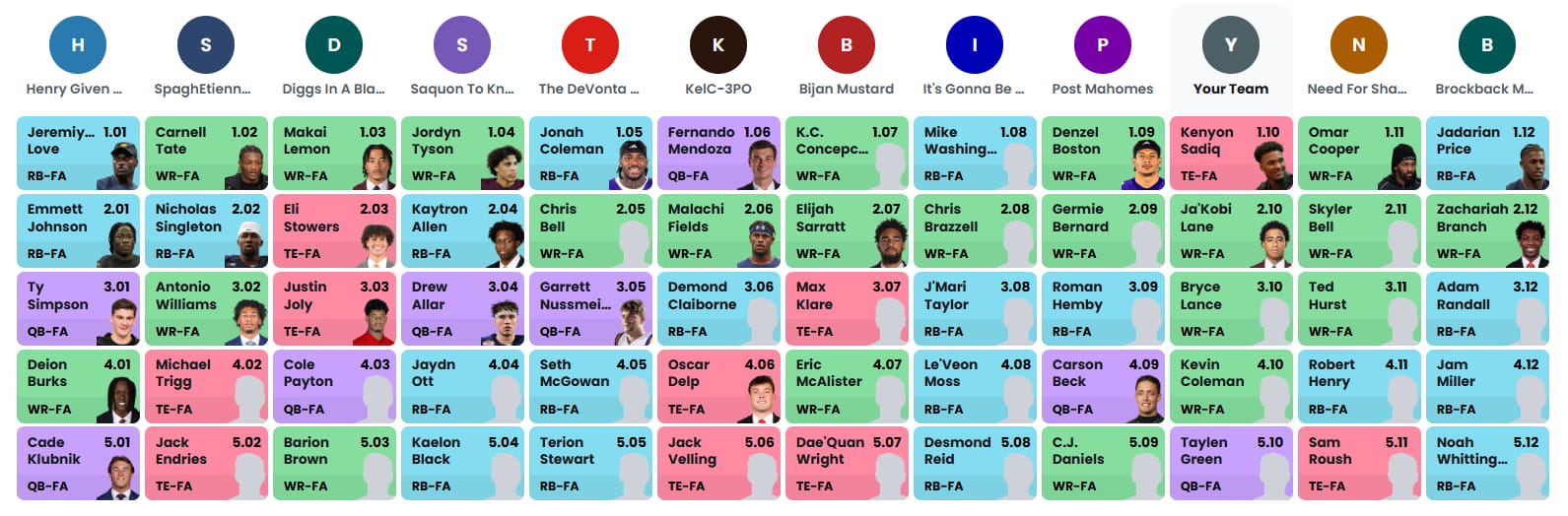
Here’s a five-round, 1QB dynasty rookie mock draft. Here is the full draft board, and we dive into the dynasty rookie draft pick selection below.
Full Dynasty Rookie Draft Board
Dynasty Rookie Draft Picks
Derek Brown breaks down a few of these dynasty rookie mock draft picks.
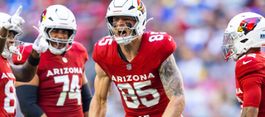
1.10 – Kenyon Sadiq (TE – Oregon)
Kenyon Sadiq should be a full-time starter for an NFL team from the jump. Not only does he deliver upside as a receiver, but Sadiq is a difference maker as a blocker. Sadiq can hold his area of grass with a strong anchor and high motor. Sadiq was also utilized as an edge-setting blocker and lead option with the running game for the backs and quarterback-designed runs. Sadiq has fluid hips that allow him to uncover at the top of his stems quickly. He has to improve his route running with the footwork at the top of his stems and his salesmanship during his routes. That isn’t to say that Sadiq is a bad route runner. That’s definitely not the case. He has the raw speed to easily pull away from corners during routes and up the seam. He flashes good ball tracking with downfield seam routes and impressive body control in the air. He has the play strength and above-the-rim skills that play well at the catch point and in the red zone. Sadiq’s catch radius is massive, with the skills to adjust to targets thrown low and behind him. He can operate as a dump-and-run option for an NFL passing attack with the ability to create yards after the catch. Sadiq can break tackles in the open field with strong contact balance and a thick lower half, which is great because he isn’t the twitchiest player with the ball in his hands. Sadiq can snap off a decent whip route, but it won’t blow you out of your shoes. The lack of suddenness in some of his change of direction and route running can improve as he hones his skills as a technician. He has the raw athleticism to improve.
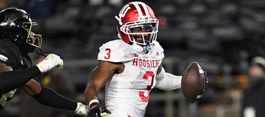
2.10 – Ja’Kobi Lane (WR – USC)
Lane is an athletic, tall drink of water. He can get downfield with deep buildup speed and strong ball tracking skills. Lane flashes body control in the air and the ability to adjust on the fly to back shoulder targets. Lane has a strong understanding of route running with plenty of bells and whistles to get open. He will add jab steps and small intricacies without losing much speed in the route. Lane displays a firm understanding of leverage and when to time his route breaks with the corner’s hips. Lane can’t stop on a dime, but he has adequate deceleration skills for his size when running comebacks and stop routes. He’ll need to continue to improve his ability to sink his hips if he wants to be tasked with a full route tree in the NFL and not just pigeon-holed as a deep threat. Lane isn’t offering much after the catch unless he slips a tackle or sees a busted coverage. He did manage 18 missed tackles over the last two collegiate seasons. His upper body strength allows him to win 50/50 balls. His hands need to improve to turn those into 60/40 balls (8.6% drop rate over the last two seasons).
3.10 – Bryce Lance (WR – North Dakota State)
Lance is a fluid athlete with smooth hips and lightning-fast speed. He can quickly get up to top gear while also having the skill to stop on a dime and sink his hips on comebacks and curls. He’s deadly on out and ups and double moves. Overall, Lance is a strong route runner who plays through contact. He can gain early separation with a solid release package and the in-route bells and whistles. Lance can telegraph his route breaks at times with exaggerated movements at the top of his stem. He’ll need to continue to clean that up, but it’s not a consistent issue. Lance is an electric field stretcher with solid ball tracking and the body control to adjust to back shoulder targets and sideline catches. Lance is a catch point winner with a 61.5% contested target catch rate. He flashes a soft set of hands with only a 3.8% drop rate, which is even more impressive when you consider the degree of difficulty of his targets. Lance has a 14.1 aDOT in college with 15.5 aDOT in his final season. In 2025, 30.4% of his target volume was 20 yards or more downfield.
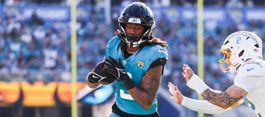
4.10 – Kevin Coleman (WR – Missouri)
Coleman Jr. is a zone-destroying specialist from the slot who also adds an element of verticality to a passing attack. His speed and burst are immediate and palpable when turning on the film. Coleman offers toughness and YAC ability with not only his speed but also his underrated tackle-breaking ability. Over the last two seasons, he ranked 17th and fifth among wide receivers in missed tackles forced. Coleman has good vision in traffic and looks like a running back with the ball in his hands, bouncing off defenders. Coleman can destroy corners underneath with slants and outs while also stretching the field with slot fades, etc. He has good snap at the top of his stems and can change direction without losing much speed. He displays solid ball tracking downfield. With his smaller frame, Coleman has a smaller catch radius. His hands aren’t a concern, though, with only a 3.4% drop rate in college. He does display strength at the catch point when presented with muddy situations, with a 53.7% collegiate contested catch rate.
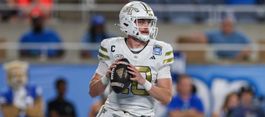
5.10 – Taylen Green (QB – Arkansas)
Dual threat passer. Green averaged 113 rushing attempts and 600.8 rushing yards over the last four years of college (8.8 rushing touchdowns per season). Green has build-up speed and the size to be a goalline threat in the NFL. He’s a straight-line runner without a ton of wiggle. He’s best viewed as an opportunistic scrambler at the next level with some upside in the designed run game. Green has the arm strength to make every NFL throw necessary. He has easy flick of the wrist velocity. His windup can get long at times, leaving the ball coming out a touch late, though. His accuracy on intermediate throws is decent, with thoughtful ball placement at times, where he’s helping his receivers avoid hospital collisions. Green’s overall accuracy is spotty, though. His deep ball can lack touch, especially on boundary go balls or corner of the end zone shots. His footwork can lapse at times, which doesn’t help his accuracy issues. His second level passes lack touch at times as he resorts to line drive fastballs when he needs to layer the ball. His pocket presence needs refinement. Green is late to feel the rush many times and doesn’t have the quick-twitch abilities to bail him out of danger situations. He wasn’t tasked with full field reads at Arkansas, but he’ll hang on his first read or miss receivers running wide open at times. Green feels a tick late at times getting the ball out. His trigger has to speed up to the pace of the NFL game.

Subscribe: Apple Podcasts | Google Play | Spotify | Stitcher | TuneIn | RSS | YouTube