Even after almost four full months of the Major League Baseball and fantasy baseball seasons, it’s important to look for players who could experience positive and negative regression. With so few games and plate appearances for each player, we will see wild swings away from normal production, and the tendency is to overreact. Sometimes we think a player is what he has been up to this point, but that is far from the truth.
Regression often comes at players quickly. When we see a player on an extreme hot or cold streak, things are likely to course correct. That’s what we will try to predict here, with some advice on how to handle these moments.

Even after almost four full months of the Major League Baseball and fantasy baseball seasons, it’s important to look for players who could experience positive and negative regression. With so few games and plate appearances for each player, we will see wild swings away from normal production, and the tendency is to overreact. Sometimes we think a player is what he has been up to this point, but that is far from the truth.
Regression often comes at players quickly. When we see a player on an extreme hot or cold streak, things are likely to course correct. That’s what we will try to predict here, with some advice on how to handle these moments.
Fantasy Baseball Regression Candidates
This series highlights players due for positive or negative regression compared to their recent performance each week to assist fantasy managers in viewing each one properly. Digging underneath the surface stats, we will examine some hitting and pitching metrics to determine if a given player is overperforming or underperforming what should be expected.
Every week, this piece attempts to look under the hood at players who are underperforming or overperforming and predict regression that could be coming. Small samples are often not enough to show regression, but in baseball, things can change quickly. Regression, whether positive or negative, doesn’t always occur quickly, but the signs are often clear.
With the first 17 weeks of the Major League Baseball season behind us and about 50 games still to go for almost every team, there will be a lot of positive and negative regression moving forward. Let’s take a look at some of the past week’s largest outliers and see what their futures might look like.
(Stats up to date through July 28th)
Player Due for Positive Regression
Junior Caminero has had quite a few ups and downs to his season so far in 2025. In March and April, he was merely pretty good, hitting .257 with a .469 slugging rate and 12 extra-base hits. In May, his production saw a huge spike. His average jumped up to .276 with a .561 slugging rate and 14 extra-base hits.
Now that we have hit June and July, the summer months when everyone thought bats would explode with power in the outdoors at George M. Steinbrenner Field, Caminero has seen his bat go cold several times. One of those times was over the last week.
Is this just a player prone to a wild roller coaster ride of production that must be considered along with his great power? The evidence shows that this could all improve quickly. Caminero is hitting .208/.269/.458 with just nine extra-base hits in July. His batting average over the last month is a very low .247, after he was over .275 in May and parts of June. But hope is far from lost here, and I think some more months like May are in store for the rest of the season.
First, Caminero’s batting average on balls in play (BABIP) is a woeful .176 in the last week. He is striking out at just a 19% rate and has hit two home runs despite the bad batted-ball fortune. This screams bad luck. I want to buy into his power in the last two months, when it is 100 degrees with 100% humidity in Florida.
Seattle outfielder Randy Arozarena has one of the weirder stat lines you will ever see from his last week at the plate. He hit .208, but with a .500 slugging percentage, including three home runs and three steals to top it off. That almost 300-point difference between his batting average and his slugging rate is because he had a .200 BABIP in that time.
Somehow, Arozarena has still been helpful in fantasy baseball because he hit two home runs and recorded three stolen bases, but this is a profile screaming for positive regression in the weeks to come. Arozarena’s barrel rate and hard-hit rate are well above his disappointing 2024 season. He is hitting the ball with a higher exit velocity as well. This should be a very temporary cold streak for Arozarena, based around some bad luck. Seattle needs him to wake up and start hitting, and the signs under the hood tell the story that he will.

Players Due for Negative Regression
Sometimes a player has two sets of statistics that are wildly opposite of one another, and it’s up to us as fantasy managers to try and decipher which one is real and which one is a mirage. This is the case with Taylor Ward of the Angels right now. Over the last two weeks, he had one of the highest strikeout rates in the league (36.2%). He also had a .300/.404/.700 slash line. Something’s gotta give.
Considering his BABIP was a robust .421 in that span, it’s likely the batting average and on-base ability will give in first. Ward’s batted ball fortune has propelled him to four home runs in the last 11 games, but someone with this much swing-and-miss right now should not be putting up an average or power like this. Ward is walking 15% of the time, which is a good number. But this means more than 50% of his plate appearances end up as a strikeout or a walk. To take the other 50% and give him a .700 slugging rate is a clear sign that regression is coming.
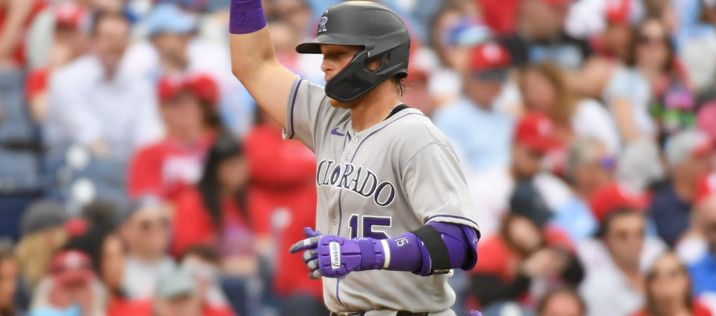
There is a strong (and reasonable) case to be made that Hunter Goodman is the National League’s best fantasy catcher. His average sits at .282, and his slugging percentage is .523. Those have helped him hit 19 home runs, drive in 59 runs and score 50 times. Goodman is in the top 10 among all catchers in home runs, average, slugging rate and wOBA.
However, his expected statistics and his home-road numbers (like all Rockies) show this is another case of production that could crater in the last two months. The Rockies are selling players off, and the lineup is depleting around Goodman. If he starts seeing less playing time, this would contribute to lower production moving forward.
According to Statcast, Goodman has a huge difference between his slugging rate (.523) and his expected slugging percentage (.462). That is still a very good number for a catcher, but it shows the power could cool down in the weeks ahead. Similarly, his batting average (.282) is way above his expected batting average (.251, 30 points lower), and could foreshadow a fall that’s coming. Expected statistics aren’t the perfect measurement, but they could be a sign of things to come.

Subscribe: YouTube | Spotify | Apple Podcasts | iHeart | Castbox | Amazon Music | Podcast Addict | SoundCloud | TuneIn