Every fantasy baseball draft season has a handful of players the market cannot quite price correctly. Some get pushed up because the upside is intoxicating. Others slide too far because the industry gets spooked by role, age, or perceived risk. That is where leagues can be won.
This discussion was less about calling players good or bad and more about identifying where ADP may be missing the point. In some cases, the concern is simple: you are paying ace prices for innings that may never come. In others, the market may be too slow to catch up to a breakout arm with real fantasy juice.
- Fantasy Baseball Draft Rankings
- Fantasy Baseball Research & Advice
- Fantasy Baseball Average Draft Position (ADP)
- 2026 Fantasy Baseball Draft Kit

Fantasy Baseball Draft Landmines or League Winners?
Here are five players at the center of fantasy baseball draft debates.
Cole Ragans (SP – KC)
Cole Ragans is the kind of pitcher fantasy managers love to build around. When he is healthy, he looks every bit like a staff anchor. The strikeout upside is obvious. The raw stuff is undeniable. On a per-inning basis, the talent is not really in question.
The issue is cost versus certainty.
If you draft Ragans at his current price, you are not drafting him as a fun upside SP2. You are drafting him as a foundational arm. That is where things get uncomfortable. He has not exactly built a long track record of bankable volume, and there is still enough health concern in the profile to make that early-round commitment feel shaky.
That does not mean Ragans cannot deliver. He absolutely can. But if you are comparing him to sturdier options in a similar range, it becomes easier to understand the hesitation. Fantasy managers who prefer safety early are going to lean toward the boring veterans who simply take the ball every fifth day.
Ragans still has ace upside. The market just may be asking you to pay for all of it.
Roman Anthony (OF – BOS)
Roman Anthony is a perfect example of the difference between loving a player and questioning the price.
The bullish case is easy to make. He gets on base. He hits the ball hard. He has the profile of a hitter who can grow into much more power if the launch angle ticks up and the approach keeps evolving. In Boston, there is also a path to premium run scoring if he settles near the top of the lineup.
The cautious case is just as clear. If you look strictly at the projection, you are paying for a ceiling outcome that has not fully arrived yet. The barrel rates and hard-hit numbers are exciting, but if the ball is not in the air enough, it is hard to deliver the kind of home run total that justifies this draft slot.
That is what makes Anthony such a polarizing pick. If you believe in the skills growth, he can absolutely return value. If you want a safer, more proven profile in that range, you are probably passing.
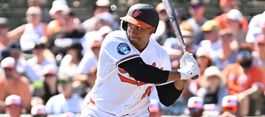
Kyle Bradish (SP – BAL)
Kyle Bradish might be the cleanest risk-reward debate on the board.
On talent alone, he looks like an ace. The stuff is there. The swing-and-miss is there. When he is right, the profile is the kind fantasy managers actively chase. The concern is not whether Bradish can pitch. The concern is how much Baltimore is going to let him pitch.
Coming off a limited workload, fantasy managers have to ask the obvious question: what does the innings cap look like? If Bradish is handled carefully, whether through a six-man rotation, skipped starts, or a softer regular-season workload, that matters a lot at his current ADP.
There is still a path where he pays off, especially if the innings reach a healthy enough total. But fantasy managers drafting him need to understand they are buying talent with workload uncertainty attached.
Bubba Chandler (SP – PIT)
This is where the market may actually be too low.
Bubba Chandler does not come with the same draft-day helium as some of the other young arms, but the ingredients are there for a massive fantasy return. He has real fastball quality, big strikeout upside, and now enough major-league exposure that it is easier to see the path.
The appeal here is not just the talent. It is the cost. Unlike some of the other rookie or near-rookie arms going much earlier, Chandler is available at a point in the draft where taking the shot makes more sense. You are no longer forcing him into an anchor role. You are buying upside without the same level of structural risk.
That is a very different conversation.
If your strategy is to take stable pitching early and then swing on upside later, Chandler fits that build perfectly.
James Wood (OF – WSH)
James Wood has star power, but the market is betting aggressively on improvement.
The tools are loud. There is impact power in the bat, and the physical upside is easy to see. But fantasy managers are still drafting a player whose second-half profile raised some real red flags. The strikeout rate got ugly, and the ground-ball tendencies put a cap on how much of that raw power actually shows up in fantasy categories.
That does not mean Wood is a bad player. It means the draft price assumes the adjustments are coming quickly.
And maybe they are. That is the gamble. But if the contact issues linger and the lineup context remains mediocre, Wood could be more frustrating than dominant in 2026. There is still league-winning upside here. There is also more downside than the market seems willing to admit.
Fantasy Baseball Takeaways
- Cole Ragans has ace stuff, but drafters are paying for a full-season anchor despite durability concerns.
- Roman Anthony is a strong skills bet, though his price assumes growth that may not fully show up this season.
- Kyle Bradish has front-line talent, but workload management makes him risky at current cost.
- Bubba Chandler looks like the value play in this group because the upside is real and the ADP is more forgiving.
- James Wood still offers star-level ceiling, but the strikeout and batted-ball profile create more bust potential than his draft slot suggests.

Subscribe: YouTube | Spotify | Apple Podcasts | iHeart | Castbox | Amazon Music | Podcast Addict | SoundCloud | TuneIn