Fantasy football projections are designed to remove emotion from the equation. That’s both their biggest strength and their biggest weakness.
While projections can help identify realistic expectations, they can also create uncomfortable conversations around players fantasy managers desperately want to believe in. Sometimes the numbers tell a story that doesn’t match the hype.
In this discussion, the FantasyPros crew examined several players whose projections lag behind market sentiment. Some of those projections created legitimate concern. Others felt overly conservative.
- 2026 Fantasy Football Expert Rankings
- Fantasy Football Dynasty Rankings
- Fantasy Football Trade Analyzer
- Best Fantasy Football Rankings

2026 Fantasy Football Projections Hate These Players
Either way, these are six players fantasy managers should be evaluating carefully before draft day.
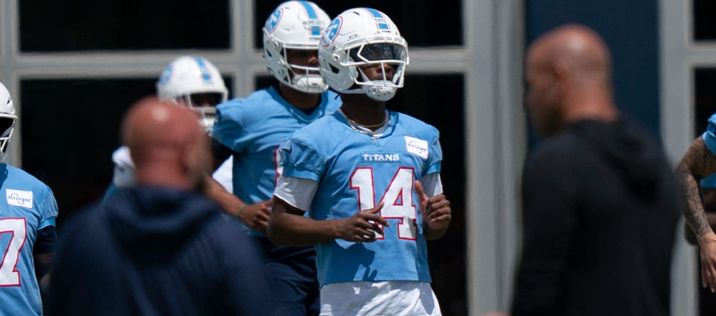
Carnell Tate (WR – TEN)
Few players generated more concern than Carnell Tate.
The issue isn’t talent. The issue is role.
FantasyPros projections forecast roughly 66 receptions, 900 receiving yards, and just over four touchdowns. For a player being drafted as a WR3, that’s a fairly underwhelming outcome.
The discussion centered around target competition and offensive structure. While many fantasy managers assume Tate immediately becomes a featured piece of Tennessee’s passing game, the projections suggest a more balanced target distribution that includes Calvin Ridley and Wan’Dale Robinson.
That’s where the risk appears.
If Tate enters the season as one piece of a larger puzzle rather than a true featured receiver, fantasy managers may end up dealing with frustrating weekly volatility.
The upside remains obvious, but the projections serve as a reminder that rookie receivers don’t always step directly into alpha roles.
Justin Herbert (QB – LAC)
Justin Herbert may be one of the most interesting projection debates at quarterback.
The projections themselves aren’t bad. In fact, they’re fairly reasonable.
FantasyPros projects Herbert for approximately 3,800 passing yards, 27 passing touchdowns, and nearly 500 rushing yards. Those are perfectly respectable numbers.
The problem is what those numbers mean for fantasy rankings.
Despite being viewed by many as a potential top-tier quarterback, those projections place Herbert closer to the large middle tier of fantasy quarterbacks than the elite group.
The discussion focused heavily on offensive pace. Even if the Chargers become more efficient offensively, there’s concern that a slower-paced offense limits Herbert’s overall ceiling.
That’s the challenge.
Fantasy managers aren’t questioning Herbert’s talent. They’re questioning whether the volume exists for him to separate himself from the pack.
Cam Ward (QB – TEN)
Cam Ward represents one of the biggest disagreements between fantasy optimism and projection reality.
The projections place him outside the QB2 conversation in many formats, forecasting fewer than 3,500 passing yards, 20 passing touchdowns, and modest rushing production.
That’s a far cry from breakout-quarterback expectations.
The analysts pointed to several reasons for caution. Tennessee’s offensive structure may not be as pass-heavy as many fantasy managers assume, and Ward’s rushing ability may not be enough to compensate if passing volume remains limited.
The conversation wasn’t entirely negative.
Ward flashed late in the season and showed encouraging signs against difficult defensive looks. However, the overall takeaway was that several things need to break correctly for a true fantasy breakout to occur.
The projections aren’t saying Ward lacks talent.
They’re simply saying the path to a major fantasy season may be narrower than many drafters believe.
Mike Evans (WR – SF)
Mike Evans may be the player on this list where projections and analyst opinion diverged the most.
FantasyPros projects Evans for roughly 900 receiving yards and six touchdowns.
The analysts weren’t buying it.
The central argument was simple: if Evans stays healthy, it’s difficult to envision him falling short of 1,000 receiving yards in this offense. There was also skepticism surrounding the touchdown projection, especially considering his expected role near the goal line.
The discussion repeatedly returned to opportunity.
A healthy Evans projects as one of the primary targets in San Francisco’s passing attack, and several analysts felt the projections were being overly cautious because of age-related concerns.
If the projections prove accurate, Evans likely disappoints fantasy managers.
The panel simply wasn’t convinced that outcome is the most likely scenario.
Kenneth Gainwell (RB – TB)
Kenneth Gainwell sparked one of the more fascinating projection conversations of the episode.
On the surface, the projections don’t appear terrible. Nearly 900 scrimmage yards and meaningful receiving work would normally represent useful fantasy production.
The issue is what those numbers imply about Tampa Bay’s backfield.
The discussion centered on the possibility that Gainwell earns a much larger role than fantasy managers currently expect. His fit within the offensive scheme was highlighted multiple times, particularly in zone-running concepts where he has historically excelled.
That creates uncertainty.
If Gainwell becomes a legitimate part of a committee, his fantasy value rises significantly. However, that same scenario could negatively impact the value of everyone involved.
The projections suggest a meaningful role.
The debate is whether that role becomes large enough to matter in fantasy lineups.
David Montgomery (RB – HOU)
David Montgomery may be the clearest example of a player whose ranking and projection feel disconnected.
FantasyPros projects Montgomery for around 930 rushing yards, approximately seven touchdowns, and limited receiving production.
Those numbers don’t seem outrageous.
What stood out was where those projections ranked him relative to other running backs.
The analysts repeatedly pointed to Montgomery’s expected workload as the reason they’re willing to bet on him. Volume remains one of the most important factors in fantasy football, and Montgomery appears positioned to receive plenty of it.
Even if efficiency isn’t elite, opportunity alone could make him a valuable fantasy asset.
That workload floor is what makes him appealing.
While projections may view him conservatively, the expectation of consistent touches creates a strong argument for drafting him ahead of several similarly ranked backs.
Why Projection Fades Matter
One of the most useful applications of projections isn’t identifying players to avoid.
It’s identifying uncertainty.
Every player on this list has a range of outcomes. The projections simply provide a baseline expectation that may differ from public perception.
Sometimes the projections are too conservative.
Sometimes they’re warning fantasy managers about risks they’re overlooking.
Understanding where those disagreements exist can be one of the most valuable edges in fantasy football drafts.
Fantasy Football Takeaways
- Carnell Tate (WR – TEN) remains exciting, but projections suggest a more modest rookie season than many managers expect.
- Justin Herbert (QB – LAC) may offer a solid floor, though questions remain about whether he has elite fantasy upside.
- Cam Ward (QB – TEN) possesses breakout potential, but projections highlight the hurdles standing in the way.
- Mike Evans (WR – SF) was one of the strongest disagreements between analyst opinion and projection models.
- Kenneth Gainwell (RB – TB) could become a sneaky value if Tampa Bay’s backfield becomes more committee-oriented.
- David Montgomery (RB – HOU) appears undervalued relative to his projected workload.
- Evans and Montgomery generated some of the strongest pushback against the projections.
- Tate and Ward represent two players whose projections are urging fantasy managers to slow down on expectations.

Subscribe: Apple Podcasts | Spotify | SoundCloud | iHeartRadio