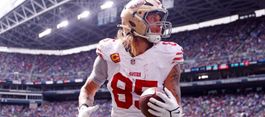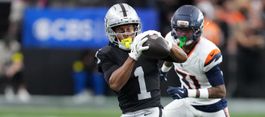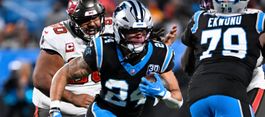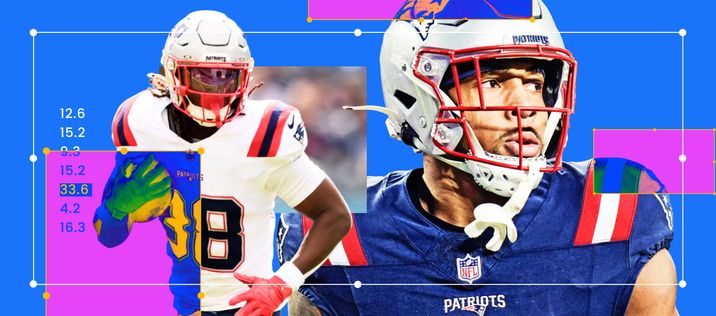
These aren’t bust candidates or pure fantasy football sleepers. They’re players with a genuinely wide range of outcomes, where getting the value right (or wrong) at their current cost could swing an entire draft. Our analysts broke down eight names across every position worth thinking through carefully before you draft them.
- 2026 Fantasy Football Expert Rankings
- Fantasy Football Dynasty Rankings
- Fantasy Football Trade Analyzer
- Best Fantasy Football Rankings

8 Players Who Will Make or Break Your 2026 Fantasy Football Draft
TreVeyon Henderson (RB – NE)
Henderson is currently going 58th overall, a full 20 picks ahead of his own backfield mate in the rankings. Last year’s split tells the story: while his teammate was healthy, Henderson managed just 6.6 fantasy points per game across the first eight weeks. Once that teammate missed time, Henderson exploded to 17.1 points per game the rest of the way, including a three-game stretch with 330 yards, five touchdowns, and RB3-level production. The market is clearly betting on a second-year breakout building on that stretch.
The concern is that the market may be underrating how good his teammate actually was last year, ranking sixth in fantasy points over expected and fifth in explosive run rate, with better yards after contact than Henderson himself. The real swing factor for Henderson’s breakout case is pass protection. He was solid there in college but never consistently showed it as a rookie, and that’s likely the prerequisite for him to take over the passing-down role that would unlock his ceiling. There’s also real offensive-context uncertainty: this team ranked near the bottom of the league in pass attempts per game last year despite an MVP-runner-up-caliber season from its quarterback, and it’s unclear whether adding a new star receiver pushes them toward more passing situations that could help Henderson specifically, or simply better execution within the same run-heavy approach. A useful comparison is Bhayshul Tuten, a similar year-two breakout bet just two spots behind Henderson in the rankings, but one where the coaching staff has been far more publicly complimentary and the presumptive backup is dealing with his own injury entering camp, making that a slightly easier bet to click.
Quinshon Judkins (RB – CLE)
Judkins was off to a strong start as a rookie before a fractured fibula ended his season. Recovery timelines from that type of injury have been mixed for other NFL players, though Judkins is young enough that he’s had ample time to heal. The bigger concerns here are about context rather than health. This team has lost a star defensive lineman and its defensive coordinator, meaning games likely won’t stay as close or low-scoring as they did last year, when tight scores let the team lean on the ground game. This is also a real evaluation year at quarterback for the franchise, and increased passing volume could come at the running game’s expense. The team is also starting five new offensive linemen, a unit that should improve on a genuinely bad group last year, but remains an unknown.
The most important reason for real caution here, though, is a teammate. Dylan Sampson is going almost 100 spots behind Judkins in ADP despite being clearly more efficient across nearly every meaningful receiving metric, including yards per route run, yards per target, and yards per reception. That’s not to say Judkins can’t catch passes, but the gap is real, and the offensive coordinator has a track record elsewhere of heavily funneling passing-down work to the more efficient back regardless of name value. Judkins sits in a genuine dead-zone range of the running back position this year, alongside names like Henderson, in ambiguous backfields where the situation matters as much as the talent. In that same range, alternatives like Bucky Irving, Jaydarian Price, and DeAndre Swift are viewed as clearer bets given their offensive contexts.
David Montgomery (RB – HOU)
Montgomery’s price has crept up steadily all offseason to the point where one analyst is no longer comfortable with it, now sitting around the second pick of the sixth round. There was real confidence in him right after his team traded real draft capital to acquire him, but the cost has now outpaced that confidence. Everything that made him look like a clear upgrade over his presumed backup last year gets shakier if this offensive situation isn’t strong. That backup struggled mightily as a rookie thrust into a bigger role than expected, finishing near the bottom of the league among high-volume backs in yards per carry, missed tackles forced, and yards after contact per attempt, but he was an excellent, target-earning pass catcher in college and has continued to show that skill.
A report suggesting the two will split first-team camp reps is being framed as developmental rather than a real threat to Montgomery’s role, but at his current price, the ideal outcome is something like a 70-30 workload split in his favor. A more realistic outcome closer to 60-40 would meaningfully cap his weekly ceiling relative to his cost. The touchdown-equity case for Montgomery is real, this team invested real capital in him and figures to use him near the goal line, but that outcome already feels baked into his current price, and there are several other names in this same range at running back, receiver, and tight end offering comparable or better risk-reward if the touchdowns don’t show up.
Rashee Rice (WR – KC)
Rice is going 25th overall as the WR11, a price that reflects real excitement about his upside. His track record supports some of that: he ranked 11th in target share among receivers last year, fourth in targets per route run, and 10th in receiving yards per game, all despite playing only eight games. He also led the league in the rate of screen-designed plays among high-target receivers. That’s exactly the concern. Rice has never played under his team’s new offensive coordinator, whose last stint with this franchise predates Rice’s arrival entirely. If you strip screens out of last year’s sample, Rice drops to 21st in fantasy points per game and 31st in target share, and he’s played just 12 total games over the last two seasons combined.
One analyst is banking on a healthy teammate having a bigger role this year and prefers other receivers going in a similar range. There’s also real uncertainty about the broader offensive environment, questions about whether the longtime head coach’s play-calling has started to decline, whether recent struggles trace back to the quarterback, the coaching, or an aging tight end room, all of which add up to a less certain situation than the star quarterback and coach pairing might suggest on paper. At a true early third-round cost, both analysts would rather wait a round or so later for a receiver with a similar or better ceiling, especially with strong running back value also sitting in Rice’s range.
Tetairoa McMillan (WR – CAR)
McMillan is coming off an Offensive Rookie of the Year season, but his outlook depends heavily on his quarterback and that quarterback’s offensive line, which is off to a rough start with two starting tackles already dealing with camp injuries. This team overachieved last year, pushing a top seed deep into the playoffs, but now faces a significantly tougher schedule, including a much harder divisional slate than last year’s softer one. McMillan personally dominated the offense last year, accounting for 43% of the team’s total air yards, the second-highest share in the league, but real question marks exist about whether other weapons taking a step forward could chip into that monopoly if the offense overall improves.
This ultimately comes down to the quarterback, who posted the fourth-worst passing yards per game and second-worst yards per attempt in the league last year. One analyst puts the odds of any real step forward, even just to a modestly viable level, at no better than 25%. There’s a silver lining worth watching, though: McMillan scored just twice in his first ten weeks last season, both in the same game, before catching six touchdowns over his final seven weeks as his red-zone usage increased. If that usage carries over, plus a tougher schedule forcing more pass attempts from behind, there’s a real path to more touchdown production. The verdict is heavily price-dependent: rich as an early third-round pick, genuinely appealing if he slides into the fourth round, and most comfortable as a true WR2 or flex play in a build that’s already secured running backs early.
Alec Pierce (WR – IND)
Pierce is going as the WR32, 74th overall, not a bad range for a player who flashed real ceiling outcomes last year, but there’s real reason for caution. He’s working back from a foot injury and has indicated he might not be fully ready until September. His entire 2025 production also leaned on one specific, historically unsustainable skill: among receivers with 50 or more targets, he posted the highest average depth of target in the league, more than a full yard ahead of anyone else, and led the position in yards per reception by nearly four yards over the next closest player. Of his 1,000-plus receiving yards, 477 came specifically on throws traveling 20 or more yards downfield.
His quarterback, who is himself coming off an Achilles injury, was uncharacteristically excellent at hitting the deep ball last year relative to his career track record, but also extremely predictable while doing it, targeting his first read on 100% of his 20-plus-yard attempts. That kind of tendency tends to get noticed and defended against. Combine an unsustainable deep-target reliance, a quarterback who may regress off an outlier accurate season, and Pierce’s own injury clouding his availability, and the picture gets shaky, especially in half-PPR scoring where touchdowns and chunk plays matter more than they would in a format that rewards shorter, higher-floor catches. He’s viewed as a name that fits best specifically in a running-back-heavy build, where a manager doesn’t need immediate production from this specific roster spot and can simply monitor for the ceiling outcome to resurface.
Jalen Hurts (QB – PHI)
One analyst has been aggressively targeting Hurts this year, a name that generates little draft-day excitement, which is exactly what makes him appealing. He’s currently being drafted in the QB10-to-QB11 range in single-quarterback leagues, worse than his consensus QB6 ranking, with reports of him falling as far as QB9 or 15 spots past his listed ADP in real drafts. His rushing volume held up fine in an otherwise down season, finishing second among all quarterbacks in both rush attempts and rushing touchdowns, but the passing game hit several career lows, and the offense ranked 19th in scoring and a dismal 24th on third down last year, production bad enough to get the offensive coordinator moved on.
A new offensive coordinator is expected to change his usage in a meaningful way. The data shows Hurts has actually been excellent throwing to the middle of the field on shorter routes, despite rarely being asked to do it, posting a low off-target rate, a high touchdown rate, and a strong completion rate on those specific throws. Two new pass-catching weapons profile well in that underused part of the field, which could meaningfully raise the offense’s efficiency after posting a career-low mark in yards after the catch last year, and by extension increase red-zone trips. This tier of quarterback, generally advised against by the conventional wisdom to either draft elite early or wait very late, is unusually deep and talented this year, and both analysts are comfortable drafting from it rather than avoiding it on principle.
Sam LaPorta (TE – DET)
LaPorta is currently the TE8, 84th overall, a range one analyst would easily take him from over two tight ends ranked just ahead of him. He’s been fully cleared from a herniated disc heading into camp and isn’t expected to miss any time, news that should push his price up over the coming weeks. The philosophy here mirrors the quarterback section: hunting for a tight end capable of a true TE1-overall outcome at the cheapest possible cost, and LaPorta may be the lowest-cost tight end with that kind of range. The main downside risk is a teammate finally having the full breakout season some have long expected, which would eat into his target competition.
The supporting case is strong. This team has the league’s easiest remaining strength of schedule according to one betting model, and the new offensive coordinator’s previous tight end saw 147 and 169 targets across his two seasons in that system. LaPorta himself has 20 touchdowns across his first 42 regular-season games and multiple 90-plus-yard games last year even with missed time, ranking top six in the league in several efficiency categories. His team scores 31.4 points per game with him on the field for his career compared to 24.8 without him, a massive split. A healthy Tucker Kraft is still viewed as a step above LaPorta by one analyst, but if Kraft’s own recovery hits any real bump, LaPorta becomes the preferred target. A similar approach applies to Mark Andrews, who one analyst is targeting as a bounce-back bet outside the top 12 tight ends, banking on continued chemistry with his starting quarterback and a thin receiving corps around him that should funnel real touchdown opportunities his way if the offense returns to form.
View the Best Fantasy Football Team Names 
Fantasy Football Draft Rankings
Check out the consensus 2026 fantasy football draft rankings from our experts.

Subscribe: Apple Podcasts | Spotify | SoundCloud | iHeartRadio