
If you went to the fantasy baseball rankings page on FantasyPros right now, you’d see the expert consensus rankings of 35 different industry experts. Some of the most well-respected analysts from all different sites submit their own personalized rankings, and the result is that you can see where, on average, industry experts have a player ranked. And since you’re reading a FantasyPros article, I know you already knew that. But sometimes my mother checks in on these things and I like to lay out the basics for her, okay?
But just because a player has an expert consensus ranking of 50 does not mean that every expert has him ranked 50th or anywhere close. Indeed, that could mean that nearly every expert has that player ranked at or close to 50th, or it could mean that half of the experts have him ranked 25th and the others have him ranked closer to 75th.
If you look at the various columns on the ECR page, you’ll see something called “STD DEV,” which stands for standard deviation. Essentially, that number tells you how far the various expert rankings skew from the player’s expert consensus ranking – the higher the number, the more divergent the rankings are on that particular player.
Players with high standard deviations are almost always the most polarizing players. So today, we’ll take a look at some of the players on whom the fantasy community appears to be split and analyze why that is. Sound good? Even to you mom? Great. Let’s go.
Gear up for your draft with our MLB Draft Simulator 
Robbie Ray (ARI – SP): ECR of 61, Standard Deviation of 25.4
Why experts are high on Ray: Putting aside the humidor, if there was one pitcher who could take the leap into the upper echelon of starters this year, it’s Ray. He obviously made major gains last year, coming in with a career-best ERA (2.89), WHIP (1.15), strikeout percentage (32.8% – fourth best in MLB), and batting average against (.197). Although his walk rate on the season was still too high, he finished the season with just a 7.6% walk rate over his final 43 innings pitched. Just 26 years old, the best is likely yet to come for Ray, and his upward trajectory likely bodes well for his future.
Why experts are low on Ray: In 2016, Ray had a 3.76 FIP, a 3.45 xFIP, and a 4.90 ERA. In 2017, Ray had a 3.72 FIP, a 3.49 xFIP, and a 2.89 ERA. In other words, his “improvement” last season was mostly a mirage. His walk rate got worse (almost four batters per nine innings), his ground ball rate declined, he allowed the most hard contact of any starting pitcher in baseball (40.4%) and yet allowed an incredibly low BABIP of .267, and his success can be attributed in part to a fluky 84.5% LOB percentage.
Even before the Diamondbacks decided to suck all of the fantasy value from A.J. Pollock and Jake Lamb by humidorifying (not a word) the balls, opinions diverged heavily on Ray. As you can see, there’s plenty of reasons to be both optimistic and pessimistic about Ray’s 2018 outlook. Your best bet is to look for something in between his 2016 and 2017 seasons, erring more toward the latter in light of the introduction of the humidor. But one thing is for sure – if you do believe in Ray, you’re going to need to pay for him.
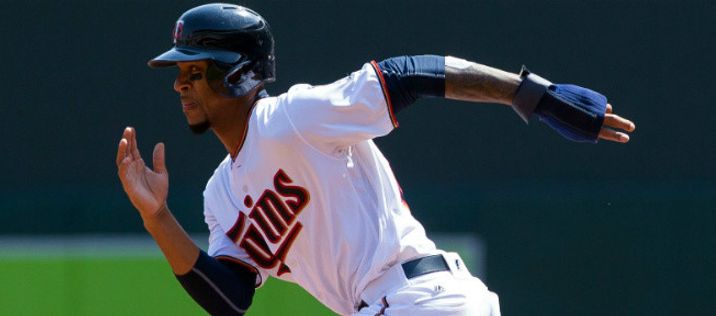
Byron Buxton (MIN – OF): ECR of 64, Standard Deviation of 24.9
Why experts are high on Buxton: After a dreadful start, Buxton finished strong for the second straight year, though his 2017 surge lasted much longer than his 2016 September surge. Over the second half of the season, Buxton slashed .300/.347/.546 with 11 home runs and 13 steals over 56 games. Even looking at his full-season numbers, which take into account his ridiculously poor first half (.216/.288/.306 with five home runs in 79 games), Buxton was plenty useful for fantasy owners, hitting 16 home runs and stealing 29 bases with just one caught stealing. He cut his strikeout rate significantly in 2017 and even more drastically in the second half. If he can even come close to repeating his second-half breakout, he should be a fantasy stud.
Why experts are low on Buxton: Fool me once, shame on you. Fool me twice, shame on me. Yes, Buxton’s second half was great, but so was his 2016 September (.287/.357/.653 with nine home runs), which certainly didn’t translate into instant success in 2017. And really, Buxton’s second half was again propped up by one insane month (August), during which he batted .324 with eight home runs, so his 2017 looks much closer to his 2016 than you’d think. And for his ultimately fine numbers last year, how many fantasy owners who drafted him held him through his lengthy first-half slump? For all his gains, he still strikes out about 30% of the time, and the Twins are good enough that they won’t sit idly by if Buxton slumps again to start the season. For a player with so much downside, a sixth-round pick is asking too much.
Buxton represents the quintessential player that evokes strong reactions from fantasy players. He’s a former top prospect with awesome skills who has shown flashes of being a star in each of the past two seasons, but one who has burned many of his fantasy owners who waste a decent pick on him. Whether you draft Buxton is largely about your risk tolerance. The payoff can be enormous, but so is the downside.
Miguel Cabrera (DET – 1B): ECR of 73, Standard Deviation of 24.2
Why experts are high on Cabrera: There’s no defending his numbers last season, but it’s worth noting that Cabrera was insanely unlucky in the first half last season until his back injuries ultimately significantly affected his play. Over the first half, he slashed .264/.357/.440 with a 12.1% walk rate. That’s far from peak Cabrera, but considering he was battling a hip injury early, that’s not a guy who will lose you your league. In the second half, as he dealt with herniated discs in his back, he slashed .230/.288/.342 with just a 7.4% walk rate, showing that his decline was almost certainly due to the injuries. Cabrera had the highest line-drive rate of his illustrious career (27.3%, third in the league) and ranked seventh in the league in hard-hit rate (42.5%). The last time Cabrera had an injury-plagued and down season in 2015, he roared back with a slash line of .316/.393/.563 with 38 home runs the following year.
Why experts are low on Cabrera: The numbers speak for themselves and although injuries were certainly a huge factor in the second half of the season, back injuries are notorious for ruining players’ careers. Big-bodied players like Cabrera often don’t age well and he’ll be entering his age-35 season. Whatever gun the Tigers were using to measure hard-contact rates at Comerica Park was clearly juiced, as everyone from Nicholas Castellanos to Alex Avila set career-highs in that category. Cabrera’s strikeout rate ballooned to 20.8%, his highest since 2004 last season, and the Tigers should be dreadful this year.
Truth be told, although I’m personally higher than ECR on Cabrera this year, I’m shocked he’s being ranked where he is. There are far more signs that Cabrera’s downward trend is legitimate than not, and age is not on his side. But with an offseason dedicated to core strength, one of the great hitters in the history of the game could still have something left in the tank. In my humble opinion, he’s worth drafting where you need to take him.
Billy Hamilton (CIN – OF): ECR of 80, Standard Deviation of 35.5
Each of the three previous players has plenty of underlying data that can be used to support the idea that an elite season is coming or suggest that major regression is due. But that’s simply not the case with Hamilton.
In his four full seasons, Hamilton has shown almost no growth as a hitter. Although his numbers fluctuate from year to year, they’ve remained largely stagnant overall, and there’s nothing to suggest a breakout is coming. He’s never batted higher than .260 or gotten on base at more than a .321 clip. His walk rate has never been above 8%, his strikeout rate hovers at about 20%, and over the last four seasons, he ranks 135th among qualified hitters in ground-ball percentage (44.3%). To take another notable speedster, Dee Gordon ranks third over that span (58.9%). Someone needs Lou Brown to make Hamilton do 20 pushups every time he hits the ball in the air.
But the reason a guy who actively hurts you in three categories and is neutral in a fourth is still so coveted is because he is utterly elite in that fifth category. Hamilton has stolen 56, 57, 58, and 59 bases over the previous four seasons. The only player who is within 70 steals of Hamilton over that span is Gordon.
And steals, as you know, are incredibly scarce. In one of my long-time leagues with standard rosters, here are the number of steals it takes to get every particular rotisserie point on average over the last 10 seasons.
| Point | Number of Steals |
| 12 | 187 |
| 11 | 166 |
| 10 | 157 |
| 9 | 150 |
| 8 | 127 |
| 7 | 122 |
| 6 | 118 |
| 5 | 114 |
| 4 | 105 |
| 3 | 100 |
| 2 | 96 |
| 1 | 80 |
As you can see, even with Hamilton, you need a whole lotta’ help. But he almost lets you at least get within the realm of competitiveness all by himself. And essentially, Hamilton’s high standard deviation is because some experts think it is worth it to secure that one category at the expense of others for the price of a mid-round pick, while others do not. In the end, how you feel about Hamilton is purely about draft strategy.
Whit Merrifield (KC – 2B): ECR of 83, Standard Deviation of 25.2
Why experts are high on Merrifield: The breakout was unforeseen, but the speed is obviously legitimate, and he’ll bat near the top of the order all year long. Although he showed more power than he ever had in the minors, his fly ball rate was in line with his minor league numbers, and his HR/FB rate was more than reasonable. His low strikeout rate suggests he’ll continue to be a help in batting average, meaning he should be fairly locked in as a three-category producer (runs, batting average, and steals), even if his power regresses. Despite coming out of nowhere, Merrifield should be considered one of the safer picks at the position.
Why experts are low on Merrifield: It’s hard to buy into a 28-year-old breakout who wasn’t on anyone’s fantasy radar prior to his 2016 season. Regardless of the whole juiced ball controversy, Merrifield’s 19 home runs have to be an outlier, as he never hit more than 10 home runs in any season in the minors. Nor had he ever totaled the 34 stolen bases he nabbed last year. Even though he’ll bat at the top of the order, the Royals offense should be fairly anemic this season, which should greatly hold back Merrifield’s run production.
Merrifield should likely require the least amount of draft capital to lock up. Although there’s probably some regression coming, his price is likely low enough that he’ll still be worth taking where you need to draft him. He may not necessarily be a target, but he’s hardly one to shy away from.
Subscribe: iTunes | Stitcher | SoundCloud | Google Play | TuneIn | RSS
Dan Harris is a featured writer for FantasyPros. For more from Dan, check out his archive or follow him on Twitter at @danharris80.


