The beginning of the fantasy baseball season is an easy time to spot outliers and candidates for positive and negative regression. With so few games and plate appearances for each player, we will see wild swings away from normal production, and the tendency is to overreact.
Regression often comes at players quickly. When we see a player on an extreme hot or cold streak, things are likely to course correct. That’s what we will try to predict here, with some advice on how to handle these moments.

The beginning of the fantasy baseball season is an easy time to spot outliers and candidates for positive and negative regression. With so few games and plate appearances for each player, we will see wild swings away from normal production, and the tendency is to overreact.
Regression often comes at players quickly. When we see a player on an extreme hot or cold streak, things are likely to course correct. That’s what we will try to predict here, with some advice on how to handle these moments.
Fantasy Baseball Regression Candidates
This series highlights players due for positive or negative regression compared to their recent performance each week to assist fantasy managers in viewing each one properly. Digging underneath the surface stats, we will examine some hitting and pitching metrics to determine if a given player is overperforming or underperforming what should be expected.
Last week, this piece correctly predicted positive regression for Mookie Betts (.417/.462/.667 with eight RBI the past seven days) and Kyle Schwarber (.857 slugging percentage with four home runs over the last week). Regression, whether positive or negative, doesn’t always happen that fast, but the signs are often clear.
With the first six weeks of the Major League Baseball season behind us and still 130+ games to go for almost every team, there will be a lot of positive and negative regression moving forward. Let’s take a look at some of the past week’s largest outliers and see what their futures might look like.
(Stats up to date through May 5th)
Players Due for Positive Regression
Matt Olson (1B – ATL)
The Atlanta Braves are finally starting to turn their season around, and are up to third in the National League East after a strong past 14 days. Unfortunately, even as the Braves are scoring more runs and finally starting to find their offense, Matt Olson hasn’t been invited to the party. He is hitting just .205 with a .432 slugging percentage in that time. But everything else in his profile screams he has been unlucky and should start to regress soon.
Starting with his plate discipline, Olson walks 20% of the time and strikes out just 12% over the last two weeks. He is seeing the ball well and has an 81% contact rate in that time. He has three home runs despite the low batting average because he still has elite barrel rates and hard-hit rates. What’s killing Olson’s fantasy production right now is horrible luck on batting average on balls in play (BABIP).
Only 15 batters have a worse number than Olson’s .176 over the last two weeks. For his career, he is at .280 and has been above .290 in each of the last two seasons. With that kind of track record, he should get back to his strong fantasy production sooner rather than later, especially as the offense for the Braves begins to click.
Vinnie Pasquantino (1B – KC)
“Vinnie Pasquantino has four home runs over the last 13 games. How can he be in line for positive regression?” is what you might be asking yourself right now. And while Pasquantino has seen a recent power surge to bring him up to six home runs on the season, the scary thing is his underlying statistics show that he could be even better over the weeks to come.
In those two weeks when he has crushed four homers, he is hitting just .185/.214/.444. He has lowered his strikeout rate to under 20%, but his BABIP is comically low at .154, the ninth-lowest of all players in that period. Home runs do not count towards BABIP, so that means when he isn’t jacking the ball out of the ballpark, he has been incredibly unlucky for two straight weeks.
On the season, Pasquantino’s barrel rate and launch angle are up compared to 2024, so perhaps these last 14 days are an indicator that Pasquantino’s swing and power are finally starting to emerge as we enter the seventh week of baseball.

Players Due for Negative Regression
Dansby Swanson (SS – CHC)
Overall, Chicago Cubs shortstop Dansby Swanson has had an up-and-down start to the 2025 season. He is hitting just .232/.276/.444 with a 29% strikeout rate and a 39% ground ball rate. Compared to 2024, his contact rate, zone percentage and outside the zone contact rate are all way down. However, in the past two weeks, he is hitting .348/.388/.652 with three home runs and two stolen bases. One of these trends is not the real Swanson. The question is, which one will last?
Unfortunately, it looks like the former is more likely to be what Swanson does the rest of the season. His BABIP over the last two weeks is an astounding .448, and it’s combined with a 29% strikeout rate and just a 6% walk rate. His exit velocity of 87.9 miles per hour (MPH) during that span is lower than his average for the season (90.5 MPH). Add it all together, and you have a player on a wicked hot streak, but one that likely won’t last too long.
His expected numbers in average and slugging percentage are better than his season-long numbers, so some positive regression may come there. But don’t expect what we have seen over the last 12 games.
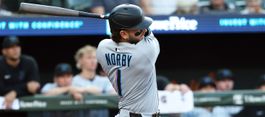
Zach Neto (SS – LAA)
Zach Neto missed more than a month to start the season due to an offseason shoulder surgery, so the thought was he would start slow after being injured and missing spring training. Nope. In 15 games, Neto is hitting .288/.311/.576 with four home runs and five stolen bases. I’m no math wizard, but that’s a 40/50 pace over a full season. After a 23/30 season, expectations were trending upwards, but were tempered because of the injury. What Neto has done to start his season is beyond any reasonable projections.
There are, however, reasons why Neto is so scorching right now. His .387 BABIP over the last two weeks is one of the highest marks in the league. It’s allowed him to slug .560 in that span despite striking out 31% of the time with just a 1.6% walk rate on the season. For his prorated balance of games, Neto is on pace for fewer than 15 walks and a .570 slugging percentage. In the history of baseball, no player since 1948 has had a .560 slugging percentage or better and 15 or fewer walks over a full season.
Neto is unlikely to be the first in 80 years to accomplish that. What this means is he needs to start being more disciplined at the plate, or the power numbers will crumble.

Subscribe: YouTube | Spotify | Apple Podcasts | iHeart | Castbox | Amazon Music | Podcast Addict | SoundCloud | TuneIn