Every fantasy football season produces a handful of second-year players who completely reshape drafts. Let’s dive into a few of our favorite second-year breakout candidates for 2026.
- Dynasty Rookie Rankings
- Dynasty Rookie Draft Simulator
- Best Fantasy Football Rankings
- Fitz’s Superflex Dynasty Rookie Mock
4 Second-Year Fantasy Football Breakout Candidates for 2026
Sometimes the rookie flashes are obvious. Other times, injuries, inconsistent usage, or team context suppress the first-year breakout before everything clicks in Year 2. That’s the central theme behind this group of breakout candidates heading into 2026.
The discussion focused on four young players who have the talent, role, and offensive environment to make a major fantasy leap this season. Some feel safer than others, but all four have paths to becoming league-winning values.
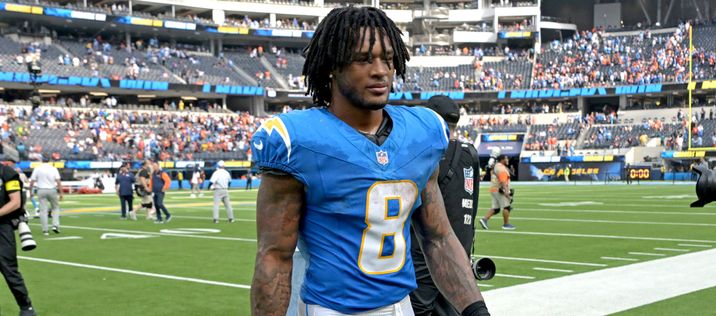
Omarion Hampton (RB – LAC)
Omarion Hampton might be the easiest bet of this group.
The case for a Year 2 breakout starts with context. Hampton’s rookie season was disrupted by injuries across the Chargers offense, including problems along the offensive line and missed time for Hampton himself. He only appeared in nine games, but when he played, the underlying numbers were extremely encouraging.
The biggest takeaway from the discussion was how complete Hampton’s profile already looks.
He flashed as both a runner and receiver. In the second half of the year, he ranked highly in yards after contact per attempt and earned strong rushing grades while also showing pass-catching ability with multiple games featuring four or more receptions.
The arrival of Mike McDaniel as offensive coordinator was also framed as a major positive. The expectation is that Hampton could see heavy involvement in the passing game because McDaniel historically targeted running backs at a high rate in Miami. That matters in fantasy, especially for a player who already demonstrated three-down capability as a rookie.
There was also confidence that the Chargers’ difficult schedule could actually help fantasy production. More shootouts and negative game scripts would likely keep Hampton heavily involved regardless of score.
The overall tone here was clear: Hampton already looks like a future top-tier fantasy running back.
Bhayshul Tuten (RB – JAC)
Bhayshul Tuten remains one of the more polarizing young running backs in fantasy.
The talent is obvious. The uncertainty comes from role projection and Jacksonville’s crowded backfield situation. Still, the bullish argument centered around the idea that fantasy managers may be overcomplicating things.
Tuten reportedly graded well across several rushing efficiency metrics as a rookie, including success rate, missed tackles forced, and yards after contact. More importantly, the coaching staff and front office actively targeted him because of his explosiveness and athletic profile.
One key point from the conversation was the passing-game upside.
While other backs on the roster may profile as early-down grinders, Tuten offers receiving ability and home-run speed that can create fantasy-friendly touches. Even in a partial role, that type of skill set can matter.
The finger injury that interrupted his rookie season also became part of the discussion. There was a belief that fantasy managers never got to see the full late-season expansion of Tuten’s workload because the injury stalled his momentum.
That’s why he still feels somewhat unfinished as a fantasy asset.
There’s understandable caution attached to Jacksonville’s offense overall, but the talent bet remains compelling enough to keep Tuten squarely in breakout territory.
Luther Burden III (WR – CHI)
Luther Burden III may end up being one of the biggest arguments in fantasy football draft season.
The excitement comes from efficiency. The hesitation comes from role certainty.
According to the discussion, Burden’s rookie-year efficiency metrics were excellent, especially in yards per route run and yards after the catch. He consistently created production on underneath targets and forced missed tackles after the catch.
The offensive fit with Ben Johnson was also highlighted repeatedly.
The idea is that Burden could thrive in the same type of slot-oriented, catch-and-run role that has historically flourished in Johnson’s offenses. The conversation suggested Chicago wants to manufacture touches for him because positive plays followed whenever the ball found his hands last season.
Vacated targets in the offense only strengthen the argument.
At the same time, there are still legitimate concerns about overall snap share and personnel usage. One of the bigger questions raised was whether Burden remains on the field consistently when Chicago leans into heavier tight end formations.
That uncertainty is probably why fantasy managers remain split on him.
Still, if Burden secures a high-volume underneath role in an ascending offense, the PPR upside becomes very real.
Colston Loveland (TE – CHI)
Colston Loveland generated the strongest overall conviction of anyone discussed.
The argument wasn’t just that Loveland could break out. The discussion pushed the idea that he could legitimately challenge for the overall TE1 spot in fantasy football.
That confidence stems from what happened late last season.
From Week 16 through the playoffs, Loveland reportedly dominated usage among tight ends, posting elite numbers in target share, yards per route run, receiving yards per game, and first-read involvement. The belief was that if those numbers were stretched across a full season, he would already profile among the elite fantasy tight ends.
The conversation also emphasized how central Loveland appears to Ben Johnson‘s offensive vision.
Rather than functioning as just another tight end, Loveland was described almost like the focal point of the passing offense. That distinction matters because fantasy football is often about identifying players who become offensive priorities rather than simply talented contributors.
The comparison to previous breakout tight ends was impossible to ignore.
The overall takeaway was that fantasy managers may need to start viewing Loveland in the same elite tier conversation instead of treating him as merely an upside sleeper.
Fantasy Football Takeaways
- Omarion Hampton (RB – LAC) looks positioned for a true three-down breakout with improved health, receiving usage, and offensive environment.
- Bhayshul Tuten (RB – JAC) remains a risky but explosive upside bet because of his athleticism and pass-catching profile.
- Luther Burden III (WR – CHI) offers major PPR upside if Ben Johnson fully unlocks his underneath and yards-after-catch role.
- Colston Loveland (TE – CHI) generated the strongest breakout conviction of the group and could emerge as a legitimate TE1 overall candidate.
- Chicago’s offense was repeatedly framed as one of the most fantasy-relevant situations for second-year breakouts in 2026.

Subscribe: Apple Podcasts | Google Play | Spotify | Stitcher | TuneIn | RSS | YouTube