Even after more than four full months of the Major League Baseball and fantasy baseball seasons, it’s important to look for players who could experience positive and negative regression. With so few games and plate appearances for each player, we will see wild swings away from normal production, and the tendency is to overreact. Sometimes we think a player is what he has been up to this point, but that is far from the truth.
Regression often comes at players quickly. When we see a player on an extreme hot or cold streak, things are likely to course correct. That’s what we will try to predict here, with some advice on how to handle these moments.

Even after more than four full months of the Major League Baseball and fantasy baseball seasons, it’s important to look for players who could experience positive and negative regression. With so few games and plate appearances for each player, we will see wild swings away from normal production, and the tendency is to overreact. Sometimes we think a player is what he has been up to this point, but that is far from the truth.
Regression often comes at players quickly. When we see a player on an extreme hot or cold streak, things are likely to course correct. That’s what we will try to predict here, with some advice on how to handle these moments.
Fantasy Baseball Regression Candidates
This series highlights players due for positive or negative regression compared to their recent performance each week to assist fantasy managers in viewing each one properly. Digging underneath the surface stats, we will examine some hitting and pitching metrics to determine if a given player is overperforming or underperforming what should be expected.
Last week, this piece correctly predicted positive regression for Randy Arozarena (.304/.360/.609 with two home runs and two steals in the last week) and negative regression for Taylor Ward (30% strikeout rate and just one home run and one run). Small samples are often not enough to show regression, but in baseball, things can change quickly. Regression, whether positive or negative, doesn’t always occur quickly, but the signs are often clear.
With the first 18 weeks of the Major League Baseball season behind us and about 50 games still to go for almost every team, there will be a lot of positive and negative regression moving forward. Let’s take a look at some of the past week’s largest outliers and see what their futures might look like.
(Stats up to date through August 4th.)
Player Due for Positive Regression
While Sean Murphy is not having a season that lights the fantasy baseball world on fire, he is certainly producing better than last year. In an injury-plagued 2024, Murphy hit .193/.284/.352 with 10 home runs and 29 RBI in 72 games. Through 73 games in 2025, he is hitting .225/.321/.473 with 16 home runs and 42 RBI. But based on what we have seen from Murphy over the last couple of weeks, there is a chance the last seven weeks of his season could be even better than that.
Over his last 40 plate appearances, Murphy has zero home runs. That’s an unusual streak since he had 16 home runs in his first 60 games of the season. But Murphy has been one of the unluckiest hitters in baseball over that time, despite how patient he is at the plate. Murphy has a .174 batting average on balls in play (BABIP) during that span, which is one of the 15 worst marks in all of baseball. But he is doing that with a 17% walk rate and just a 26% strikeout rate.
The Braves’ season might be going down the toilet, but at least Murphy should be able to look ahead and picture better days. Assuming Atlanta sticks with him behind the plate the rest of the season, Murphy’s power should turn back up in a big way.
Unlike Sean Murphy, Marcus Semien has had a terrible season by his high standards. He has played 113 games, but is sitting at .226/.303/..357 with 13 homers and 11 steals in 476 plate appearances. It’s been even worse the last two weeks, with a .204/.254/.315 line, including just one home run. But Semien is not producing these numbers because of poorly hit balls. His expected slugging rate this season is 40 points higher than his actual slugging rate. Semien is another player who has been especially unlucky with batted-ball data in the last two weeks.
He has a .208 BABIP in that time, even though he is only striking out 10% of the time. His hard-hit rate and barrel rare are the same since last season, and he has increased his exit velocity. Can some of this be attributed to the fact that Semien has over 7,000 career plate appearances? Certainly, but the quality plate appearances are still there, meaning a late-season surge could be on the horizon.

Players Due for Negative Regression
Despite a .305 batting average for Dodgers first baseman Freddie Freeman, it’s hard not to call his fantasy baseball season a disappointment. He has just 13 home runs in 100 games (for comparison, he had 13 in the 60-game season in 2020), and has just 61 RBI in what was supposed to be the best offense in baseball. He has two steals and is not on pace to even reach 75 runs this season. However, things have been looking up for Freeman in the past couple of weeks. Whether or not it is sustainable is a whole other question.
In his last 52 plate appearances, Freeman is hitting .396/.453/.625 with three home runs, eight runs and 12 RBI. Put another way, 19% of his season’s home runs have come on just 12% of his season’s plate appearances. He does have a strong 9.4% walk rate in those two weeks, but the power and the batting average are being driven by something. Some might call it luck or good fortune, and there is a strong chance things come back to earth soon. Freeman’s .516 BABIP over the last two weeks is the second-highest in all of baseball. He is also striking out 26% of the time.
That’s not a good match for a hot streak to continue. Freeman has proven he can get a .300 batting average in his sleep, but a streak this elite is likely to come to an end before too much longer.
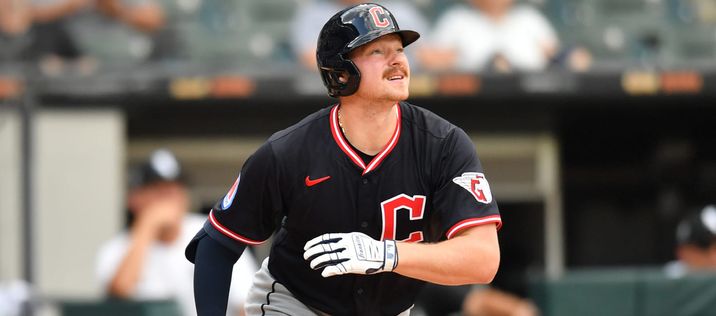
Another player with a .500 BABIP the last two weeks? Kyle Manzardo of the Cleveland Guardians. His batted-ball profile has led him to put up a .342/.409/.526 line with two home runs and 10 RBI in that span. Is it much better than his seasonal .234/.310/.462 line? Absolutely. But the fact that the BABIP is so high and his strikeout rate is 34% in the last two weeks proves it’s not due to a change Manzardo has made, but rather some good fortune at the plate.
But this is a performance Manzardo needed right now. He is now not just fighting for playing time with Carlos Santana, but the Guardians just called up first base prospect C.J. Kayfus to see what he can give the club over the season’s last seven weeks. Kayfus has a big bat, so Manzardo is going to need to maintain his elite production to stay on the field. I’m just not convinced that it will happen much longer.

Subscribe: YouTube | Spotify | Apple Podcasts | iHeart | Castbox | Amazon Music | Podcast Addict | SoundCloud | TuneIn