Whether you’re taking a Hero-RB strategy or a true risk-taker going Zero-RB, knowing the lower-ranked backs with the most realistic RB1 upside is critical to fantasy football success. Investing in the right RB3 can carry your team to a championship. The key to drafting in the RB3-ranking territory and hitting is to aim for upside. Sure, there are safe options that can’t necessarily get RB1 production but offer a safe floor. However, we’re looking for the players with true RB1 upside.
RB3s with RB1 Potential (2026 Fantasy Football)
Jadarian Price (RB – SEA)
Rookie ADPs ebb and flow frequently, often getting hyped up and leading to overdrafting. However, Price is holding steady in the RB3 range. Fantasy analysts are remaining rather responsible in rankings because there’s a lot to navigate with Price. He’s a first-round pick in line for a potentially massive workload, but he’s in a system that operates as a committee with an existing back recovering from a torn ACL. We’ll likely see peaks and valleys based on coach-speak sound bites, injury timelines, and practice reps.
Seattle’s backfield will remain a committee. Zach Charbonnet and Kenneth Walker combined for over 400 carries in 2025. While Seattle is changing offensive coordinators, their core concept should remain the same with Sam Darnold at quarterback. The workload requires the use of multiple backs, particularly for a team with postseason aspirations.
Seattle appears optimistic regarding Charbonnet’s timeline. However, it’s tough to imagine he’ll be ready for Week 1. If that happens, we’ll likely see Emanuel Wilson getting significant work in training camp, especially because Price profiles as the replacement for Walker and Wilson profiles as the stand-in for Charbonnet. Don’t panic. In fact, welcome it. We want confusion around reps to depress Price’s ADP, so he remains in the high-end RB3 range, behind players like D’Andre Swift and David Montgomery.
Bhayshul Tuten (RB – JAC)
Tuten’s value should be on the rise after the Jags passed on running backs in the draft. However, the addition of Chris Rodriguez stopped the Tuten hype train and placed him squarely in the questionable RB3 territory. Rodriguez did have a solid 2025 season with Washington, but don’t underestimate the effective work Tuten did last year.
The most glaring takeaway from 2025 is his red zone efficiency. Tuten had 24 attempts inside the red zone, converted five into touchdowns, and four of those were inside the five – a very impressive conversion rate that was actually better than Travis Etienne. He also had two red zone receptions converted to two touchdowns. That level of redzone trust in a rookie backup running back is very specific, and it makes me very confident in Tuten’s upside. The only question we have is whether or not he has the trust as a blocker to secure third-downs.
The good news is that we know Rodriguez doesn’t offer that capability. LeQuint Allen Jr. is a candidate for third-down work, but hasn’t operated from a three-down capacity. The Jags also signed UDFA J’Mari Taylor, who absolutely does not profile as a lead back but could logically be a candidate for change-of-pace third-down work. We’ll need to see how the offseason shakes out, and we should be very skeptical of training camp reps after the Tank Bigsby debacle of 2025. However, Tuten does profile as the only back on the roster who could operate as a three-down back.
Rico Dowdle (RB – PIT) & Jaylen Warren (RB – PIT)
While Mike McCarthy will absolutely improve the quality of the Steelers’ pass game compared to 2025, McCarthy wants to run a balanced offense. He was vocally frustrated with Kellen Moore’s pace of play in Dallas and thought the pace put too much strain on the Cowboys’ defense. The run game will remain a vital part of the Steelers’ 2026 identity, so there may be enough volume to support a committee between Dowdle and Warren. Technically, both have RB1 upside if either one gets injured. However, the question for us is whether or not either running back can offer RB1 upside with the other active.
Dowdle has operated as a three-down back under McCarthy, so he does have the most logical path to RB1 production. However, it’s important to note he did not finish as an RB1 with Dallas. If the Steelers use both backs, Warren is just flat out the better blocker and receiver. We’ll likely see Warren shift from early down and short yardage to change-of-pace and receiving with split work on the ground. Warren likely would have the better shot at RB1 upside in PPR. Keep your eye on the role of both backs during training camp and offseason workouts.
*Note that while Rodgers is checkdown-friendly, it was amplified by a lack of reliable receivers. With Pittman’s short-area reliability and the recent praise of rookie Germie Bernard, we’ll likely see a decline in checkdowns. I wouldn’t expect Gainwell’s egregious 73 receptions to directly translate.
Jacory Croskey-Merritt (RB – WAS)
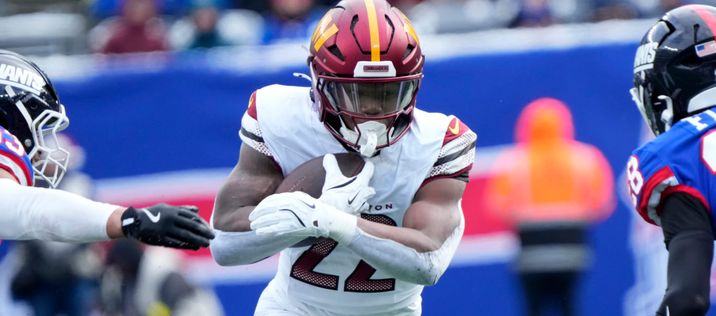
It might feel counterintuitive to discuss only Croskey-Merritt as having RB1 and exclude Rachaad White, who has factually finished as an RB1. However, there’s a logical reason. White’s RB1 season was 272 highly unproductive carries, boosted by his receiving upside. His job was promptly stolen by Bucky Iriving. White is a great blocker and receiver. However, he’s simply ineffective on the ground. Both Croskey-Merritt and rookie Kaytron Allen would have a clear edge on early down and goal line work. Washington will likely continue to operate as a committee with Croskey-Merritt and White.
While an early down committee back isn’t the ideal recipe for an RB1, we’ll make an exception for Croskey-Merritt because of his ability to gain yardage in chunks through breakaway runs. A homerun hitting back in an offense that should bounce back with a healthy Jayden Daniels could provide RB1 upside, particularly if the Commanders exercise more caution with Daniels’ carries. Croskey-Merritt’s metrics look a little funky because we have to consider that Daniels missed over half the season and Washington’s offense struggled significantly. However, he had several encouraging performances, including a 100-yard, two-touchdown game against the Chargers.
Jonathon Brooks (RB – CAR) & Chuba Hubbard (RB – CAR)
Hubbard actually falls into the RB3 territory, while Brooks is well below an RB3. However, we must look at both backs because there are two very realistic outcomes. Trevor Etienne simply doesn’t profile as a lead back, and AJ Dillon – added this offseason – is past his prime. This is a battle between Brooks and Hubbard. The Panthers continue to add to their offensive line, and an improved line will help with efficiency and conversions at the goal line. As the offense continues to build, there will be more goal line opportunities, and the Panthers want to lean on the ground game. An RB1 can exist in this offense in 2026.
If Brooks stays healthy and is rehabbed to his original capabilities, he could easily assume the RB1 role over Hubbard. Hubbard is a fine, reliable back, but no one would ever accuse him of being a game-changing running back. There’s a reason we saw him promptly lose his job to Rico Dowdle. The Panthers have shown one very specific quality…they have ZERO loyalty at running back. If you look good, they will give you reps. If those reps are better than the starting back, they will absolutely let you steal his job.
However, if Brooks suffers another serious injury, Hubbard would remain the lead back with no competition. Etienne would help on third down. However, blocking and converting with receptions was actually the only aspect of Hubbard’s game that was successful last season. It stands to reason that Hubbard would be the three-down back, and pure volume would help him reach an RB1 season. Hubbard was dangerously close in 2024, and that was with a subpar offensive line and inconsistent quarterback play with limited receiving weapons.

Subscribe: Apple Podcasts | Google Play | Spotify | Stitcher | TuneIn | RSS | YouTube