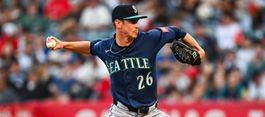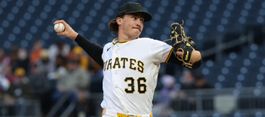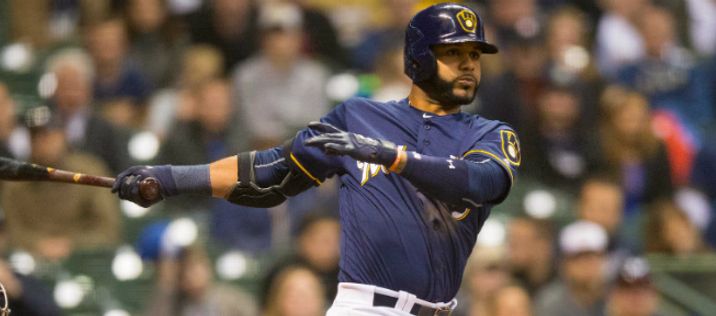
Often the players who cost the most on Draft Day are those least likely to lose significant value on investment. We call these “high floor” players — even at the plausible low end of their range of possible outcomes, they remain positive assets.
We can apply this principal to players coming off career-best performances. When we pay top dollar for these players based on their most recent production, are we considering the true scope of their range of outcomes? Or are we simply betting on the prospect that their best-case outcome will repeat?
Here are five infield-eligible players coming off peak production seasons whose current market value appears set on a repeat performance but whose underlying stats might suggest a negative regression, making them risky assets come Draft Day.
Sync your cheat sheet to your draft with our fantasy baseball software 
Many Draft Day summaries this spring will begin with the question, “How early did Trea Turner go off the board?” And the answer will almost always be, “Too early.”
Indeed, after the Nationals’ infielder took the league by storm with his .342/.370/.567 triple slash and 33-steal output across a mere 73 games last season, the market for Turner going into 2017 has become utterly ravenous. Thanks in no small part to an increasingly barren steals market, the young speedster with only 100 MLB games to his name finds himself the 11th player off the board overall per FantasyPros average draft position data.
Sure, if Turner can extend his 2016 output to 60-plus steals with 20-plus homers and a league-leading batting average across a full season, he will be well worth the investment. But that prospect seems to be on the narrow end of Turner’s range of possible outcomes, especially given his below-average contact rate and barely-there walk rate. MLB Statcast isn’t enamored of his power either, with his 7.5 percent barrels rate just about league average, suggesting that Turner’s torrid power pace last year was more fluke than fact.
Turner’s upside is indeed quite tempting, but the price here seems to far outweigh the risk.
Jonathan Villar (2B/3B/SS – MIL)
Even more so than Turner, Jonathan Villar is a stolen base asset who toes a thin line between being an all-around plus for your fantasy squad and a grossly overpriced specialist. The allure of Villar going to work atop the speed-happy Brewers lineup sure is hard to deny, but the young infielder’s surprisingly balanced excellence in 2016 is hardly a given to repeat in 2017.
The problem with assessing Villar, though, is that his three previous seasons of play seem too short (58, 87, and 53 games, respectively) to treat as normalized samples. As such, for Villar there are far more questions than there are clear outcomes.
For instance, what do we make of the fact that a major spike in hard-hit rate between 2015 (24.7 percent) and 2016 (35.1 percent) was accompanied by an insubstantial increase in line drive rate (up to 20.3 percent from 19.5) and a minor decrease in grounder-to-fly rate (down to 2.31 from 2.50)? We know Villar is fast, but is his true talent batting average on balls in play (BABIP) really as high as the .371 we saw last year? Is the near-20-percent homer-to-fly rate (HR/FB%) an indication of Villar’s actual power? Were his low HR/FB% marks in prior years mere sample-size anomalies?
It will likely cost a pick in the first three rounds of standard leagues to find out if Villar is an all-around stud, a mere one-trick pony, or something in between, so risk-averse fantasy owners might want to look elsewhere for help in the steals column.
After three seasons of sporadic, injury-plagued performance, the switch flicked in a big way for the former top prospect in 2016, as Myers flirted with 30-homer and 30-steal production across 157 games for the Pads. The market heading into 2017 is all in on a repeat from the young slugger, with ADP data slotting him as the 10th first baseman off the board and 53rd player overall.
We’ll certainly need a repeat performance to see Myers make good on that hefty Draft Day cost. But the batting average floor for the young bopper is somewhat concerning, with Myers tallying a strikeout rate just below 24 percent last year. That rate in and of itself is no grave concern, but what doesn’t quite pass the sniff test in his plate discipline stats is the jump in out-of-zone contact percentage, which jumped from low-to-mid 50s in his first three seasons to almost 68 percent last year.
A gamble on Myers at his current cost seems like a gamble on the young hitter suddenly becoming a Joey Votto-esque plate discipline maven. If Myers’ plate skills regress significantly, his final line could look a heck of a lot like the current projections for Keon Broxton and Carlos Gomez, both available 150 picks later in drafts.
Odor seems to have a wider range of possible outcomes than his current ADP as the seventh second baseman off the board would suggest. Granted, the power metrics were there for Odor in 2016, with spikes in line drive rate, homer-per-fly ball rate, and hard-hit rate all seeming to indicate that Odor’s arrival as a strong power threat was serious and repeatable.
But Odor’s plate discipline grades about as poorly as one can imagine from a full-time starter, with an out-of-zone swing rate resting 12 percentage points above league average, plus an overall swing rate nearly eight points above average and a three percent walk rate that tied for a bottom-five mark among players with 200 or more plate appearances. Sure, Odor is young and could very well adjust–but so too could opposing pitchers, who fed Odor a below average 42.5 percent pitches in the zone in 2016, a number that could continue falling as the book on Odor’s plate discipline issues fills out. Odor’s power upside is undeniable, but he seems like a very risky pick at his current ADP near 40th overall.
Coming off his most productive season as a pro, Hosmer seems to be a bargain at his current ADP outside of the overall top 100. But the subdued market on Hosmer is no accident. With below-average power for his position, a declining speed profile, and a gradually ballooning strikeout rate, the Royals’ first baseman offers little upside and a lower floor than you might expect.
After all, despite the 25-homer campaign last year, there’s no real indication that Hosmer is blossoming into a significant power threat. His fly-ball percentage has hovered near 24 percent in each of his last two seasons, with the difference last year being an outsized 21.4 percent homer-to-fly rate that should raise some eyebrows, especially given that Hosmer submitted a near-59-percent groundball rate that was his career high by some margin.
Add to that the fact that Hosmer’s batting average has fluctuated enough over the past four seasons (.302, .270, .297, .266) to make it difficult to know where exactly his true talent lies. The prospect of a sub-.270 season with fewer than 20 combined homers and steals is well within the range of possible outcomes for Hosmer, making his mid-round ADP seem far less enticing.
- 10 Middle Relievers to Target
- Six RP-Eligible Starters to Target
- 10 Low-Cost Hard Hitters to Target
- 5 Bounce-Back Infielders to Target
- 5 Bounce-Back Outfielders to Target
- 5 Bounce-Back Pitchers to Target
Subscribe: iTunes | Stitcher | SoundCloud | Google Play | TuneIn | RSS
Tom Whalen is a featured writer at FantasyPros. For more from Tom, check out his archive or follow him @drillguitar.