We’re just a few weeks away from the start of the baseball season, which means we’re entering peak fantasy draft season. Hooray! So what better time to look at everyone’s favorite fantasy draft topic — sleepers!
Sure, it feels great to pick those can’t-miss superstars at the start of your draft, but it’s snagging those diamonds in the rough in the mid-to-late rounds leaving your draft mates groaning that can make all the difference. Today, let’s take a look at second base and see who your opponents might be sleeping on this year.
Nail your draft with our award-winning fantasy baseball tools 
Jose Peraza (CIN): ECR No. 174
With Brandon Philips no longer around to hog second base, Peraza’s clear path to playing time means he’s not slipping by many fantasy owners anymore, as his average draft position (ADP) rises by the day, particularly in NFBC drafts. But he’s still going way too late in Yahoo and ESPN leagues, making him a worthy inclusion on this list. In some leagues, he may only be eligible at shortstop to start (hardly a bad thing), but as the starting second baseman, he will gain eligibility in short order.
Peraza is a low-power, elite speedster in the mold of Dee Gordon, but at 22 years old he’s six years his junior. In just 256 plate appearances last year, Peraza swiped 21 bags and hit .324, showing the kind of upside we could be dealing with. He benefited from a .361 BABIP, but between his speed, 87.1% contact rate, and 27.5% line-drive rate, there are signs it’s not all smoke and mirrors.
As his projections show, it’s probably best to not expect an above .300 average again, but a solid .280-.290 average could be in the cards. Roster Resource also has him pegged for the two-spot, which would give a boost to his counting stats.
However, he also had a middling 2.7% walk rate, something that will almost certainly have to improve if he wants to keep getting on base at a decent clip. Also, Peraza never exhibited much power in the minors, so his .087 isolated power (ISO) is pretty much what to expect moving forward. Any home runs at all are probably a bonus, a clear weakness if everyone else is hitting bombs like last year.
But while home runs totals have gone up, stolen bases have gone down, so there’s plenty of value in grabbing a guy who should easily reach 30-40 stolen bases in a full season. And unlike Gordon or Billy Hamilton, Peraza won’t cost you a top-70 pick.
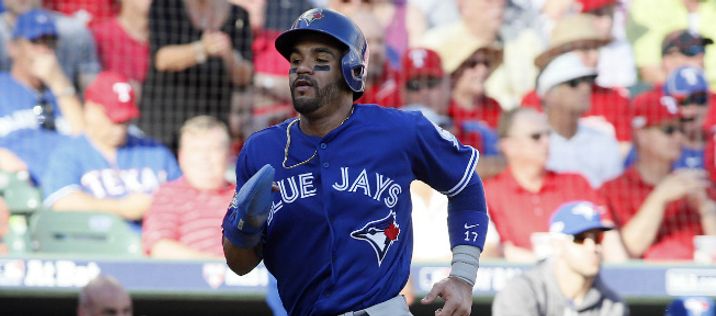
Devon Travis (TOR): ECR No. 191
Travis is probably the biggest boom-or-bust name listed here. Due to injuries, he’s only played 163 games across two years in the majors, but that conveniently shakes out to almost exactly a full season, giving us a glimpse of what might be if he can stay on the field. In 671 plate appearances, he’s amassed 92 runs, 19 home runs, 85 RBIs, seven stolen bases, and a .301 average — numbers you would gladly take out of someone going outside the top 200!
Unfortunately, there’s plenty of reason for the Draft Day discount. For the second straight offseason, Travis is recovering from surgery, this time on his knee, and he’s only just now seeing his first spring action. There’s no guarantee he will be ready for Opening Day.
A jack-of-all-trades sort, Travis doesn’t excel at any one thing. The .301 career average looks nice, but it was the byproduct of a .354 BABIP, so some regression can be expected.
His 5.7% career walk rate could use some improvement, and nothing in his minor league track record suggests much growth in home runs or stolen bases. But all that being said, health permitting, a .280-20-10 season is entirely possible for the Blue Jays’ expected leadoff man.
No one likes drafting an injury-prone player, but outside of AL-only leagues, you’re not banking on him as your starting second baseman, which alleviates some risk. If he can finally put together a full season, he will easily surpass his Draft Day price.
Ryan Schimpf (SD): ECR No. 281
Schimpf is a bit of an odd case. He made his rookie debut last year but will turn 29 in early April. That’s usually not a good sign of major league staying power, but what Schimpf does possess is home run power.
Last year, across 330 plate appearances Schimpf hit 20 home runs with a whopping .315 ISO and absurd 64.9% fly-ball rate. It’s almost a certainty he won’t hit fly balls quite that often this season, but he’ll surely still hit quite a few. Add that to a 39.7% hard-hit rate and a 95.2 MPH average exit velocity on fly balls and line drives, and you have some wonderful home run potential.
In the spirit of the Chrises, Davis and Carter, though, Schimpf struck out 31.8% of the time, leading to an undesirable .217 average. But unlike them, his 73.6% contact rate and 11.3% swinging-strike rate aren’t so bad that he can’t make some improvements in his second major league season.
Still, considering we’re starting closer to the Mendoza Line than not, Schimpf probably requires a roster with high batting average players to offset his low floor. Even taking into account last year’s league-wide power surge, finding a middle infielder with legit 30 home run power late in the draft should peak your interest.
Joe Panik (SF): ECR No. 304
Let’s get this out of the way first — Panik wasn’t very good last year. After slashing .312/.378/.455 in a breakout 2015 season, those figures fell to .239/.315/.379. A fairly low-value power-speed guy, to begin with, the dismal average torpedoed his fantasy value.
The good news is much of his batting average woes can be attributed to an uncharacteristically low .245 BABIP. Panik also suffered a concussion after getting struck in the head by a pitch in June, keeping him out for about a month. He hit just .215 following his return, so it’s possible the injury affected him the rest of the season.
Despite this, he managed his highest walk rate (9.5%) and lowest strikeout rate (8.9%) of his career and maintained an excellent 90% contact rate. It appears his crummy season was more the result of bad luck and injury than a decline in skills. Panik can only reasonably be expected to reach the low teens in home runs, so he’s more floor than he is ceiling, but it’s hard to not see him bouncing back as a lower-risk option, particularly in NL-only leagues.
Brandon Drury (ARI): ECR No. 326
Our final entry only played 12 games at second base in 2016, so he may not qualify there in your league just yet, but he is expected to be the Diamondbacks’ starting second baseman this season. However, Drury should begin the season eligible at third base and outfield, and while multi-position eligibility isn’t something to pay extra for, it’s certainly a nice bonus.
Drury entered last season as a prospect with no starting role, but bouncing around the field netted him 499 plate appearances. The results were solid as he put together a .282 average and showed decent pop with 16 homers, 31 doubles, and a .176 ISO. He had a below average 6.2% walk rate, but an 8.1% second half walk rate could mean that improvement is on the way.
His high 50.1% ground-ball rate and low 29.6% fly-ball rate puts a bit of a damper on his home run potential if he doesn’t nudge that ratio in the fly ball direction. Even so, with a solid 32.9% hard-hit rate, and regular playing time, he should reach 16 homers again with room for more. Drury won’t swipe any bags and is still a relatively unknown commodity, but at just 24 years old there’s some sneaky upside to be had at a very low price.
- Fantasy Baseball Sleepers: First Base
- Fantasy Baseball Sleepers: Third Base
- Fantasy Baseball Sleepers: Shortstop
- Fantasy Baseball Sleepers: Outfielder
- Fantasy Baseball Sleepers: Catchers
- Fantasy Baseball Sleepers: Starting Pitchers
Subscribe: iTunes | Stitcher | SoundCloud | TuneIn | Google Play
Kenyatta Storin is a featured writer with FantayPros. For more from Kenyatta, check out his archive and follow him @kenyattastorin.