
Michael Wacha hasn’t exactly been dominant this year, but with a major step up in his K/9 and a 3.49 FIP to back up his solid 3.66 ERA, the Cardinals righty has certainly been a solid standard-league asset, especially in this depressed, injury-haunted pitching market. But don’t tell that to the 3,000-plus Yahoo! owners who dropped Wacha outright after his six-earned-run outing against the Dodgers this past week. Talk about a short leash!
I guess this hair-trigger approach shouldn’t come as a surprise. After all, recency bias is arguably the most significant market inefficiency in fantasy sports. Those of us who dig beyond the surface stats sure know how to exploit this trend: what have you done for me lately is only part of the equation; what will you do going forward is often a different story entirely.
So, let’s get down to it. These five hitters have had notable stretches of production this month–some have been red hot, others ice cold. What are their prospects for regression, positive or negative, going forward?
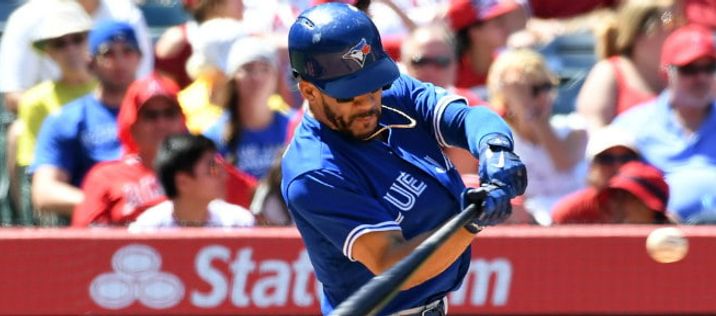
A slow-to-breakout fantasy sleeper who had tantalized owners with squandered potential since his 2015 debut with Toronto, Devon Travis has never stayed consistently healthy for long enough to flash his considerable talent at the dish.
Travis’ early 2017 performance did little to calm fears that he would remain compromised by his recovery from off-season arthroscopic knee surgery, with the 26-year-old infielder slashing a measly .130/.193/.195 across his first 83 PAs. But the month of May has found Travis absolutely thriving, with a 1.000-plus OPS in 87 PAs and a 174 wRC+ on the month that’s good for 11th-best in the majors.
Fantasy owners who were patient enough to stick through Travis’ miserable start (or those who pounced when other owners weren’t) might think they have a surging fantasy start on their hands, but a little attention to the underlying trends here show that Travis is in the midst of a truly spectacular stretch of good batted-ball luck.
His past two weeks has been particularly fortunate, with the infielder managing an eye-popping .514 BABIP despite a 50-percent fly ball rate. You have to like his near-40-percent hard contact rate over that span, but considering how much more likely fly balls are than grounders to lead to outs, it’s hard to treat the .361 average that Travis has maintained over the last month as anywhere near his true talent.
Travis has never posted notable walk totals (his career walk rate is 5.4 percent, and on the season he’s closer to 4 percent), but his out-of-zone swing rates and overall swing rates are down; along with his major spike on opposite-field percentage over the past month, this could suggest a change in approach. The opposite field trend could also be part of the batted-ball luck equation, though, seeing as a near-50-percent opposite field percentage coincides with that .500-plus BABIP across the past two weeks, meaning we could be looking not at a conscious adjustment but at a series of bloops falling in for hits.
The latter is a rather glass-half-empty take, for sure, but it can’t exactly be ruled out. Travis is an exciting player, but I’m not paying anywhere near full freight on his current pace until I see him sustain close to this level of production once his batted-ball luck regresses. Of course, by then it might be too late to buy in, but I suppose those are the breaks.
Like Travis, erstwhile Dodgers phenom Yasiel Puig is a promising but perennially disappointing talent. Unlike Travis, though, Puig’s 2017 hasn’t had many bright spots, at least not in terms of surface results. That said, Puig’s underlying stats suggest that he could make for an interesting speculative buy.
Puig’s current .220/.293/.387 triple slash on the young season is hardly noteworthy; his past two weeks proving especially lousy, with a 42 wRC+ that’s among the lowest for MLB regulars along that span. His splits over that recent sample aren’t all dire, though, with a respectable .167 ISO and a ten-percent walk rate. The downside is an unlucky .120 BABIP, absurdly low by any standard, let along Puig’s career .330 mark.
The plate discipline profile here is especially encouraging. In terms of out-of-zone swings, overall swings, and swinging strikes, Puig’s batting eye is the best it’s looked since 2014, his only full season of strong MLB work. There are other positive indicators, too: more hard contact, less soft contact, more contact on pitches out of the zone.
Recall that Puig was no slouch in the second half of last season, slashing .297/.371/.486 from July 21st on. Puig’s sneaky good plate discipline and strong contact skills make production in this range a strong possibility going forward, with 20 or so combined homers and steals to boot. Gambling on imminent positive regression from Puig seems like a strong play, particularly for owners who are scuffling to find elusive production in the batting average and stolen base categories.
Steals speculators would like to think that they’re found a diamond in the rough with suddenly resurgent speedster Cameron Maybin, who’s amassed 6 steals and a wild 1.200+ OPS over the past two weeks while slugging his way into to leadoff duties for the Angels.
Most impressive amid Maybin’s recent hot streak is his 18-percent walk rate over the last month, a top-five mark across the MLB in that span. The outfielder has made gradual, notable gains over the course of his career in terms of contact skills, chiseling his swinging-strike rate down in just about all of his 10 MLB seasons since debuting in 2007 with a discouraging 17-percent whiff rate. His sub-19-percent overall strikeout percentage across his most recent five seasons is a notable improvement on the 25-plus percent rate that he carried over his first five.
There’s a bit of noise in Maybin’s plate-discipline metrics, though, suggesting that his newfound walk numbers aren’t likely to stick. Sure, the notable dip in out-of-zone swing rates is a good sign, but the fact that Maybin’s swing rates in the zone are also way down doesn’t exactly point to a batting-eye renaissance–he’s just plain swinging less, laying off not only bad pitches, but good ones as well. Meanwhile, a three-year low in overall contact rate could mean that the skills that have put him on base over this hot stretch might begin to betray him once opposing pitchers stop challenging him with the notably high 60-plus-percent fastball rate that he’s seen this season.
Make no mistake, a leadoff hitter who can take walks and swipe bags is nothing to brush off, especially not one who hits in front of arguably the best player in the game. Still, I’d expect some regression in those plate-discipline numbers to kick in soon, so I’m in no rush to crown Maybin as a standard-league mainstay going forward.
Might you be able to trade the white-hot Cam Maybin for the slumping Jose Ramirez? The Indians utility man started the season with a blistering hitting run of his own, slashing .330/.388/.593 over 100-plus PAs, but his results have been much more subdued in May, with a paltry .568 OPS and a mere 13 combined runs and RBIs across the month.
We’ve seen some expected regression on the near-18-percent HR/FB rate that carried Ramirez through that impressive first month, and one could certainly argue that his true talent is a little lower than the 10- and 11-percent rates that he showed last year. After all, a month-by-month breakdown of these rates finds Ramirez climbing above 6-percent in only three of fifteen qualifying months.
But even amid this slump, Ramirez has been hitting the ball with authority, maintaining a 31-plus-percent hard hit rate while actually improving a problematic infield fly rate, which is down below seven percent after it hung out near 15 percent over the first month of the season. His bat skills haven’t taken any noticeable hit, with his swinging strike rate a stingy 2.8 percent and his contact rate above 95 percent over the past two weeks. With those kinds of skills, that .212 May BABIP shouldn’t hold for much longer.
In other words, there’s no reason to be any less convinced of Ramirez’s status as a prime standard-league asset. He’s unlikely to repeat the sizzling power numbers that made him an early-season star, but with positive regression almost certainly on the horizon, I’d be taking any sort of discount on Ramirez that I could get.
I’m much less convinced about the prospect of a turnaround for struggling Phillies outfielder Odubel Herrera. The 25-year-old is in the midst of one heck of a cold stretch, mustering an arctic .333 OPS over the past weeks, during which time he’s struck out at a 28-percent clip without drawing a single walk. It’s no wonder he’s tallied a -19 wRC+ across that span, the worst mark in the majors among hitters with at least 50 PAs.
Indeed, the futility for Herrera has been total. Over the past two weeks, he’s offering at over 43 percent of pitches outside of the zone and whiffing at a near-15-percent clip. Maybe this shouldn’t come as a major surprise, seeing as how the last calendar year has shown similar trends writ large, with a near-40-percent reach rate and 12.5-percent swinging strike rate across 600-plus PAs.
It’s probably the case that drafters who invested in Herrera as a top-40 outfielder got a little ahead of themselves, forgetting that his numbers from last year were unnaturally inflated by his awesome first month, where he maintained a 22-percent walk rate and a stingy 21-percent reach rate, both clear outliers to the larger trends that followed.
It’s tempting to see a struggling young power/speed threat with plus plate discipline in his recent small sample as a nice target for positive regression, but I wouldn’t be too eager to pay anything of value on that speculation. Sure, Herrera is unlikely to be this bad for the duration, but the chances seem slim that he’ll ever again be as good as he was at the start of last season.
Subscribe: iTunes | Stitcher | SoundCloud | Google Play | TuneIn | RSS
Tom Whalen is a featured writer at FantasyPros. For more from Tom, check out his archive or follow him @tomcwhalen.


