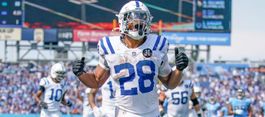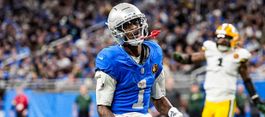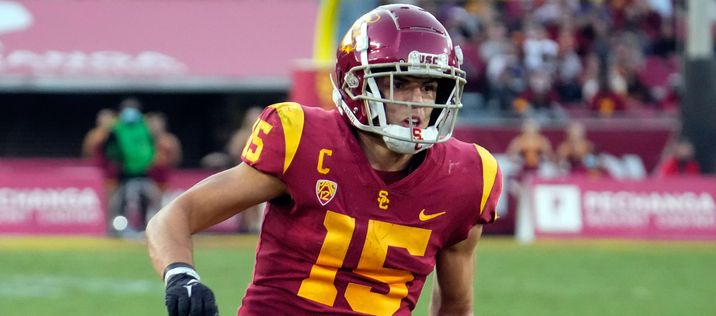
The NFL Scouting Combine is back! From March 1-7, the NFL Network will share wall-to-wall coverage from Lucas Oil Stadium in Indianapolis, including three nights of primetime footage. After a one-year viral hiatus, the Combine will attempt to excite NFL teams and fans alike by televising top football prospects while they perform drills and athletic testing in Spanx.
Some cynics relish the first week of March because they can mockingly refer to this rigmarole as the “Underwear Olympics,” while sneering smugly over their escarole salad. Without knowing for certain why I will have every screen in my home locked into this event. My third-grade daughter is planning to set up the three-cone drill and make fun of my wife’s tiny, Joe Burrow (QB – CIN)-sized hands. For the BMI crowd, I should remind you that it doesn’t matter (unless you’re comparing me to my BMI twin, Aaron Donald (DT – LAR)).
After a month of playoff football with nary a whisper of COVID-19 (they might as well change the name to Voldemort), the Combine was prepared to sequester the athletes in a “bubble” of sorts without access to their normal dietary or training regimen. This unsurprisingly miffed many prospects and their agents. Up to 155 athletes were prepared to not participate in workouts of any sort unless the bubble idea was lanced. As of Monday, February 21, the NFL has since loosened its restrictions to avoid a costly boycott.
Get a FREE 6-month upgrade with our special offer 
Historical Significance
Gone are the days of baggy, sweat-stained gym clothes to conceal the awkwardly gaunt figures of future sixth-round quarterbacks from the Big Ten, whose 40 times were timed on a sundial. We have reached the new age of athletic training, scouting, and wardrobe. The Wonderlic test is also gone, leaving behind a void of knowledge about these prospects’ sense of irrelevant logic. For every Mike Mamula and Darrius Heyward-Bey (whose splendor in spandex vaulted them to Icarian heights), there will be Anquan Boldin, Terrell Suggs, and Tom Brady-type players who flourish in helmets and pads after falling flat (or slow) in Indy.
For us fantasy football nerds, combine performances do matter. They just don’t matter that much. Even though Al Davis would draft the fastest guy at the combine in the first round, most teams use the combine to confirm what they saw on tape. Most football coaches would attest that it also helps greatly to watch the players move in person at field level. Some players have a lot to prove, while others will stand around and watch after their measurements and interviews are completed.
Each drill has weighted significance for each position. Prowess in certain types of drills can demonstrate strengths that directly translate to the football field. Apart from the position-specific drills, the athletic assessments are the driving force of the televised popularity of the event. Just like with the NFL’s overt attempt to monetize the Scouting Combine, this is the first audition for players to promote their brand heading into their professional careers. Plenty of prospects have entered Indianapolis a relative unknown, only to emerge as a bona fide star prospect after a scintillating combine performance.
40-yard Dash
Men have been challenging one another to foot races since Neanderthals carved their bragging rights into a wooly mammoth’s hindquarter. I still remember being the third-fastest kid in my fifth-grade PE class. No, the 40 doesn’t carry as much bearing on one’s football ability as its entertainment value, but certain positions do require the acceleration and long speed demonstrated by this drill.
Quarterbacks and offensive linemen don’t exactly need to prove these two things. We know Malik Willis (QB) is probably fast (we’ve seen it). Trent Williams (OL – SF) went into motion as a 5.0 second 40 guy and it was still terrifying.
Running backs, especially the smaller ones (under 210 pounds), need to post respectable times. Long speed isn’t usually essential, but it does help (see Jonathan Taylor (RB – IND)). Receivers who aren’t the hulking former basketball players, like Drake London (WR), are definitely under the microscope in the 40-yard sprint. Similar to running backs, the undersized prospects can see their value fall in the draft process if they don’t have the speed to make up for other perceived limitations. Bigger receivers who run fast (like DK Metcalf (WR – SEA), Kyle Pitts (TE – ATL), Christian Watson (WR)) are given more credence as demigods by the media. I don’t make the rules. That’s just the way it is.
The pass rushers who run fast times in the 40 are giving themselves a bonus. There are plenty of other drills to demonstrate their explosion and short-area quickness, but only the slowest times warrant a pass rusher any sideways looks.
Linebackers and defensive backs might have the most to lose from a bad 40 time. The NFL is a passing league and the rules are bent heavily in favor of the skill positions, so guys who can’t run a respectable 40 time for their position are shunned faster than dollar store toys. There have been very few exceptions to this in the last five to ten years.
Vertical Jump
Right along with “run faster” is “jump higher.” Football is a brutally physical and dynamic sport. There are only a couple of positions where the vertical jump doesn’t merit much discussion. It is a very good way to measure lower body strength and the ability to explode from the ground. Until football turns into Quidditch, a prospect’s leaping ability will be judged with scrutiny.
Truthfully, quarterbacks don’t need to be high leapers. Every once in a while, a Tim Tebow jumps out of the building and tricks a team into drafting him in the first round. Although it is important for offensive linemen to have very strong lower bodies, the vertical jump takes a back seat to the broad jump in relevance.
For running backs, it is of sneaky importance to excel at the vertical jump. It is entirely a display of lower-body explosiveness, which running backs in the NFL must-have. The backs who jump the highest put a nice feather in their cap heading into the draft.
Receivers and defensive backs are the marquee attraction in this drill. They are always jumping. Most other positions don’t have “jump” in their job descriptions. The two-fold benefit of the vertical jump for receivers and DBs is that they can show how explosive they are while puffing out their chest that they can win those infamous 50-50 balls.
Defensive linemen and linebackers certainly need to demonstrate their lower body strength. These players are under a lot of scrutiny in every drill to compile a body of work that puts them higher on the scouting radar leading into the draft. Players like Isaiah Simmons (LB – ARI) and Micah Parsons (LB – DAL) have raised the bar for the desired prototype athletes that singlehandedly change the makeup of an entire defense.
20-yard Shuttle
You would think that a drill like the shuttle would be a great way for any football player to show their short-area quickness and reaction time. The person starts in a three-point stance, then explodes up five yards, back ten yards, then returns another five yards to the start line. The whole thing lasts between four or five seconds, similar to the 40-yard dash. It is, however, a drill that is much more vital to defensive prospects at the combine.
The 20-yard shuttle is about reaction time and change-of-direction balance. Most of the skill position guys all perform well here, but defensive players are under a hot magnifying glass. Coaches and scouts want their defensive players to have quick-twitch reactions and good balance when low to the ground. They must display quickness when changing directions, as they are constantly reacting to the offensive players to make plays. The closer to 4.0 seconds flat (or under), the better.
Broad Jump
The broad jump is just like the vertical leap…but broader? I don’t know why they wouldn’t call it the “horizontal” jump. This drill is once again an indication of lower body strength and ability to explode from the ground. The difference is the landing. The hip flexibility and balance required to land a broad jump is a great way to be judgmental about the offensive linemen.
Offensive linemen who score well on the broad jump are usually the guys slated to play tackle at the next level, where lower body strength and hip flexibility are both essential traits. With the other positions, it’s a look-at-me contest of overall athletic ability in this drill. Byron Jones (CB – MIA) of the Miami Dolphins famously set the combine (and world) record broad jump at the 2015 combine with a ludicrous 147″ (3.73 meters), vaulting him from an intriguing corner from UConn to a first-round pick by the Dallas Cowboys.
Three-Cone
The three-cone drill is my favorite to watch. It’s a bit difficult to describe, but I’m sure a quick YouTube search could clear it up. DK Metcalf famously paired his ridiculous 4.33 40-yard dash with a horrendous 7.38-second three-cone. This drill measures one’s ability to bend and change direction quickly. It is most useful in grading defensive linemen, especially edge rushers. Nearly every elite pass rusher in the NFL put forth a dazzling three-cone time at the scouting combine. Running backs are also a group to watch out for. Nearly all of them do well in a drill that highlights their life’s work, but it’s captivating to watch how quickly and effortlessly they do it.
Bench Press
This is a drill for everyone, but especially those wide-bodied hogs in the trenches. Linemen need upper body strength in their battle for leverage on every single play. The person tries to perform as many repetitions of a 225-pound bench press as they can. Technique and pace are just as important as strength. Cowboys’ Hall of Fame lineman Larry Allen famously cranked out 43 reps at the Pro Bowl in an insane display of raw country boy strength from the Butte College alum. Some say that receivers who do well at the bench press are also more successful against press coverage because they can better out-muscle the defensive back to gain separation at the line of scrimmage.
The NFL Scouting Combine isn’t the end-all-be-all for these young prospects. It gives us something fun to talk about in fantasy football circles leading up to the upcoming draft. Weighting a non-padded series of exercises too heavily has and will lead to franchise-crippling mistakes by supposed experts in fantasy and the NFL. As stated above, use the combine as entertainment first and confirmation second. We rarely actually learn anything from this pomp and circumstance, but it sure beats binging Tiger King on Netflix.
Practice mock drafts with our FREE Dynasty Draft Simulator
Subscribe: Apple Podcasts | Spotify | Google Podcasts | Stitcher | SoundCloud | iHeartRadio
Beyond our daily fantasy football content, be sure to check out our Daily Fantasy Football Tools. From our Lineup Optimizer – which allows you to build winning DFS lineups in seconds for Cash and GPP contests – to our Projected Ownerships – that allows you to see ownership projections for the day’s players – we’ve got you covered this fantasy football season.