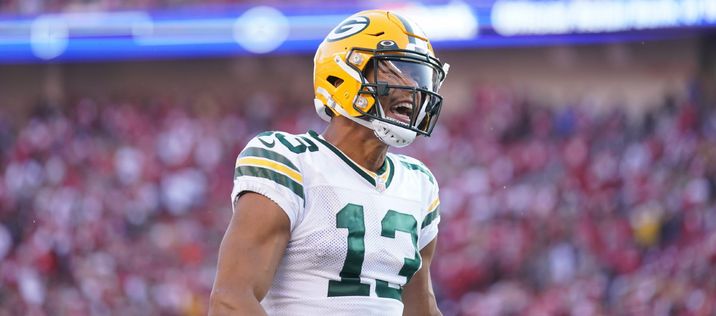
In our “Closer Look” series, we’re examining ambiguous, hard-to-read position groups and offering advice on how to handle them in 2022 fantasy football drafts. In this installment, Derek Brown takes a closer look at the WR position for the Green Bay Packers.
- A Closer Look at the Chiefs Wide Receivers
- A Closer Look at the Falcons Running Backs
- A Closer Look at the Cardinals Wide Receivers
- A Closer Look at the Dolphins Running Backs
- A Closer Look at the Patriots Running Backs
- A Closer Look at the Broncos Wide Receivers
- A Closer Look at the Patriots Wide Receivers
- A Closer Look at the Jaguars Wide Receivers
- A Closer Look at the Texans Running Backs
- A Closer Look at the Jets Wide Receivers
With Davante Adams gone, a Grand Canyon-sized hole remains in this passing attack. One of the offseason’s big questions is who, if anyone, can step forward and seize the throne. The Packers likely remain a top offense this year with Aaron Rodgers at the helm. If they come close to last year’s production, there will be plenty of fantasy points for this wide receiver depth chart.
Last year Green Bay was 10th in points per game, 11th in points per play, and third in EPA per play while also holding the third-highest offensive success rate in the NFL. Rodgers showed no dropoff as he was the top quarterback in the league in EPA per dropback.
Who will step forward as the new apple of Rodgers’ eye? Let’s meet the contestants.

Primary Contributors
*ADP per Underdog Fantasy*
Allen Lazard (ADP: WR40, 81.2 overall)
The splits for Aaron Jones without Davante Adams have been tossed around a bit, but Allen Lazard’s aren’t too shabby either. Yes, it’s a small sample, so it’s best to take Lazard’s uptick in the box score as a positive and not biblical scripture when projecting his full-season outlook. Although, if we want to indulge the demon, the fantasy points per game without Adams would have left Lazard as the WR22 last season.
| Year | Yards per Route Run* (rank) | YAC per reception* (rank) | Target % per route run (rank) |
| 2019 | 1.50 (53rd of 97) | 3.9 (56th) | 23.9% (42nd) |
| 2020 | 1.84 (32nd of 99) | 6.4 (7th) | 18.5% (66th) |
| 2021 | 1.13 (85th of 103) | 4.7 (30th) | 15.8% (90th) |
*Among wide receivers, minimum 40 targets per Pro Football Focus (PFF)
Stepping away from the bull case for Lazard and putting his career under the microscope, we find some positives to draw from (2020) and a smattering of underwhelming production. Lazard has never been a high-volume target earner, even during his best statistical season. So, it’s highly unlikely he resides anywhere close to the Davante Adams-esque target share, even with the rosiest of glasses. Can he still see an uptick in action and walk away with a solid season? Sure.
Lazard’s ability with the ball in his hands is integral to him actualizing that ceiling. Two strong seasons in the YAC per reception department offer hope. More on why this is so important later.
Christian Watson (ADP: WR53, 116.1 overall)
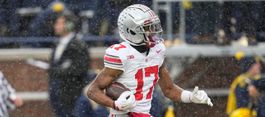
The hype train whistle was blowing furiously in Christian Watson’s favor coming out of Senior Bowl week and after he blew up the combine. While the glittering appeal of those spectacles has worn off as we trudge along through the offseason, we need to be reminded that Watson backed up the hype with his production in college.
| Year | Formation alignment Slot / Wide | Yards per route run (Rank) | YAC / reception |
| 2019 | 10.4% / 89.6% | 2.86 (28th of 290)* | 10.1 (12th) |
| 2020 | 33.3% / 64.9% | 2.70 (25th of 146) | 8.3 (7th) |
| 2021 | 12.8% / 83.1% | 4.33 (1st of 251) | 8.0 (17th) |
Among FCS/FBS wide receivers with 50 or more targets (*Statistics referenced per PFF)
Watson leaves the comfy confines of North Dakota State with a decorated analytic profile. His non-early declare status is a ding, but we should also be balancing it with a 90th percentile college dominator and 88th percentile collegiate yards per reception ranking. His Yards per route run have stacked up well against his FBS counterparts in each season before he blew the doors off in 2021, leading the nation in Yards per route run among the 251 FBS and FCS wide receivers in the sample. Watson, much like Lazard, is an after-the-catch maven ranking no lower than 17th in YAC per reception over the last three years.
Sammy Watkins (ADP: WR75, 171.0 overall)
Before we get to Sammy Watkins’ talent profile at this stage of his career, we must first address how he and Randall Cobb might be utilized in 2022. This talking point weighs on Cobb more than Watkins while noting it could affect both. The Packers have been a 12-personnel-heavy team over the last two years as they ranked second (29%) and tenth (24%) in the usage of the formation. Green Bay has only run out three or more receivers 55-65% of their snaps in that same period. If you are a slot-only player making the starting lineup, you won’t likely sniff more than a 60-65% snap rate. This hampers Cobb more as he is strictly a slot wideout with 82.9% of his career snaps coming inside.
Watkins has more hope of earning a full-time role. During his final two seasons in Kansas City, he played 48.2-53.1% of his snaps from the slot. Last year in Baltimore, he transitioned back to being an outside-only wide receiver (87.1%). It’s a valid point that Watkins could be more valuable from the slot at this point in his career, though. Last year, his Yards per route run dipped to 1.45 (60th, minimum 50 targets per PFF). Over the last four years, Watkins has logged two top 24 finishes (1st, 24th) in slot Yards per route run (minimum 10 slot targets, per PFF). Over that timeframe, he’s seen at least 58.1% of his targets against zone coverage in three seasons. If Watkins can secure the boundary receiver role over Watson or Lazard and kick inside when the team rolls with 11 personnel, he could carve out a full-time role.
Randall Cobb (ADP: WR101, 214.4 overall)
Randall Cobb looked like a receiver on his last legs in 2021. Cobb cratered to 72nd in Yards per route run (minimum 35 targets, per PFF) with the second-lowest YAC per reception of his career. He was a situational role player and only managed to crest 60% of the snaps in 33% of his games played. Cobb was Rodgers’ red zone best friend, with 35.8% of his target volume coming inside the 20.
Other Potential Contributors (Longshots)
Amari Rodgers (ADP: WR108, 215.3 overall)
Amari Rodgers entered the NFL with a middling prospect profile and draft capital (third-round). Rodgers has been an iffy bet to pan out as a productive fantasy player, and his rookie season didn’t change that outlook. His 37th percentile or lower marks in college dominator, yards per reception, and breakout age forecasted a player that could struggle to see meaningful playing time, especially in his rookie season. Rodgers followed suit with that projection playing above 25% of the offensive snaps in only one game all season. He only drew eight total targets limping to 1.10 Yards per route run, with 66.7% of his snaps coming from the slot (per PFF).
Romeo Doubs (ADP: WR100, 214.2 overall)
Romeo Doubs arrives in cheese town via the fourth round of this year’s NFL draft. Doubs averaged 1,055 receiving yards in his final two seasons at Nevada as Carson Strong‘s go-to receiver commanding 19.8% and 25.9% target shares. He ranked 71st and 21st in Yards per route run among FBS wide receivers (minimum 50 targets, per PFF) over that stretch. Doubs was a boundary receiver, with 89.4% of his collegiate snaps coming out wide. He checks a few analytical boxes that help his profile with a 73rd percentile collegiate target share and 80th percentile breakout age. However, Doubs still has areas of his game to clean up if he’s going to make it on the outside at the next level. Most notably, his footwork and releases as he significantly struggled to separate in 1-on-1s at the Reese’s Senior Bowl.
Juwann Winfree (ADP: N/A)
The former sixth-round pick by the Denver Broncos (2019) has been with the Packers for the last two seasons. Most of his contributions during his nine active games have come via special teams. He’s only mustered 13 targets and 0.66 Yards per route run in his career.
Malik Taylor (ADP: N/A)
Malik Taylor is another career special teamer. Taylor has been active for 25 games since 2020 but has only drawn nine targets. He’s been utilized more in the return game. His career 0.88 Yards per route run means, more than likely, this will be his role in 2022.
Samori Toure (ADP: WR124, 215.9 overall)
The former Nebraska Cornhusker dropped to the seventh round of the NFL Draft this year before getting scooped up by Green Bay. Toure landed in Nebraska after transferring from Montana after he posted a monster season of 87 receptions, 1,495 receiving yards, and 13 receiving touchdowns in 2019. In his only season with Nebraska, he finished 32nd in Yards per route run (minimum 50 targets, per PFF), immediately ahead of David Bell. Sticking with a continuous theme of what the Packers look for in their receivers, he finished 22nd in YAC per reception last year among all FBS wide receivers with 50 or more targets (per PFF).
Danny Davis (ADP: N/A)
Danny Davis is a new UDFA addition this year. He concluded a five-year career at Wisconsin as a role player, never eclipsing 478 receiving yards in any season. He logged an aDOT of 14.5 or higher in three of those years, but his 1.69 collegiate Yards per route run (per PFF) display that his best chance of sticking on the roster will have to come with special teams.
Analysis
Davante Adams has seen a ridiculous 30.3-33.9% target share over the last three seasons. The void he leaves behind can’t be overstated. Will one of the aforementioned receivers lay claim as the next king of the mountain? To Adams’ degree, it’s doubtful, but Allen Lazard and Christian Watson are the best bets to make from this receiver group.
As I’ve mentioned a few times here, yards after the catch ability is paramount in this offensive system and a consistent trend filtering through the depth chart. This is where Lazard steps in. As I laid out in a thread earlier this offseason, Aaron Rodgers has peppered his receivers in the short area of the field, expecting them to create on their own. Lazard has done so efficiently, ranking top 25 in Yards per route run in this area of the field over the last three seasons (minimum 20 targets, per PFF).
Aaron Rodgers (3/3)
2019-2021:
13th, 8th, 13th (39.6-45.6% of att) in passing att between 0-9 yds
Lazard’s YPRR & Ranks 0-9 yds
(Among WRs w/ 20 or more tgs at this depth)2021: 7.0 (25th of 103)
2020: 9.5 (1st of 90)
2019: 8.05 (7th of 93)Lazard could be ready for liftoff pic.twitter.com/P6NToTiCtt
— Derek Brown (@DBro_FFB) April 11, 2022
Watson’s scintillating YAC ability will also be a focal point. The biggest quandary with Watson isn’t his raw athletic ability but whether he will quickly acclimate to facing NFL talent daily or not and how fast he can build rapport with his new signal caller. Green Bay has not tossed substantial draft capital at a young receiver in quite some time. The last widout the Packers took with a top 32 pick was Javon Walker in 2002. Look for Green Bay to ease Watson in using him in space and in the screen game, allowing his physical gifts to take over as he adjusts. The unimpressive receiver room does offer him the upside to draw substantial volume this year if he’s up to the task.
If Watson is slow out of the gate or if the Packers play this conservatively, Sammy Watkins could be lining up opposite Lazard in two wide sets in Week 1. Watkins is definitely past his prime, but that doesn’t mean he can’t get the veteran deference from Rodgers and enjoy a slight resurgence. Cobb will still command at least rotational snaps in the slot and near the goal line if Green Bay plugs him back into this 2021 role.
This receiver room could be in flux, and we can’t rule out Green Bay adding another veteran before Week 1 (I’m looking at you, Julio Jones). If the depth chart remains the same, it’s difficult to see Amari Rodgers or Romeo Doubs playing anything more than bit parts this year while the rest soak up special teams snaps.
How to Value These Players
Something we must remember with the Packers’ offense and when valuing these players is the context of their offensive design. Green Bay ranks 11th (60%) in neutral script passing rate since 2020, but their offensive pace waters down the aerial volume. This team also ranked 32nd in neutral pace, running the ninth-most plays in close games over the last two years. This has held Green Bay in check, ranking 24th and 15th in pass attempts, with Aaron Rodgers averaging 528 per season. If Allen Lazard or Christian Watson can earn a 19% target share, then we’re looking at approximately 100 targets if all of the other factors remain consistent. The 100-target mark last year was ranked 35th among wide receivers.
Currently, on Underdog Fantasy, Allen Lazard sits at WR40 while Watson is trailing him at WR53. Comparing this to our FantasyPros Expert Consensus Rankings (ECR), we find consensus in line on Lazard (WR45) but much lower on Watson (WR69). My Lazard stance is in line with both markets as I have him currently ranked as the WR45. Where I differ from both is my Watson outlook – I’m a tad more bullish as I have him creeping up behind Lazard at WR48. Either one of these wide receivers could step forward and lead the team in targets, but as we discussed earlier unless they are elite target earners like Adams, the raw volume of targets will likely disappoint. To this point, Lazard hasn’t flashed this ability, but with a target vacuum like Adams here previously, it’s fair to question his opportunity to do so.
Lazard and Watson are fine WR4 targets with upside this season. The ceiling on each is questionable as the overall target volume could get dispersed this season with no one commanding a massive share. Sammy Watkins and Randall Cobb are players I’ll target only in best ball as later-round playoff week or stack correlation adds. The rest of their wide receiver room is best left on the waiver wire in redraft or the player pool in best ball. If you’re going off the page in large field best ball tournaments, I don’t hate some exposure to Romeo Doubs, though, given his prospect profile.

Subscribe: Apple Podcasts | Spotify | Google Podcasts | Stitcher | SoundCloud | iHeartRadio
If you want to dive deeper into fantasy football, be sure to check out our award-winning slate of Fantasy Football Tools as you navigate your season. From our Start/Sit Assistant – which provides your optimal lineup, based on accurate consensus projections – to our Waiver Wire Assistant – that allows you to quickly see which available players will improve your team and by how much – we’ve got you covered this fantasy football season.