When preparing for your fantasy football drafts, knowing which players to target and others to avoid is important. The amount of information available can be overwhelming, so a great way to condense the data and determine players to draft and others to leave for your leaguemates is to use our expert consensus fantasy football rankings compared to fantasy football average draft position (ADP). In this way, you can identify players the experts are willing to reach for at ADP and others they are not drafting until much later than average. Let’s dive into a few notable late-round fantasy football picks I target in drafts.

When preparing for your fantasy football drafts, knowing which players to target and others to avoid is important. The amount of information available can be overwhelming, so a great way to condense the data and determine players to draft and others to leave for your leaguemates is to use our expert consensus fantasy football rankings compared to fantasy football average draft position (ADP). In this way, you can identify players the experts are willing to reach for at ADP and others they are not drafting until much later than average. Let’s dive into a few notable late-round fantasy football picks I target in drafts.
Fantasy Football Advice: Late-Round Draft Picks to Target
Let’s dive into late-round draft picks I target.
Josh Downs (IND)
Downs displayed real growth in year two, finishing as the WR28 in fantasy points per game, but it still doesn’t tell the entire story of his 2024 season. That end-of-season finish doesn’t fully illustrate Downs’ upside. In the games that Joe Flacco played at least 80% of the snaps last year, we got a glimpse of it. In those games with Flacco, Downs had a 25.7% target share, 2.38 yards per route run, 66.4 receiving yards per game, a 32.4% first-read share, 0.144 first downs per route run, and 15.5 PPR points per game (per Fantasy Points Data). If he had kept that pace up in those categories, among wide receivers with at least 50 targets last year, he would have ranked ninth, 15th, 20th, ninth, and fourth as the WR21 in fantasy points per game. With Richardson under center, his numbers dipped with a 21.3% target share, 2.15 yards per route run, 48.3 receiving yards per game, a 26.8% first-read share, 0.076 first downs per route run, and 10.7 PPR points per game (WR44). Downs is a stable WR3/4 who could easily out-kick his ADP in 2025 if Indy gets more consistent quarterback play.
Darnell Mooney (ATL)
Last year, Darnell Mooney posted the second WR3 finish of his career in fantasy points per game (WR34), and he could easily do it again in 2025. There’s no disputing that the Falcons’ passing attack will be led by Drake London and Mooney this season. The target tree is extremely consolidated. Last year, Mooney had a 19.6% target share while averaging 62 receiving yards per game (29th-best), posting 2.04 yards per route run (31st) and 0.099 first downs per route run (28th, per Fantasy Points Data). With Michael Penix looking to push the ball downfield more than Kirk Cousins did, I could see Mooney’s target share jumping into the low 20s and his fantasy stock increasing accordingly. Mooney is a nice late-round WR3/flex that could offer more if Penix puts it all together in 2025.
Jayden Higgins (HOU)
Higgins got the capital I was hoping for as the fifth wide receiver selected in the NFL Draft at the top of the second round. Higgins should immediately file in as the starting outside receiver opposite Nico Collins in two wide receiver sets. Higgins was an underrated player throughout the entire draft process, ranking 27th and 16th in yards per route run and first and 18th in receiving grade during his final two collegiate seasons (per PFF). He’s a sure-handed receiver who will become a trusted safety blanket for C.J. Stroud after posting a 2.2% drop rate or lower in each of the last three seasons and a 55.6% contested catch rate in college. The addition of Higgins and fellow former Iowa State wide receiver Jaylin Noel should push Christian Kirk while also hopefully fueling a big bounce-back season for Stroud. Higgins is a WR3/4 that could easily evolve into a weekly WR2 as the 2025 season rolls along.
Romeo Doubs (GB)
Out of the cloudy receiving picture in Green Bay, Romeo Doubs is the wide receiver I want to draft this season. On the surface, there doesn’t appear to be much cause for being over the moon for Doubs, but hear me out. Last year, he finished as the WR47 in fantasy points per game, but he was the clear leader of the Green Bay Packers receiver room, and underneath the surface, he POPS in a number of metrics that matter. Doubs was the only receiver for Green Bay that eclipsed a 75% route share (team-leading 76.7%) while leading the team in target share (18.7%) and first-read share (23.6%). He posted a solid 1.90 yards per route run while ranking 25th among 85 qualifying receivers in first downs per route run (0.104, per Fantasy Points Data). Here’s where things get really interesting: Doubs, last year among 112 qualifying receivers, ranked 11th in separation and second in route win rate. Doubs could be quietly headed for a massive breakout season, and with the addition of Matthew Golden and the Packers’ run-heavy approach last year, it’s not priced into his ADP at all. He’s one of my favorite late-round dart throws this season.
Joshua Palmer (BUF)
Palmer is a solid and cheap bet to make on the Buffalo offense. His surface stats don’t jump off the page. In the games in which he played at least 50% of the snaps last year, he had a 13.7% target share, 1.57 yards per route run, a 17.2% first-read share, and 0.075 first downs per route run (per Fantasy Points Data). It’s when we pop open the hood and peek at his per-route metrics that things get interesting. Last year, among 112 qualifying wide receivers, Palmer was one of the best separators in the NFL, ranking 16th in separation and 12th in route win rate. Now, those numbers are eye-popping, especially when you discuss one of the best offenses in the NFL, yet only one receiving option was able to draw more than a 20% target share last year (Khalil Shakir). Palmer’s route running and separation ability could lead to consistently heavier usage in Buffalo, where they don’t have a receiver commanding a high target share. Palmer is worth the late-round flier to find out.
Pat Bryant (DEN)
The Denver Broncos surprised everyone by selecting Pat Bryant in the third round of the NFL Draft. In the post-draft presser, Sean Payton compared Bryant’s game loosely to his former standout receiver, Michael Thomas. While I wasn’t head over heels in love with Bryant during the pre-draft process, this comparison and his surprising draft capital do raise the antenna. Bryant quietly checks the analytical boxes that we look for, ranking 18th in yards per route run and seventh in receiving grade in his final collegiate season (per PFF). He’s worth tossing a dart at with your final pick in redraft leagues. Denver needs another receiver to step in as an every-down contributor in the offense in 2025, opposite Courtland Sutton and Evan Engram.
Dont’e Thornton Jr. (LV)
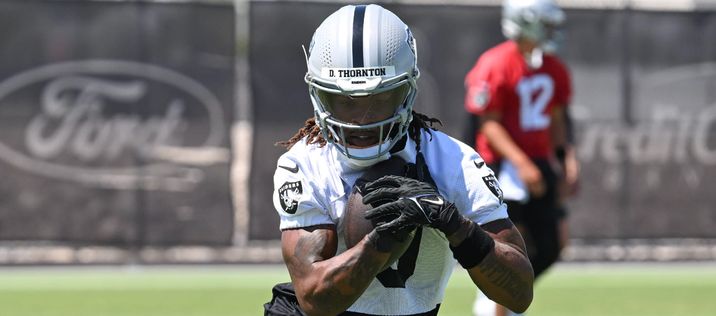
I love the addition of Thornton to this Raiders’ wide receiver room. He fits in nicely with the receivers they already have on the roster as a field-stretching compliment. He should be starting in three wide receiver sets shortly over Tre Tucker. Thornton had only 34 targets last season, but he posted a whopping 3.72 yards per route run (per PFF). With his elite build-up speed, he will take the top off of plenty of defenses in 2025. If Las Vegas hands Thornton Jr. the D.K. Metcalf route tree in year one as a full-time starter, he could surprise people, but that’s not a given. It’s tough to project him to become a high-end target share earner in 2025, but he could easily offer some week-winning upside from the flex when the matchup is right.
Jalen Coker (CAR)
Jalen Coker burst on the scene last year as an undrafted free agent. He earned a starting spot in the Carolina Panthers passing offense as the season moved along and racked up four games with at least 60 receiving yards in the process. In the six games, he played at least 68% of the snaps, and Bryce Young was the starting quarterback; Coker had solid numbers with an 18.3% target share, 55.7 receiving yards per game, 1.89 yards per route run, and a 23.8% first-read share (per Fantasy Points Data). He averaged 11.4 PPR points per game with three top-36 weekly fantasy finishes (WR17, WR12, WR28). He looks like he’s on the outside looking in for a starting spot in 2025, but one injury in camp or during the season could easily change that.