The 2025 fantasy football season is officially in the books. While it’s tempting to already start looking ahead to the offseason and 2026 (I know I am), now is also a great time to take a step back and reflect on the season that just ended. It’s often hard to find time to zoom out and look at the big picture during the week-to-week rush of the season, so let’s take this opportunity to do that.
Specifically, this article will look back at the expert consensus rankings (ECR) from draft season, comparing them to how players actually finished. Which players did the experts nail, and which did they get horribly wrong? We’re about to find out.
- Fantasy Football Advice
- Weekly Fantasy Football Rankings
- Fantasy Football Advanced Stats
- Fantasy Football Trade Tools

2025 Fantasy Football Expert Misses
Calvin Ridley (WR – TEN)
This feels a little harsh, as Calvin Ridley only played in seven games, including a couple that were massively injury-shortened. But even in his healthy outings, it was a rough season for the veteran wideout. He averaged just 6.2 half-PPR points in five games where he played over 50% of the Titans’ snaps, which would have ranked outside ofthe top 60 receivers for the season.
That’s not good for the experts, who ranked Ridley as the WR27 and inside the top 60 picks overall. Things look even worse when we consider that the general fantasy market was lower — correctly — on Ridley than the experts. His average draft position (ADP) in half-PPR formats was 66th overall, making him the WR29. Missing massively compared to actual results and slightly compared to ADP makes Ridley a clear loss for the experts in 2025.
With that said, there aren’t many obvious takeaways from this miss. Perhaps the big one is that investing in players on teams with unproven offenses — and/or rookie quarterbacks — is a risky choice. The Titans’ offense was a fantasy black hole for most of the season, with zero reliable players as rookie Cam Ward struggled.
On the other hand, Ward did improve later in the season (after Ridley was already done for the year). If the first overall pick had hit the ground running, Ridley could have been a massive winner, a la Terry McLaurin with Jayden Daniels in 2024. This is still a miss, but I’m not sure there were any clear issues with the process that led to it.
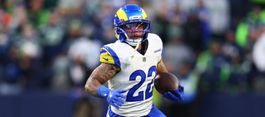
Matthew Stafford (QB – LAR)
Misses really don’t get much clearer than this. Matthew Stafford was the QB25 in ECR heading into the season. He finished as the QB3 in both total points and points per game, and he’s probably going to be the NFL MVP.
Once again, the general community consensus was also closer to the truth than the experts. Stafford’s overall ADP made him the QB23; that’s obviously still nowhere near his actual finish, but it’s a step in the right direction.
And, unlike with Ridley, this consensus ranking of Stafford does seem flawed (with the benefit of hindsight, of course). We knew coming into the year that the Rams had added Davante Adams, still a hugely effective option, even at 32 years old. Adding him to All-World receiver Puka Nacua meant Stafford had two excellent options. And, aside from last season, the veteran signal-caller had easily outperformed his QB25 ECR in every one of his healthy seasons with Sean McVay in Los Angeles.
The real culprit here was likely the late off-season panic that Stafford might not be able to play at all while dealing with a back injury. In general, the fantasy community — experts and non-experts — tends to overrate how predictable injuries are. Stafford was clearly planning on playing, so fading him because he was old and might be dealing with an injury was probably the wrong move, especially given his upside with Adams in town.
Troy Franklin (WR – DEN)
This is another one where the consensus clearly got one over on the experts. The sophomore receiver’s ECR was outside of the top 100 at his position (WR102), while his ADP was much higher at WR78. Troy Franklin blew both out of the water, finishing as the WR33 in total half-PPR points and the WR41 in points per game. There was a brief stretch in the middle of the season where he was genuinely a must-start as the Broncos’ apparent top target.
The lesson here is almost the opposite of the one with Ridley. The Broncos were expected to be a good team, with at least a decent offense in Bo Nix‘s second year. They also had no clear second receiver behind Courtland Sutton. Throwing a very cheap dart at a second-year player in that offense should have been a no-brainer.
Kyle Pitts (TE – ATL)
We have to give credit to Kyle Pitts for a very impressive 2025 season. After often struggling to meet fantasy expectations to start his career, the former eighth-overall pick finally came through this season. Just when everyone stopped believing in him. He had an ECR of TE16, but finished as the TE2 overall and the TE6 in points per game.
To be fair, a solid chunk of Pitts’ final ranking is thanks to one massive game, as he exploded for 40.1 fantasy points in Week 15 with Drake London sidelined. But he did finish as a weekly TE1 in eight out of 17 games, a very solid number.
At the end of the day, Pitts will almost certainly be ranked higher than TE16 heading into 2026, so it’s hard to argue that his 2025 consensus ranking wasn’t a mistake. Perhaps the lesson here is to give some grace to a former elite prospect at a notoriously slow-developing position who was still just 24 years old at the start of the season.

2025 Fantasy Football Expert Hits
Drake Maye (QB – NE)
Obviously, the experts didn’t nail Drake Maye’s massive second-year breakout. He finished as the QB2 overall and tied with Matthew Stafford for the QB3 in points per game. He’s also the only player other than Stafford with a shot to be this year’s NFL MVP. With that in mind, his ECR of QB13 — outside of the QB1 range — feels like a clear mistake.
But everything is relative. The expert consensus was significantly higher on Maye than the general community. This was true both within quarterback rankings (QB13 versus QB16) and in overall rankings (101 versus 126). Maye even consistently appeared in lists of top expert sleepers at the quarterback position.
What the experts probably got right here is betting on the upside of a young, mobile signal-caller. The results weren’t great, but Maye flashed some elite skills in his rookie year, including playmaking ability on the ground. Especially given that his situation was clearly trending upward in terms of weapons and coaching, we shouldn’t be too surprised by Maye’s breakout season.
Joe Mixon (RB – HOU)
Again, this pick is all about being directionally accurate. Joe Mixon’s ECR was RB56, which doesn’t look that great given he never even made it to the Texans’ active roster this season while dealing with a foot injury. But that expert ranking suddenly looks very sharp compared to his RB30 ADP.
Things look even better for the experts if we look at his overall ranking. Mixon’s overall ECR was 161, placing him as a relatively meaningless 14th-round pick. His overall ADP was 79, costing managers a valuable selection in the middle rounds for a literal zero.
The lesson here is that the experts are sometimes simply more locked in than the average manager. There were rumbles for much of the offseason that Mixon’s mysterious foot ailment was worse than was being widely reported. Experts correctly downgraded Mixon massively as the season approached with no positive updates, while the general community didn’t react quickly enough. If you notice a player with a gap this large between their ADP and ECR, it’s usually worth double-checking to see if the experts are reacting to a key piece of information.
Breece Hall (RB – NYJ)
The experts nailed Breece Hall right on the dot. His consensus ranking settled in as the RB18 in half-PPR formats. At the end of the season, he was the RB18 in half-PPR formats.
To be fair, Hall was actually just the RB20 in points per game, so he slightly underperformed his RB18 ECR by that metric. But ECR again wins directionally, as his ADP was even higher at RB15. The experts also get a win in terms of overall ranking, where they had Hall nearly a full round later at 45th overall compared to his 34th overall ADP.
Like with Ridley, the lesson here is about considering the team environment. Hall is a very talented young player, but the Jets’ offense had massive systemic risk with Justin Fields as their QB1. We’ve seen in previous years that Hall wasn’t able to reach his theoretical upside in terrible New York offenses, and that was the result once again this season.
Emeka Egbuka (WR – TB)
We are back to the directional wins here. With an ECR of WR32, the experts didn’t predict Emeka Egbuka’s impressive WR19 finish, but they were a lot closer than his WR45 ADP. In fact, that WR32 ranking actually looks pretty dang good compared to his WR28 finish in points per game (among players with at least five games).
Admittedly, Egbuka’s season was very weird. He started incredibly hot, racking up touchdowns in the first few games of his NFL career. But he slowed down as the season continued, eventually becoming an afterthought in the Buccaneers’ offense as Mike Evans, Chris Godwin and Jalen McMillan all returned to the field. That’s the opposite of the expected trajectory for highly drafted rookies.
But the key here is the fact that Egbuka, the 19th overall pick in this year’s draft, was a highly drafted rookie. Even in a theoretically crowded situation in Tampa Bay, that draft capital meant he had more upside than most players available in the middle rounds of fantasy drafts. He showed that upside early, and the crowded situation came back to bite him late, but he still easily outperformed his draft day price — as predicted by the experts.

Subscribe: YouTube | Spotify | Apple Podcasts | iHeart | Castbox | Amazon Music | Podcast Addict | TuneIn
Ted Chmyz is a fantasy football contributor for FantasyPros.com. Find him on Twitter and Bluesky @Tchmyz for more fantasy content or to ask questions.