Dynasty fantasy football is all about balancing talent, age, situation, and long-term stability. The toughest players to evaluate are often the ones with recognizable names and recent production because that’s where market value can drift away from reality.
- Dynasty Fantasy Football Rankings
- Best Fantasy Football Tools
- Dynasty Rookie Mock Drafts
- Fantasy Football Mock Draft Simulator
12 Dynasty Fantasy Football Players to Avoid or Trade Away Now
That was the core theme throughout this discussion. None of these players are being labeled “bad.” In fact, several are still productive fantasy assets right now. The concern is cost versus long-term outlook, especially in dynasty startup drafts where every pick carries multi-year implications.
Baker Mayfield (QB – TB)
Baker Mayfield‘s career has always felt tied to circumstance, and that’s part of the concern heading into dynasty drafts.
The conversation focused heavily on how much Mayfield’s success may depend on strong offensive play callers. His best stretches came with Sean McVay, Dave Canales, and Liam Coen, while last season under Josh Grizzard was viewed as a clear step backward.
The numbers reflected that regression. His completion percentage and yards per attempt both dropped significantly, while turnovers remained an issue. Injuries around him certainly mattered, but the panel questioned whether Mayfield’s grip on long-term job security is actually as stable as fantasy managers assume.
In dynasty startups, quarterback age matters less than it does at other positions. The bigger concern is whether the NFL still views Mayfield as a locked-in starter two years from now if the production slips again.
That uncertainty makes him difficult to prioritize over younger quarterbacks with more insulated long-term value.
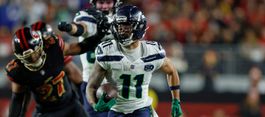
Sam Darnold (QB – SEA)
Sam Darnold was viewed more as a “safe but capped” dynasty quarterback.
The analysts acknowledged Darnold’s recent success, including a strong run with Seattle, but they also repeatedly emphasized the likely structure of the Seahawks offense moving forward. The expectation is still a run-heavy, defense-oriented system built around controlling pace and limiting mistakes.
That creates a fantasy profile that may produce steady QB2 numbers without offering much week-winning upside.
The discussion also questioned whether Darnold’s recent rise is partly tied to excellent offensive environments and quarterback-friendly coaching. Even though there’s optimism Seattle maintains continuity offensively, there’s less certainty about his ceiling compared to quarterbacks drafted in similar ranges.
For superflex formats, the takeaway was fairly clear: Darnold is fine as a QB3 and survivable as a QB2, but probably not someone managers should aggressively target.
Dalton Kincaid (TE – BUF)
Dalton Kincaid might be one of the more frustrating dynasty assets at tight end.
The efficiency numbers were excellent last season, but the role simply wasn’t. Kincaid remained a part-time player in Buffalo’s offense, finishing behind Dawson Knox and rookie Jackson Haw in snaps.
That disconnect between talent and usage is what worried the panel most.
There was also significant concern surrounding Kincaid’s lingering PCL injury situation and Buffalo’s public comments about managing his workload. Even with strong efficiency metrics, limited snaps capped his fantasy usefulness.
The bigger dynasty takeaway is that Kincaid may never become the every-down centerpiece fantasy managers hoped for when he entered the league.
Unless Buffalo fundamentally changes how it deploys tight ends, the ceiling appears lower than his name value suggests.
Sam LaPorta (TE – DET)
The criticism of Sam LaPorta was less about the player himself and more about dynasty roster construction.
The panel repeatedly came back to the idea that the middle tier of tight ends may not be worth the startup draft cost. Managers can either invest early in elite difference-makers or wait and piece together production later.
LaPorta still projects as a productive fantasy tight end, but back injuries this early in a career naturally create some concern. He’s also entering a tier where managers are passing on premium running backs, quarterbacks, and wide receivers to draft him.
That opportunity cost matters in startups.
The overall takeaway wasn’t that LaPorta is overrated as a talent. It’s that the market may still be overpaying for a non-elite tight end profile when comparable production can potentially be recreated later in drafts.
Brian Thomas Jr. (WR – JAC)
Brian Thomas Jr. generated one of the most interesting debates in the discussion.
His rookie season was electric, but year two brought serious regression. Drops increased, efficiency cratered, and his connection with Trevor Lawrence never consistently clicked.
The panel also questioned whether Jacksonville’s evolving offense is naturally moving away from the environment that fueled Thomas’ breakout. Increased target competition, more tight-end-heavy personnel groupings, and the emergence of Parker Washington all complicate his long-term projection.
There was also a strong point made about emotional attachment in dynasty. Managers who rostered Thomas during his rookie breakout may still be valuing him closer to that ceiling than current production justifies.
The talent still exists, but expectations appear to be changing. Instead of viewing Thomas as a future dynasty WR1 overall candidate, the discussion framed him more as a possible low-end WR1 or strong WR2 moving forward.
Chris Olave (WR – NO)
The concern with Chris Olave comes down almost entirely to concussion history.
Three straight seasons involving concussions, plus additional issues dating back to college, create long-term dynasty risk that’s difficult to ignore. The discussion even referenced reports that Olave contemplated retirement after his latest concussion.
That naturally changes how dynasty managers should value him.
At the same time, nobody questioned the talent. Olave remains an extremely productive receiver with multiple 1,000-yard seasons already on his resume.
The disagreement mostly centered around how much risk managers are willing to absorb at his current dynasty price.
If fantasy managers are valuing Olave strictly as a top-12 dynasty receiver, the panel believes that cost may be too aggressive given the medical concerns.

Marvin Harrison Jr. (WR – ARI)
Marvin Harrison Jr. might be the toughest dynasty evaluation on this entire list.
The pedigree remains elite. The talent still flashes. But through two NFL seasons, the production simply hasn’t matched expectations.
The discussion pointed to inconsistent quarterback play, questionable usage, and injuries as contributing factors. Still, there was growing skepticism about whether fantasy managers are continually moving the goalposts on Harrison’s outlook.
The biggest point made was that expectations have changed dramatically. Early in his career, Harrison was viewed as a potential Ja’Marr Chase-level dynasty superstar. Now, the realistic ceiling may be closer to a lower-end WR1 outcome.
Some analysts are already fully out. Others are willing to give him one more season before completely closing the book.
Either way, the market correction appears very real.
Josh Downs (WR – IND)
Josh Downs became a conversation about archetype as much as player evaluation.
The panel questioned whether fantasy managers consistently overvalue smaller slot receivers who rely heavily on short-area volume. Downs profiles as exactly that type of player right now.
While opportunity exists following roster changes in Indianapolis, concerns remain about his lack of explosive plays, limited yards after catch ability, and capped touchdown upside.
The expectation is that Downs could still produce useful PPR numbers, but there’s skepticism about whether another major fantasy leap is actually available.
That makes him difficult to prioritize in dynasty formats where managers often chase ceiling over floor.
Javonte Williams (RB – DAL)
Javonte Williams is one of the clearest examples of a productive player who still feels fragile in dynasty.
The panel praised his comeback season after a devastating knee injury, but concerns linger about long-term durability and role security. There were also signs of wear late in the year as his efficiency and receiving involvement declined.
For contenders, Williams still makes sense as a win-now asset. In startups, though, the analysts repeatedly leaned toward either younger running backs or full rebuild strategies instead.
The production is useful. The long-term insulation is not.
Kenneth Walker III (RB – KC)
Kenneth Walker III became a discussion about workload expectations.
The concern wasn’t talent. Everybody agreed Walker is capable of taking over games. The issue is whether fantasy managers are now projecting a workhorse role that simply may never exist consistently.
The panel highlighted his limited goal-line usage, injury history, and the fact that Seattle carefully managed touches throughout most of his career before finally leaning heavily on him during the playoff run.
That postseason stretch may have inflated expectations heading into dynasty drafts.
Walker still belongs firmly in the RB2 range, but the analysts pushed back against treating him like a locked-in top-10 dynasty running back.
RJ Harvey (RB – DEN)
RJ Harvey was viewed as one of the shakier young running back assets discussed.
Once injuries opened the door for a larger workload, Harvey failed to fully capitalize despite operating behind a strong offensive line in a favorable environment. His efficiency dipped badly late in the season, and Denver’s offseason moves suggested the organization may not fully trust him as the long-term answer.
That uncertainty is the problem.
The panel acknowledged Harvey still has upside if things break correctly, but dynasty managers may be overestimating how secure his role actually is.
Tony Pollard (RB – TEN)
Tony Pollard feels like a classic short-term producer with limited dynasty longevity.
The analysts still see value for this season, especially if Tennessee’s offense improves. But beyond that, the long-term outlook gets murky quickly.
Pollard is approaching 30, entering free agency soon, and no longer producing efficiently enough to offset the age concerns. The recommendation here was straightforward: if Pollard starts strong, rebuilding teams should immediately explore trade opportunities.
His value probably won’t get much higher from this point forward.
Dynasty Fantasy Football Takeaways
- Baker Mayfield and Sam Darnold profile more as short-term QB2 options than long-term dynasty building blocks.
- Dalton Kincaid (TE – BUF) and Sam LaPorta (TE – DET) highlight the risks of investing heavily in the middle tight end tiers.
- Brian Thomas Jr. (WR – JAC) still carries upside, but expectations have shifted significantly after a disappointing second season.
- Chris Olave (WR – NO) remains talented, though repeated concussion concerns create major dynasty risk.
- Marvin Harrison Jr. (WR – ARI) may be entering a make-or-break season for dynasty believers.
- Josh Downs (WR – IND) offers PPR utility but may lack the ceiling fantasy managers hope for.
- Javonte Williams, Kenneth Walker III, RJ Harvey, and Tony Pollard all carry role or durability concerns that complicate their long-term dynasty outlook.
- Dynasty startups are often won by avoiding fragile value pockets as much as by landing breakout stars.

Subscribe: Apple Podcasts | Google Play | Spotify | Stitcher | TuneIn | RSS | YouTube