As I noted in the 2019 Relief Pitcher Primer, pitcher usage has been undergoing significant changes. I addressed how those changes have impacted relievers, but they have affected starters, too.
The most obvious change was one utilized frequently by the Rays, who routinely used an “opener” last year. The opener was tasked with completing a single inning, or perhaps two, to start the game. He would then hand the ball off to a long-man, who would pitch multiple innings. The Rays often used Ryan Yarbrough as the piggyback option. The left-handed pitcher amassed 147.1 innings in 38 appearances, only six of which were starts. Using an opener allowed the Rays (and other clubs who adopted the strategy as 2018 wore on) to maximize hitter/pitcher splits in a similar fashion to how teams have used relievers mid-game. For instance, they used righties Sergio Romo, Hunter Wood, Ryne Stanek, and Diego Castillo against right-heavy tops of lineups before pulling them for Yarbrough.
That’s not the only dramatic change for starters. They’re simply no longer widely used as workhorses. Starters are typically worse multiple times through the order. You might hear the expression “times through the order penalty” used to describe pitchers struggling when they face a lineup a third time, for instance. Not allowing hitters to see a pitcher a third time also allows starters to lean more heavily on their best offerings without holding something back for a later at-bat.
Of course, the game’s truly elite starters aren’t held to the same five-and-dive standards. The fact there are less elite starters who amass big innings totals drives up the value of the elite few.
Get award-winning advice with our fantasy baseball tools 
2018 Rankings
Speaking of value, in the relief pitcher primer I directed readers to a tweet from Alex Chamberlain noting that closers outside of the top two in ADP are typically a bad investment. With that in mind, it should probably come as little surprise that the top-13 pitchers last year were all starters. Blake Treinen checked in as the highest-ranked reliever at 14. Edwin Diaz (the 18th best pitcher in 2018) was the only other reliever in the top 35. Craig Kimbrel (37th), Josh Hader (38th), and Jeremy Jeffress (40th) brought the total to five relievers in the top-50 ranked pitchers last season. There was a pile-up of relievers from 51 through 65, with seven strictly relievers in that mix with swing-men Ross Stripling and Yarbrough. Having said that, starters ruled the roost in the top 50 as well as the top 100.
ADP/ECR
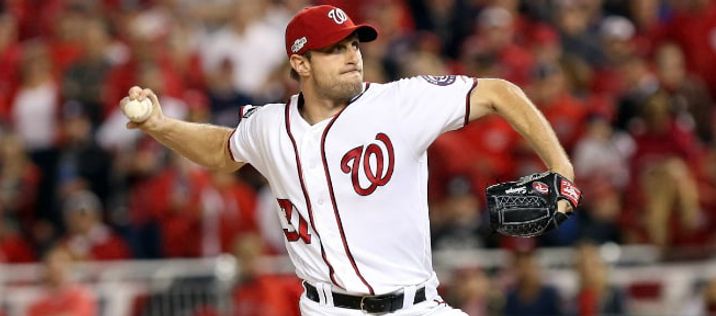
Only three pitchers have a top-20 ADP. Max Scherzer leads the way with an ADP of 6.8, and he’s followed by Chris Sale and Jacob deGrom with an identical ADP of 13.0. Corey Kluber (21.2), Justin Verlander (23.2), and Aaron Nola (25.0) round out the pitchers going in the top 25. Fourteen pitchers (all starters) crack the top 50 in ADP. There are a total of 27 starting pitchers in the top-100 ADP.
Starters also dominate the pitcher landscape in ECR. The top-15 pitchers in ECR are starters before Diaz checks in at 16. Interestingly, three more relievers cracked the top-25 pitchers in ECR. In other words, 21 of the top-25 pitchers in ECR were starters. Looking at starting pitchers relative to all players in ECR, five are in the top 25, 14 are in the top 50, and 23 are in the top 100.
Innings
Getting back to usage, as I noted in the intro, there aren’t many workhorses anymore. Last year, only 13 pitchers eclipsed 200 innings. Scherzer led the way with 220.2 innings. His total bested Sale’s MLB-high total of 214.1 innings in 2017, but each leader from 2010 through 2016 hit at least 230 innings. You have to go back to 2011 to find a pitcher who bested 250 innings. In 2018, 116 pitchers hit the 120-innings threshold. Since 2015, a little under 120 pitchers have hovered around that benchmark. From 2010 through 2014, the total number of pitchers to reach that threshold hovered between a low of 121 and a high of 131. Below, you’ll see a table illustrating various innings benchmarks for each season going back to 2010.
| Year | 250+ | 240+ | 230+ | 220+ | 210+ | 200+ | 170+ | 150+ | 120+ |
| 2018 | 0 | 0 | 0 | 1 | 5 | 13 | 50 | 78 | 116 |
| 2017 | 0 | 0 | 0 | 0 | 2 | 15 | 45 | 75 | 115 |
| 2016 | 0 | 0 | 1 | 6 | 9 | 15 | 64 | 84 | 118 |
| 2015 | 0 | 0 | 2 | 7 | 14 | 28 | 69 | 89 | 119 |
| 2014 | 0 | 2 | 4 | 8 | 17 | 34 | 78 | 102 | 128 |
| 2013 | 0 | 1 | 2 | 6 | 19 | 36 | 76 | 96 | 128 |
| 2012 | 0 | 0 | 3 | 5 | 17 | 31 | 84 | 99 | 121 |
| 2011 | 1 | 2 | 10 | 17 | 26 | 39 | 84 | 107 | 131 |
| 2010 | 1 | 2 | 6 | 15 | 27 | 45 | 88 | 103 | 127 |
Wins
Predictably, a decrease in workhorse pitchers has impacted win totals. In order to avoid including middle relievers with fluky win totals, the following table shows win thresholds for pitchers who’ve pitched a minimum of 120 innings in each season dating back to 2010. The season-high total for wins each year going back to 2010 is included in parentheses next to the season in the table below. There is year-to-year fluctuation, but last year featured the lowest number of pitchers with at least 120 innings and 13-plus wins, and the lowest total of pitchers with at least 120 innings and 12-plus wins.
| Year | 20+ | 19+ | 18+ | 17+ | 16+ | 15+ | 14+ | 13+ | 12+ |
| 2018 (21) | 2 | 3 | 6 | 11 | 14 | 19 | 23 | 29 | 40 |
| 2017 (18) | 0 | 0 | 4 | 9 | 12 | 17 | 25 | 34 | 48 |
| 2016 (22) | 3 | 4 | 7 | 9 | 17 | 23 | 27 | 35 | 44 |
| 2015 (22) | 2 | 5 | 8 | 10 | 11 | 13 | 22 | 34 | 42 |
| 2014 (21) | 3 | 3 | 7 | 9 | 14 | 25 | 36 | 49 | 55 |
| 2013 (21) | 1 | 3 | 4 | 6 | 10 | 16 | 31 | 39 | 49 |
| 2012 (21) | 4 | 5 | 7 | 10 | 21 | 27 | 33 | 44 | 58 |
| 2011 (24) | 3 | 5 | 6 | 8 | 17 | 20 | 27 | 41 | 57 |
| 2010 (21) | 3 | 6 | 9 | 14 | 17 | 24 | 33 | 48 | 62 |
One takeaway from the innings and wins tables is that top-flight pitchers who don’t hit workhorse innings totals shouldn’t be undervalued and evaluated against previous lofty benchmarks. Furthermore, Scherzer is worth his high price tag, and other starters with elite ratios and high innings totals should be valued as the unique fantasy baseball assets they are.
Check out all of our position primers
Subscribe: iTunes | Google Play | SoundCloud | Stitcher | TuneIn
Josh Shepardson is a featured writer at FantasyPros. For more from Josh, check out his archive and follow him @BChad50.