
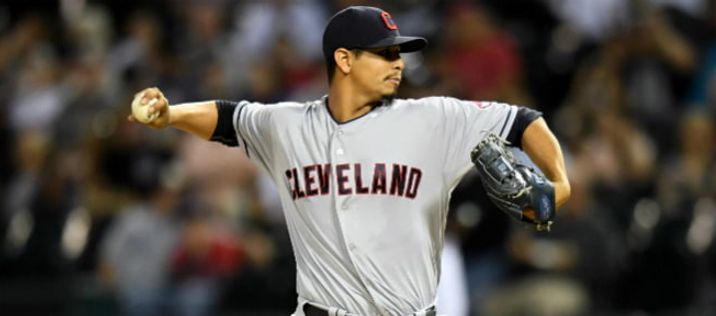
When we take a look at Statcast numbers, certain ones apply to both hitters and pitchers. Barrels, for instance, are used to measure well-hit balls with a great exit velocity and launch angle. Swinging strikes, on the other hand, are more often examined when looking at a pitcher to see how many times he gets the opposition to swing and miss.
When talking about exit velocity, we are typically looking at hitters, but results are also kept for pitchers.
Now that numbers are starting to normalize, it’s a good time to look at some of the top pitcher leaders in exit velocities. Because it is still early in the season, I’m going to set the results to 90 batted-ball events as the qualifier.
Let’s take a look at those who are allowing the hardest exit velocity (measured in mph) on average entering Monday.
Mike Leake – 91.9
Felix Hernandez – 91.7
Tyler Mahle – 91.5
David Hess – 91.3
Patrick Corbin – 91.3
Reynaldo Lopez – 91.2
Homer Bailey – 91.2
Matt Harvey – 91.0
Carlos Carrasco – 90.9
Andrew Cashner – 90.8
Overall, this list looks a lot like you’d think it would, with a lot of not-so-good pitchers on it. However, names like Corbin, Carrasco, and even Mahle — who was worst before Sunday’s start — are surprising.
So, what are they doing to counter the hard-hit balls?
Before we take a look at their current doings this year, let’s see how their present numbers compare to their 2018 results.
2018 Mahle – 88.4
2018 Corbin – 88.0
2018 Carrasco – 89.1
All are higher this year, which could be a product of early numbers not quite setting yet.
While Mahle is allowing a lot of hard-hit balls, he also has a higher ground-ball rate, which helps suppress them. Also working in his favor is his 28.8 percent fly-ball rate, which is the 15th-best mark in baseball. There’s a lot to like about Mahle’s peripherals, so I’m not worried about his high exit velocity
Carrasco has been hurt by the fly ball, allowing eight home runs already this year, and his fly-ball rate is the sixth-highest in baseball at 47.1 percent. But his season-long line is a little skewed with his 4.91 ERA. He’s actually sixth in baseball with the highest ERA/FIP differential at 1.41. Carrasco is striking guys out at a 33.3 percent clip, which is MLB’s fourth-best mark, and he’s been BABIP’d to death all season with his fifth-ranking .354.
He’s allowing a lot of hard contact, and it’s just finding all of the holes right now. Better days are ahead.
Lastly, before getting to those not allowing a high exit velocity, let’s look at Corbin. Like Carrasco, he has a high fly-ball percentage at 40.3, which is the 23rd highest in baseball. To go along with this bloated mark, he has a high ground-ball rate, too. Corbin is building off of last year’s breakout, so there’s nothing really to write home about with his high number of hard-hit balls. On the year, he’s tied with Aaron Sanchez and Masahiro Tanaka for the ninth-most balls hit 95-mph or harder with 63.
So we’ve seen that seven of the 10 pitchers allowing the highest exit velocity have, for the most part, struggled from a fantasy perspective this year. What about those suppressing hard contact?
Kenta Maeda – 83.9
Joey Lucchesi – 84.4
Luis Castillo – 84.7
Charlie Morton – 84.9
Kevin Gausman – 84.9
Sandy Alcantara – 85.1
Caleb Smith – 85.3
Jose Berrios – 85.4
CC Sabathia – 85.5
Jhoulys Chacin – 85.7
So, this list is all over the place. We see some burgeoning aces (Castillo, Berrios, Smith), some reliable pitchers year over year (Morton, Maeda), pitchers we can’t quite figure out (Lucchesi, Alcantara), and pitchers who have hurt us too many times to count (Sabathia, Chacin, Gausman).
Like the last list, let’s look at the guys who have stood out as great fantasy options this year to see what kind of leaps they have made.
2018 Castillo – 88.1
2018 Smith – 87.0
2018 Berrios – 86.1
All three have seen a decrease in their allowed exit velocity to various degrees. All three are also in the top six in baseball in strand rate (LOB%).
What else are the three knocking-on-the-door aces doing differently?
For Castillo, he has seen a major boost in strikeout percentage up to 31.8 from 23.3 last year, but that’s also come with more walks. The biggest difference is that he is now more of a ground-ball than fly-ball pitcher, as he has a 59.3 ground-ball rate compared to a 26.3 fly-ball rate this year.
There’s a lot to love about what Smith is doing this year, including an increase in strikeouts, decrease in walks, and gains in soft contact and ground balls. His 2018 season was cut short due to injury, and he was overlooked in a sneaky-good Miami rotation to start the season.
He’s not overlooked anymore, as he’s been one of the better surprises of the season.
As for Berrios, I had him as my 30th-ranked pitcher heading into the season, realizing the potential he has to make that ace leap. The only issue is, for the past two years, we’ve been treating him like an ace. We’ve seen the ace-type flashes, but when he went on a great three-start run, he would then put together a string of dreadful starts.
One overlooked aspect of his value was that he is pitching in a horrible division, which lifts his worth.
His season has been great, but it has also been weird. He’s striking out fewer batters and has also seen a rise in fly-ball percentage and hard-hit rate. He’s been throwing his changeup more this year, too, which he worked on with Johan Santana in the offseason. The results have been good so far, as it’s actually graded as his best putaway pitch (26.7 percent) and has generated the highest percentage of whiffs (29.7 percent) among his offerings.
Given his schedule of opponents faced, Berrios is likely to be a top-10 pitcher by the end of the year by default. I’m not ready to consider him a true ace yet, but he’s getting there.
Import your team to My Playbook for instant Waiver Wire advice 
Subscribe: Apple Podcasts | Google Play | SoundCloud | Stitcher | TuneIn
Michael Waterloo is a featured writer at FantasyPros. For more from Michael, check out his archive and follow him @MichaelWaterloo.


