The dust has settled from Rounds 2 & 3, but there is still one day of the 2022 NFL Draft ahead! Rounds 4-7 always provide a few diamonds in the rough, especially at the running back position. Fantasy football fans rejoice!
Let’s look at the top rookie 2022 NFL Draft prospects remaining on Day 3.
Round 1 and Day 2 winners and losers 

Running Backs
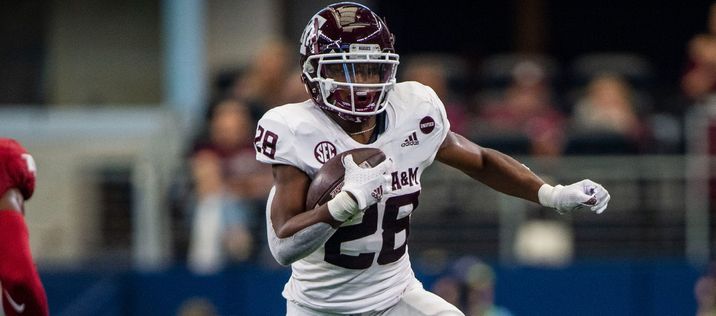
Isaiah Spiller (RB – Texas A&M)
Age-adjusted production is a critical metric for dynasty managers, and no running back is better than Isaiah Spiller. Since Day 1 at Texas A&M, Spiller has been the lead dog for the Aggies. As a true freshman in 2019, he scored 10 rushing touchdowns and finished 16th in the nation in yards after contact per attempt en route to a 22% dominator rating.
The power running back capped off his first year impressively with back-to-back seasons of 1,000 rushing yards and 100 missed tackles. Spiller also displayed receiving prowess, commanding at least an 8% target share and an average of 25 receptions per season.
With an all-encompassing skill set and desirable size – 6-feet and 217 pounds – Spiller should be a solid producer at the next level, although his lack of top-notch speed could keep him from being elite. He had only eight carries of 20-plus yards in 2021.
The testing numbers at the NFL combine also did no favors to his draft stock. He elected not to run the 40-yard dash on Indy’s fast track and laid an egg in the jumping drills. The 7th percentile vertical jump and 22nd percentile broad jump will make it more challenging for him to demand high Day 2 draft capital.
Spiller reportedly went through drills with an injury, explaining the poor showing. Either way, he will get an opportunity to boost his numbers at Texas A&M’s pro day on March 22nd.
Spiller tested below average at the pro day with a 4.27-second short shuttle, 4.63 40-yard dash, 33-inch vertical, and a 9-foot-6 broad jump, rating in the 62nd, 44th, 42nd, and 34th percentiles, respectively. Not ideal for his long-term outlook that he possesses underwhelming athleticism.
There’s no doubt Spiller’s poor testing contributed to his fall into Day 3.
Dameon Pierce (RB – Florida)
Dameon Pierce took the title as PFF’s highest-graded running back in the FBS (92.0) despite seeing just 100 carries. The senior’s 39% missed tackle rate ranked second among the 2022 draft class.
However, Pierce never entirely took over Florida’s backfield does raise red flags. His 12% career dominator rating is eerily similar to Trey Sermon‘s (12%) from last season, and Sermon struggled to separate himself from the pack in his rookie campaign.
During his breakout senior season, the 5-foot-10 and 218-pound running back earned just a 22% dominator rating while sharing the backfield alongside fellow draft-eligible running back Malik Davis.
However, I am willing to offer some benefit of the doubt after Pierce never topped 106 carries in college. There may have been some underlying issue with former Gators head coach Dan Mullen that prevented Pierce from seeing a more featured role. Case in point: Pierce only had two games with double-digit carries in 2021, both of which came after Mullen was fired toward the end of the season.
Pierce’s lackluster dominator rating doesn’t capture his coach’s potential ineptitude. Pierce competed with NFL talents like Jordan Scarlett and La’Mical Perine very early in his college career, painting a better picture of how his impact will be felt in years to come.
His running style and body type resemble Patriots running back Damien Harris.
Zamir White (RB – UGA)
Zamir White runs with strong intent and decisiveness at the line of scrimmage. He knows where to go and how to hit the hole. Solid explosiveness and burst; constantly get yardage after first contact. Elusive in space as a receiver.
The Georgia Bulldog is built like a three-down back at 6-feet and 214 pounds. Great testing measurables from the NFL Combine: 4.40 40-yard dash (93rd percentile) and 128? in the broad jump (94th percentile).
White’s overall counting stats are not particularly great, but he split work with James Cook and Kenny McIntosh, as many Georgia backs often do. What matters more is White’s career three yards per snap – a mark that stacks up with the likes of Michael Carter from last year’s draft class.
As PFF’s third-highest graded running back in the SEC last season, White is in solid contention to earn Round 4 capital.
NFL comp: Lamar Miller
Pierre Strong Jr. (RB – South Dakota State)
For any small-school running back to make a living in the NFL, they need to dominate their competition in college. That’s what gives South Dakota State’s Pierre Strong Jr. a chance to make a splash at the next level.
Strong finished with a top-10 career and single-season dominator rating while grading out as PFF’s highest rusher (95.6). His 3.3 yards per play also ranks second among running backs in his class, which is an excellent indicator of future success. Last year’s late-round standouts in that category included Elijah Mitchell and Rhamondre Stevenson.
The 5-foot-11 and 207-pound back also blazed a 4.37 40-yard dash (95th percentile), tying him with Rutgers’ Isiah Pacheco for the fastest running back time.
Strong jumped 36? in the vertical (71st percentile) and 124? in the broad jump (84th percentile).
Strong’s “strong” outing will boost his draft stock for both the real-life NFL and fantasy rookie drafts. High-end college RB producers who display above-average athleticism tend to hit the next level.
The South Dakota State running back gives off strong Darren McFadden vibes (in a good way).
Tyler Allgeier (RB – BYU)
Tyler Allgeier has been a monster over the past two seasons, ranking first in rushing yards after contact (1,847), second in rushing touchdowns (36), and third in PFF rushing grade (94.8) among FBS players with at least 150 carries.
The high-end production helped the BYU running back post a 28% dominator rating since the start of 2020, capped off by an astounding 36% rating in his final season with the Cougars. That mark is the class’s best “true” single-season dominator rating.
Allgeier credits a lot of his backfield success to his experience playing linebacker, a trait that definitely aided Javonte Williams in his progression as an NFL running back.
Allgeier also displayed an ability to overcome adversity in 2021 after the team lost so many key components – from future New York Jets quarterback Zach Wilson to the entire starting offensive line. That hardly slowed down the former walk-on, though, as he finished sixth in his class in yards after contact per attempt (4.16) and first in touchdowns (23).
He also set career highs in receptions (32) and target share (8%).
Although my concerns with Allgeier were realized by his lack of explosiveness in the testing drills. 4.60 40-yard dash (42nd percentile) and sub-65th percentile jumps don’t suggest he will be blowing past NFL defenders. He will have to win by embracing contact, which could shorten his shelf life as a runner.
My NFL comp for Allgeier is James Conner, who fantasy players know has dealt with a flurry of injuries due to his physical style of play.

Quarterbacks
Sam Howell (QB – UNC)
Sam Howell earned the starting quarterback job at North Carolina as a 19-year-old true freshman and never looked back. He finished fourth in the FBS with 38 touchdown passes in his first season, cementing himself on the NFL radar.
He followed up an impressive introduction with an even more dominant performance as a passer in 2020, finishing as the nation’s sixth-highest-graded quarterback (92.3) and fourth-best deep passer (98.0) in an offense littered with future NFL talent.
Unsurprisingly, Howell took a bit of a step back in his final season without the likes of Javonte Williams, Michael Carter, Dyami Brown, and Dazz Newsome at his disposal. The UNC product was PFF’s 37th-graded passer (80.3) – 15th among his 2022 draft class.
Howell turned up the dial on his rushing production to compensate for the lack of passing efficiency. After posting just 600 yards on the ground through two seasons, Howell rushed for 1,106 yards as PFF’s second-highest-graded rusher (91.0) in 2021.
Howell was looking to create yards with his legs if the first read wasn’t there. This presents problems for the real-life NFL but shouldn’t be considered negatively for fantasy.
Howell’s escapability lends itself to rushing success at the NFL level if he doesn’t have a lot of talent around him. Conversely, his first two years of college show he will take full advantage when he does have weapons around him.
It’s hard to label Howell as a “situation-proof” quarterback – a rookie quarterback’s team context plays an integral part in their growth – but it’s hard to overlook his versatility as far as how he can rack up fantasy points based on which team selects him.
Carson Strong (QB – Nevada)
The Nevada Wolfpack put a lot on Carson Strong’s plate in 2021, as the redshirt junior attempted 523 passes after never having cracked 400 in the two years prior. Still, Strong did not falter, finishing with a career-high 89.9 PFF passing grade and 36 passing touchdowns. The Wolfpack QB also ranked fourth in PFF passing grade from a clean pocket (93.2).
Strong is your typical strong-armed pocket passer who can make all throws on the field, but he’s a statue in the pocket – his 8.3 rushing yards per game is by far the lowest mark in a quarterback class filled with guys who can create value with their legs.

Defensive Line
Kingsley Enagbare (Edge – South Carolina)
Only two edge players – Aidan Hutchinson and Nik Bonitto – earned a higher PFF pass-rush grade than Kingsley Enagbare in 2021. The South Carolina product’s pressure didn’t necessarily translate to many sacks (4). Still, his ability to win one-one matchups – third-highest ranked pressure win % – suggests he has a pass-rush ceiling at the next level.
Especially considering he has been a top-tier rusher in the SEC for the past two seasons.
Perrion Winfrey (DT – Oklahoma)
Don’t be fooled by Perrion Winfrey’s defensive tackle designation. At 290 pounds – 13th percentile – he is not a run-stuffing space eater that will stop the run game. However, he can wreak havoc on the interior versus slower guards.
Winfrey finished with the 13th-best PFF pass-rush grade among his 2022 draft class.
He also ran a 4.89 40-yard dash at the NFL Combine – 90th percentile.
Eyioma Uwazurike (DT – Iowa State)
Eyioma Uwazurike is the exact name you want to hear your favorite team draft late on Day 2 or early in Round 3. The Iowa State defensive tackle is a 6-foot-6 316-pound disruptor that can play anywhere across the defensive line.
He finished second in the defensive tackle class in both pressure share (17%) and sacks per game (0.7), trailing only Texas A&M’s DeMarvin Leal. But keep in mind that Leal weighs almost 30 pounds less than Uwazurike.
Uwazurike is a big man that creates havoc, evidenced by his aforementioned pressure stats and his No. 1 62% forced bounce rate – a metric provided by Sports Info Solutions that captures the percentage of runs in the defender’s direction that didn’t go through the designed gap.
Thomas Booker (DT – Stanford)
Thomas Booker has an athletic profile, as demonstrated by his NFL Combine testing. He was 80th percentile or better in the 40-yard dash, three-cone and 20-yard shuttle, capturing the attention of the NFL coaching staffs.
He also led the FBS in tackles and ranked sixth in run stops among his 2022 classmates.
Offensive Line
Daniel Faalele (OT – Minnesota)
It’s only a matter of time before Daniel Faalele coins the nickname “Monster from Minnesota.” The Golden Gopher offensive tackle weighs 384 pounds and measures a towering 6-foot-8. He’s the “immovable object” meeting the “unstoppable force” John Madden preached about.
The traits are there for Faalele to be a franchise tackle in the NFL, but it might take some seasoning. After all, he’s only been playing football since 2016 after spending most of his life in Australia.
But the progression and growth Faalele has displayed – improved PFF blocking grade all three years at school – suggests he is just scratching the surface of his potential. Also, with his limited playing experience, Faalele is best suited to continue playing at right tackle to start as he did at the college level.
Darian Kinnard (OL – Kentucky)
It’s tough to find another tackle that has been as solid as Darian Kinnard has been over the past three seasons. In 2019, the Wildcat offensive tackle graded top-10 per PFF at the position, and he would follow that up with back-to-back top-5 grades the last two seasons.
Kinnard’s aggressive run-blocking will put teams on notice with three straight top-11 finishes since 2019 among all offensive linemen in the FBS.
He will likely move full-time inside to guard at the next level.
Jamaree Salyer (OL – Georgia)
Jamaree Salyer allowed just four pressures on 577 snaps in 2021, cementing his status as the most efficient tackle in the Power 5 on a per-snap basis. With experience playing every position on the offensive line, Salyer’s versatility will be highly coveted by the Bengals.
Rasheed Walker (OT – Penn State)
The Penn State product adds depth as a swing tackle with plus athleticism. Injuries derailed his tape during his last season and prevented him from testing at the combine.
Max Mitchell (OT – LA-Lafayette)
Right tackle Max Mitchell was PFF’s highest-graded tackle in 2021 due to his impressive No.1-ranked grade as a run-blocker (95.0). He’s a bit on the smaller size – 34th percentile weight at 307 pounds – so it’s possible an NFL team kicks him inside to guard.
The former Ragin’ Cajun is a great addition for any team looking for depth on their offensive line in a zone running scheme
Zach Tom (OL – Wake Forest)
Left tackle Zach Tom posted the lowest blown pass-block percentage (0.7%) last year despite 633 pass-blocking snaps.
Marquis Hayes (OL – Oklahoma)
The Sooner’s 0.8% blown-block percentage (per Sports Info Solutions) is the third-best mark in the class.
Kellen Diesch (OL – Arizona St.)
It took Kellen Diesch some time – six college seasons – to show NFL scouts what he could achieve at the tackle position. The Arizona State offensive lineman finished as PFF’s third-highest graded pass-blocker in the FBS.
Equipped with an elite athletic profile – 97th percentile 40-yard dash, 95th percentile short shuttle – and enormous size at 6-foot-7, Diesch is the prototypical swing tackle. Not likely a long-term answer at his position because of how skinny he is at 301 pounds, but good enough to carve out a long career as a depth piece.
Dohnovan West (OL – Arizona St.)
Dohnovan West has started at Arizona State since he first stepped on campus back in 2019, starting at right guard, left guard and center over his three-year career. At just 21 years old come draft day, West has the potential to be a long-term starter across the interior offensive line with him best suited at the center position.
He allowed zero QB hits in 2021 as the Sun Devils starting center.
Linebacker
Brandon Smith (LB – PENN)
Brandon Smith earned a bottom-20 PFF grade in run defense in 2021 but a top-10 grade in coverage among his draft-eligible classmates.
He needs some fine-tuning, but he possesses the requisite athleticism that will allow him to be a gliding force all over the field. The Penn State product has scary speed and burst at his 6-foot-3 and 250-pound size.
Darrian Beavers (LB – Cincinnati)
Linebacker Kwon Alexander remains unsigned, opening up the possibility that New Orleans drafts a linebacker. Darrian Beavers earned a top-10 PFF pass-rush grade in 2021.
Damone Clark (LB – LSU)
Damone Clark has undergone spinal fusion surgery after an MRI at the combine revealed a herniated disk. He will miss his entire rookie season, but will make a full recovery.
When healthy he is a disruptor. His 32% pressure rate and tackles per game (11.6) both ranked first in the class in 2021.
Wide Receiver
Calvin Austin III (WR – Memphis)
A 4.32 40-yard dash (96th percentile) combined with a 135-inch broad jump is quite the showing. That’s what Calvin Austin put on display at the NFL scouting combine. The mark is the best broad jump ever at the Combine by someone 5’8? or smaller, per NFL Network research ace @FrontOfficeNFL.
Considering he was already a draft riser after a strong performance at the Reese’s Senior Bowl, the Memphis product is staking his claim as a Day 2 selection. Just be wary that his size at 5-foot-8 (1st percentile) and 170 pounds (2nd percentile) will limit his fantasy ceiling, despite the elite athleticism. His closest player comps per MockDraftable.com like Marquise Goodwin (WR – CHI) and D’Wayne Eskridge (WR – SEA) leave a lot to be desired.
If his fantasy draft stock grows exponentially, he’s probably going to be a strong fade in rookie dynasty drafts.
Khalil Shakir (WR – Boise State)
Khalil Shakir’s electric Boise State career hit its peak during his 2020 season when he cultivated a whopping 46% dominator score – the second-highest single-season rating among the 2022 Draft Class. He finished that year as PFF’s ninth-graded WR (88.8), averaging over 100 receiving yards and 7.4 catches per game.
Shakir’s junior season was a strong follow-up to his 2019 breakout sophomore campaign when he hung a 22% dominator rating at age 19.
The Boise State slot wide receiver would end his college career on a high note as PFF’s third-highest-graded wide receiver (92.9) among his draft class.
As a strong favorite to etch out a role working inside for an NFL offense, Shakir could emerge as a Russell Gage-esque receiver that works well in fantasy PPR scoring.
Justyn Ross (WR – Clemson)
Justyn Ross looked the part of college football’s next superstar after a breakout freshman season. At 18 years old, Ross led the Clemson Tigers in receiving yards despite playing alongside older teammates Tee Higgins, Amari Rodgers and Hunter Renfrow, who were future pros. He was PFF’s second-highest-graded WR in his first season (91.2).
The 6-foot-4 and 205-pound wideout followed up with an impressive sophomore campaign, leading the team in receptions (66) as Trevor Lawrence‘s (QB – JAC) most heavily targeted receiver.
Ross was well on his way to being a locked-and-loaded Round 1 selection for the 2021 NFL Draft, but a rare condition affecting his neck and spine forced him to miss the entire 2020 season.
He came back in 2021 to show that he was fully healthy, but an anemic Clemson offense that ranked 87th in PFF’s grading torpedoed his numbers. Only 64% of his targets were deemed catchable, which ranked in the 28th percentile.
If Ross can recapture his playmaking ability from 2018, he will be a steal for a team on Day 2.
He’s an underrated route runner at his size but not a contested-catch fiend. It reminds me a lot of Corey Davis because Ross is not particularly explosive.
Cornerback
Coby Bryant (CB – CIN)
With a name like Coby Bryant, you are bound to be battle-tested. The Bearcats cornerback saw plenty of targets come his way over his four-year college career (270), with 75 coming this past season.
But give Bryant credit for showing up when teams “tried” to pick on him with Ahmad Gardner locking down the other side of the field. His PFF coverage grade ranked 8th (85.0) – just one spot behind Gardner.
Obviously, Bryant was facing the team’s inferior receivers more often. But it at least showed he could be a solid No. 2 cornerback option for an NFL team with a No. 1 already entrenched.
His well-rounded skill set – top-12 run defense and tackle grade – awards Bryant the “jack of all trades, master of none” mantra among his cornerback class.
Tariq Woolen (CB – UTSA)
Tariq Woolen will command decent draft capital because of his elite speed, not his college tape.
The UTSA Roadrunner amassed a 4.26 40-yard dash (99th percentile) at the NFL combine, and that’s a speed that coaches cannot teach. Woolen is currently raw as a cornerback but boasts sky-high upside with his unmatched speed.
Jalyn Armour-Davis (CB – Alabama)
JAD gained plenty of experience playing press coverage in 2021 and possesses the tools to become a perimeter starter at the next level. He allowed just a 52.3 passer rating when targeted – ninth-best in his class among CBs with at least 300 coverage snaps.
Injuries have been a concern, but that matters not to the Falcons, who aren’t looking to win games in 2023.
Joshua Williams (CB – Fayetteville State)
Cornerback Joshua Williams’ 91st percentile arm length checks the box for what many NFL GMs covet at the position.
Chase Lucas (CB – Arizona St.)
Chase Lucas projects as a potential starting slot cornerback after playing 34% of his snaps there in 2021. He was also just one of 11 CBs in his class (minimum 300 coverage snaps) to not allow a TD in coverage in 2021.
Tight End
Charlie Kolar (TE – Iowa State)
You’ll be hard-pressed to find a tight end who was more consistent than Charlie Kolar over the last three college seasons. The Iowa State product owns a 24% dominator rating over that span and PFF’s fifth-best receiving grade (93.1) among tight ends.
Kolar’s 24th-ranked 2.13 yards per route run and 158 receptions – tied with McBride for the most among all college tight ends – highlight a receiving prowess that should make him a fantasy factor in the NFL. Kolar’s massive frame will help him carve out a role as a red-zone threat.
Isaiah Likely (TE – Coastal Carolina)
Turn on any Coastal Carolina game over the last four years, and you’re likely to see a tight end haul in a touchdown. Isaiah Likely hauled in 27 receiving touchdowns since 2018 – more than any other tight end in college football.
Likely’s nose for the end zone fueled his 24% career dominator rating – the highest in the class and a mark matched only by Pat Freiermuth from 2021’s tight end class.
Touchdown equity is not the only part of his profile that is alluring. He’s not just falling in the end zone. He’s a terrific wide receiver playing tight end, as evidenced by his 95.2 PFF receiving grade (third), 1,513 receiving yards (first), and 2.87 yards per route run (sixth) since 2020.
Only McBride and Kyle Pitts have a higher PFF receiving grade over that span.
At 6-foot-4 and 245 pounds, Likely fits the archetype as a pass-catching tight end at the next level – which is exactly what fantasy footballers should gravitate toward. It’s rare to find tight ends who come into the league with this kind of receiving profile and mismatch potential against slower linebackers/safeties.
However, be wary that his tweener size does create some inherent risk if he ends up on a team that doesn’t know how to use him properly. He is too small to be a legitimate in-line tight end but too big to be a traditional wideout-the essence of Julius Thomas and Ricky Seals-Jones.
Likely also won’t be much of a factor in the blocking game unless he puts on substantial weight. If that does happen, be confident that Likely can fill an every-down tight end role after finishing in the 91st percentile in a positively graded run-blocking rate in 2021.
Subscribe: Apple Podcasts | Spotify | Google Podcasts | Stitcher | SoundCloud | iHeartRadio
If you want to dive deeper into fantasy football, be sure to check out our award-winning slate of Fantasy Football Tools as you navigate your season. From our Start/Sit Assistant – which provides your optimal lineup based on accurate consensus projections – to our Trade Analyzer – which allows you to instantly find out if a trade offer benefits you or your opponent – we’ve got you covered this fantasy football season.