I’m well aware that the term “safe” is subjective and might mean different things to different people. To me, a “safe” fantasy football player is someone I don’t have to worry about putting into my lineup. Yes, injuries happen, and no, not every safe player is going to single-handedly win me my week. That said, safe players tend to have a higher floor and can sometimes still be the difference between winning and losing a matchup.
Obviously, the top-ranked players are much safer than the lowered-ranked ones, and where’s the fun in that? To avoid any obvious choices, I will pick players typically considered bench options. These are players ranked outside the top 12 or 24 at their position in the Expert Consensus Rankings (ECR) on FantasyPros. This means that you can probably get them later in your draft to add some balance to your team.
Now that we’re all on the same page, here are my seven safest players you can draft this year.
Beyond our fantasy football content, be sure to check out our award-winning slate of Fantasy Football Tools as you prepare for your draft this season. From our free mock Draft Simulator – which allows you to mock draft against realistic opponents – to our Draft Assistant – that optimizes your picks with expert advice – we’ve got you covered this fantasy football draft season.

Kirk Cousins (QB – MIN) – ECR: QB14
If you look up “safe” in the dictionary, you should see a picture of Kirk Cousins. He’s a consistent performer and a terrific QB2 in all formats, including SuperFlex. Cousins is like that warm blanket you curl up with to watch a movie, but you leave it on the couch when it’s time for bed. He’s good but not great, and pretty much everyone knows it. But that’s okay. It has a purpose and is vital to enjoying your time on the couch.
Cousins finished with 300 fantasy points last year, good enough for QB11 overall, yet he’s being drafted as a backup in most leagues this year. He’s scored over 17.4 fantasy points per game every season since 2015 when he played for Washington, except for 2019 when he missed a game. That was also before the team drafted Justin Jefferson, and we all saw how well that went. Ah, I love a consistent QB2 like a warm blanket, so I love me some Cousins. He’s as safe as they get.
Kareem Hunt (RB – CLE) – ECR: RB28
Past the top 24 running backs, things get pretty bleak in terms of safety. However, one of my favorite bench players is Kareem Hunt, who is ranked at RB28 in ECR. He’s technically being drafted as a bench player, but he’s still one of the best at what he does. He has scored 13.8, 13.7, and 12.7 PPR points per game in his three years with Cleveland, even though in two of those years, he missed significant time due to injury.
All of that is exactly what I’m looking for if I take a “Zero RB” approach and am looking for starting RBs in those middle rounds. If Hunt gets cut or traded, he might even land somewhere else, which could only help his stock. If he stays in Cleveland, he’s still got a great floor as the pass-catching back in an offense looking for a direction. He’s worth the shot if you’re looking for a high floor and safer option in your draft.
Tony Pollard (RB – DAL) – ECR: RB30
Pollard is a lot like Hunt in that he’s a backup on his team but could easily be the starter if things go the right way. His rank of RB30 feels a little low to me right now since we’ve seen his talent and Ezekiel Elliott‘s inability to stay healthy in years past. Even if Elliott stays healthy, Pollard should see plenty of touches of his own this year.
Unlike Hunt, Pollard doesn’t really have the history to back up his spot on this list. He scored a meager 10.4 PPR points per game last season, which is admirable, but it’s not something you want to rely on in your lineup. So I’m choosing to look ahead rather than the past here, and I think Pollard is trending upward. He’s had 86, then 101, then 130 carries in his three years so far in Dallas. If that trend continues, he’s looking at about 160 carries this season, and that’s a damn good floor to me.
Amon-Ra St. Brown (WR – DET) – ECR: WR27
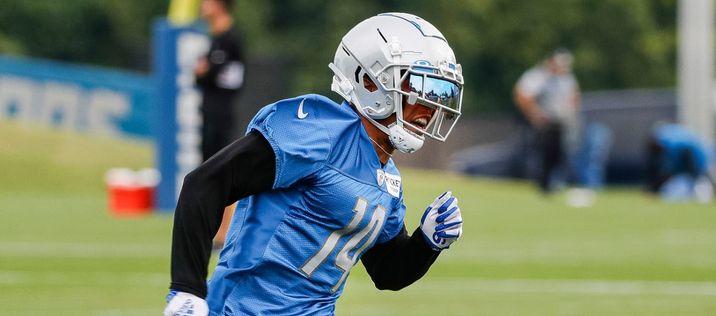
Putting a second-year player on a “safe list” is a little risky but hear me out. St. Brown played well as a rookie on an offense that relied on him a lot. He played in all 17 games and scored an above-average 13.4 PPR points per game. This was enough to put St. Brown at WR21 at the end of the year, meaning you were probably very happy to start him most weeks.
The offense is essentially the same this year but should look even better. Love him or hate him, QB Jared Goff is back, as well as stud RB D’Andre Swift and top TE TJ Hockenson. St. Brown should have no problem adjusting to these familiar surroundings and should take significant steps forward as a player this season. Rookie WR Jameson Williams is already said to be starting the season on the PUP list, giving St. Brown even more targets out of the gate. I think he’ll easily outperform last year’s numbers, making his ECR of WR27 a terrific value for any team looking to add some stability to their lineup in those middle rounds.
Adam Thielen (WR – MIN) – ECR: WR34
Like his teammate mentioned earlier, Thielen almost defines the term “safe” here. Over his 118 games in the NFL, Thielen scored 11.6 PPR points per game. He’s surpassed that in five of the last six years, meaning his average has only been going up. Last year’s 15.4 PPR points per game in 13 games was pretty good, but his 10 touchdowns are what propelled him to a WR28 finish on the year. Of course, it’s hard to predict touchdowns, so I won’t try, but Thielen and Cousins clearly have a connection.
All of that alone is enough to make me feel safe about drafting Thielen, but there’s one more giant piece that was added to the puzzle. The Vikings hired former Rams offensive coordinator Kevin O’Connell to lead their offense this year. Both the Lions and the Rams opted to throw on around 59% of their offensive plays last year, but O’Connell was much more aggressive in Los Angeles than the Vikings were. I fully expect Cousins, Jefferson, Dalvin Cook and Thielen to all put up bigger numbers this year than last year under this new scheme. So if Thielen was safe last year, he’s even safer this year at WR34 in ECR. And somehow, he’s going even later in drafts; make it make sense.
Robert Woods (WR – TEN) – ECR: WR43
Woods is the last wide receiver on my list, but he’s also the presumptive WR1 in Tennessee. Remember what I just said about how aggressive the Rams were last year? Woods was the beneficiary of that. In his five years with the team, Woods has scored over 13.6 PPR points per game in each season. He was the focal point of the Rams’ passing attack until he got hurt, and they unleashed Cooper Kupp last year. Heading into 2021, fantasy managers were flipping a coin between the two. Now Kupp is WR1, and Woods is WR43. How’d that happen?
Well, the situations changed significantly for both, duh. Woods tore his ACL in Week 9, and Kupp went on to play in the Super Bowl. Woods was then sent packing for a sixth-round draft pick this off-season. That’s not exactly a high return, but it doesn’t mean Woods is toast either. He’s on a Titans team that will need to lean on him. Rookie WR Treylon Burks is struggling to adapt to the speed of the NFL so far, leaving Woods as Ryan Tannehill‘s likely favorite option. It’s entirely possible that Woods finishes the year with another season of 13+ PPR points in weekly production on his stat sheet. Even though he’s coming off a bad injury, Woods’ situation and opportunity should help him score fantasy points in your lineup. He’s relatively low risk but also high reward. That screams safe to me.
Noah Fant (TE – SEA) – ECR: TE15
At tight end, I have to be honest; it’s ugly out there. The only safe players are those at the top. Once you get to TE5 or TE6, it falls off a cliff. That being said, I think Fant could be one of the few tight ends outside the top 12 to see a big uptick in his value from draft season to fantasy finals.
Fant finished as TE12 last year with the Broncos, scoring an average of 9.9 PPR points per game. He scored 10 points per game in 2020. Even though it’s only two years, that’s the kind of consistency I like to see, especially at the tight end position. He’s on a new offense with a lot of question marks, so calling him safe feels risky, pun intended. However, given the tight end landscape, I think he’s one of the few TE2 options who could become an every-week starter for your team. In tight end premium formats, he’s definitely worth a stash if you’re streaming the position or just miss out on those top guys. I doubt he’s TE1 overall, but he could easily finish as TE10, which isn’t bad given his draft cost.

If you want to dive deeper into fantasy football, be sure to check out our award-winning slate of Fantasy Football Tools as you navigate your season. From our Start/Sit Assistant – which provides your optimal lineup based on accurate consensus projections – to our Trade Analyzer – which allows you to instantly find out if a trade offer benefits you or your opponent – we’ve got you covered this fantasy football season.
Andrew Hall is a featured writer for FantasyPros. For more from Andrew, check out his profile and follow him @AndrewHallFF.