Hello and welcome to the Week 11 edition of Hoppen to Conclusions! This is where I, Sam Hoppen, will share some of my favorite charts, which are designed to give you an overview of the NFL landscape. These charts, along with the commentary that I provide, aim to help you make start or sit, DFS lineup construction, betting picks, or any other fantasy football decisions. There can be a lot of noise in fantasy football analysis, but these charts have been carefully selected to give you some of the most relevant and useful decision points.
- Waiver Wire Advice
- Weekly Fantasy Football Expert Rankings
- Fantasy Football Start/Sit Advice
- Fantasy Football Trade Tools
Each of the charts has been designed in a way that you want to target players and teams that are in the top-right quadrant of the chart as denoted by the dotted black lines, which signify the median value for the stat on either the x-axis or y-axis. You’ll notice that I’ve added a second chart to each section. This is the same chart that you’re used to seeing for each section, but looking purely at the last four weeks. As we move through the season, the more recent weeks should hold more weight so this will give you a snapshot of more recent usage and trends! Before getting to each of the charts and analyses, here are some brief descriptions of what you will find on each chart and how to interpret them.
- Team Pace and Plays: Compares a team’s average plays per game to its pace over expected, using seconds per play as a measure of pace. On the chart, the y-axis flipped to show faster-paced teams (running plays faster than expected) on top. Simply put, teams (and overall matchups) with more plays and faster pace will offer more opportunities for fantasy point-scoring.
- Team Pass Rates: Compares a team’s pass rate over expectation (PROE) to its red-zone pass rate. Here we can identify which teams are passing the most when game script isn’t a deciding factor and when they get close to the goal line.
- Running Back Usage: Compares rushing expected fantasy points per game to his receiving expected fantasy points per game, with the size of the player’s point as his snap percentage. I use expected fantasy points as a measure of one’s workload in that specific area of the game, so it can help us discern which players are getting strong rushing or receiving workloads.
- Wide Receiver & Tight End Usage: Compares player weighted opportunity rating (WOPR) to his yards per route run (YPRR), with the size of the player’s point as his routes run rate (as a percent of the team’s dropbacks). WOPR weighs both air yards share and target share to evaluate a player’s opportunity, while yards per route run is a measure of one’s efficiency with the routes (and targets) he’s given. The charts show the same information for both the wide receiver and tight end position.

Fantasy Football Trends & Takeaways
Team Pace and Plays
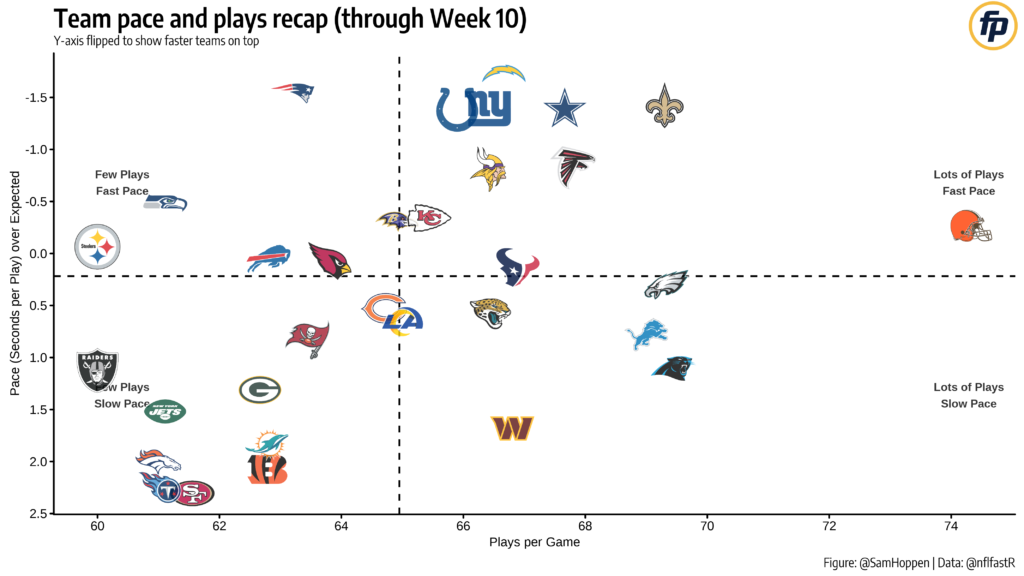
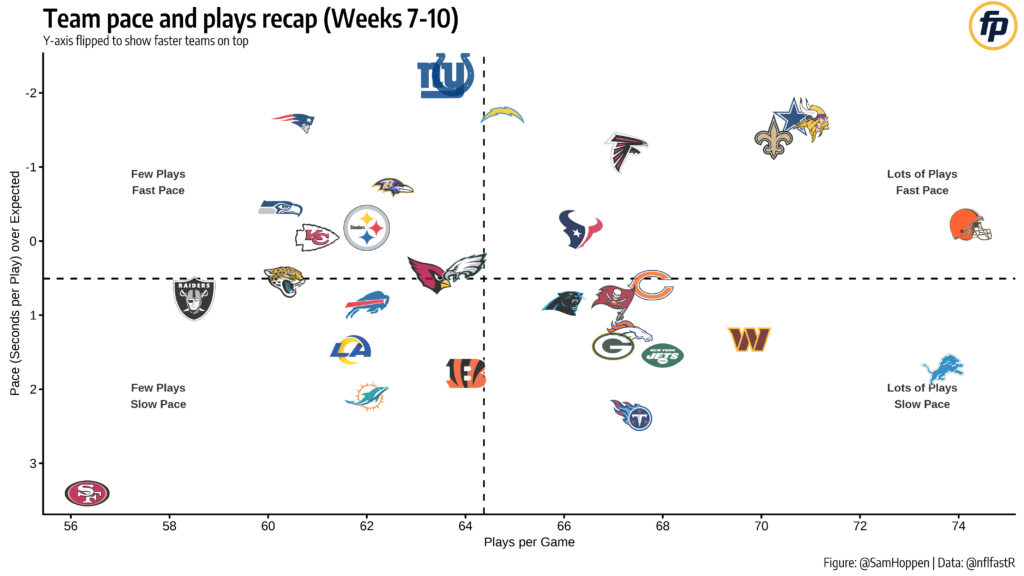
- This week features a bevy of inter-divisional matchups, including the Jacksonville Jaguars hosting the Tennessee Titans, which figures to be a grueling slog of two plodding teams. Both Jacksonville and Tennesse have been taking their sweet old time running plays, as they both rank in the bottom eight in neutral-script seconds per play and no huddle rate over the last four weeks. Having said that, the three Will Levis starts have produced Tennesee’s three fastest games relative to expectation. Tennessee is still a run-first team, though, which is more likely to keep the clock moving in this matchup. Speaking of, keeping the ball moving is something Jacksonville has struggled to do recently, too, as their -0.154 early-down EPA per play ranks 27th since Week 7. Tennessee’s defense isn’t much of a stonewall, but it can hold its own as its 20 points per game allowed is in the top ten in the league.
- Action: bet under 40.5 total points

Team Pass Rates


- Washington continues to air it out like they have Patrick Mahomes under center when, in reality, it’s Sam Howell. They are now one of two teams (Kansas City being the other) with a positive PROE in every game this season and are averaging a league-high 39.7 pass attempts per game. The issue is that there is little consistency in how these targets are being distributed. Over the last four weeks, the Commanders have five players with a target share between 10% and 20% with Terry McLaurin leading the team with a 21% target share over that span. The routes, however, remain fairly condensed between McLaurin (90% routes run rate over the last four weeks), Jahan Dotson (87%), and Logan Thomas (79%). One can hope that the allocation of targets to Howell’s best pass-catching options starts to condense. Until then, McLaurin is the one that I trust most in lineups.
- Action: buy Terry McLaurin, start Jahan Dotson as a boom/bust flex option, and hold Logan Thomas
- It felt almost too obvious that when Antonio Pierce — a former linebacker — took over as the Raiders’ interim head coach, that they would become a run-heavy team. In their past two games, they have PROE marks of -11.7% and -14.0%. Some of that has to do with the switch in quarterback from Jimmy Garoppolo to rookie Aidan O’Connell, who has thrown just 24 and 25 passes in those two weeks. Though the Raiders have been one of the more concentrated passing attacks this year, it was much better when Las Vegas was averaging over 32 attempts per game. This has adversely impacted Jakobi Meyers who, after averaging over nine targets per game to start the game, has gotten just eight targets in the last three weeks combined. Davante Adams has gotten the squeaky-wheel treatment with target totals of 7, 7, and 13 in the last three weeks. That said, the Raiders face a plethora of teams (Dolphins, Chiefs twice, Chargers, Vikings) to end the season that should push them to throw the ball, but until we see that change actually happen, Adams is the only Raiders pass-catcher I’m trusting in my lineups.
- Action: start only Davante Adams of the Raiders’ pass-catchers, hold Jakobi Meyers

Running Back Usage


- Rachaad White has become the new poster boy for the Volume is King mantra. With his volume, it doesn’t matter that he’s one of the least efficient rushers in the league (his -0.7 rushing yards over expected per carry is fourth-worst). Even if he were to lose rushing work, his receiving usage is among the best in the league – only Christian McCaffrey and Kyren Williams have run a route on a higher percentage of their teams’ dropbacks. His three touchdowns in the last two games have been huge for him, but he’s one of just eight running backs averaging over five HVTs per game and of the 15 green-zone touches the Buccaneers have had this year, White has been given all but one. He’s a locked-and-loaded RB1 the rest of the way.
- Action: buy Rachaad White
- In his first game back from injury, James Conner was not eased into a workload whatsoever as he was given 17 total opportunities on a 63% snap share. His HVT profile is less than ideal, though, as he’s averaging just 3.2 per game in the contests that he’s fully played. I don’t see this changing because, with Kyler Murray also back, the green-zone touches will be shared with Murray like they were with Joshua Dobbs earlier in the season. The benefit Conner has is the lack of competition in the backfield as he earned a season-high 84% running back touch share in his return.
- Action: buy James Conner
- I want to believe in Roschon Johnson, I really do, but it seems unlikely that he’ll have the type of breakout that I had hoped for. Johnson has played in three games with Khalil Herbert on injured reserve and has just a 19% share of the carries. D’Onta Foreman, with a 71% rush share over that span, has done enough to earn continued playing time once Herbert does return. The one saving grace that Johnson might have is his pass-catching work. In those three games, he’s run a route on 39% of Chicago’s dropbacks with a season-high 51% in Week 10. Even if he does have that secured, Chicago doesn’t have a game with a neutral-script pass rate over 50% since Week 6 and just one game all year with a positive PROE.
- Action: sell Roschon Johnson
Wide Receiver Usage


- CJ Stroud has been absolutely phenomenal, but I’d like to shift your focus to the Texans’ wide receivers, who deserve a ton of credit for the way they’re playing. Tank Dell has seen the post-bye rookie bump as he’s averaging four more targets per game in the three games after the bye compared to the five games he played before the bye. He also has his three highest routes per dropback rates of the season in those games and has caught three touchdowns in the past two games. He should be a WR2 in leagues the rest of the way. Robert Woods missed two games following the bye due to injury, but he was at a 66% and 67% routes rate in the two games before the bye and then returned to a season-low 63% in Week 10. That’s likely due to the emergence of Noah Brown, who has exploded for 325 total receiving yards in the past two games. Both Dell and Brown are high-upside receivers who should continue to thrive even when Nico Collins returns to the lineup.
- Action: buy all the Texans receivers except Robert Woods
- Ladies and gentlemen, Calvin Ridley and his fantasy managers are down tremendously. Ridley has run a route on 90% of the team’s dropbacks this year (most on the team) but has just a 20% target share (third on the team). This doesn’t tell the whole story, though. Among receivers with at least five games played, Ridley’s 6.8 targets per game average ranks 36th and he’s recorded more than four receptions in just three of his nine games played. Ben Solak of The Ringer wrote earlier this week that “Ridley is one of only two receivers leaguewide to face press coverage on more than 40% of his snaps … [and] he averages half as many yards per route run against press coverage.” If we’re looking for a silver lining, it’s that Ridley faces a Titans team this week that uses press coverage at the 24th-highest rate. You shouldn’t drop Ridley, but he’s become a WR3 with minimal upside.
- Action: bench and hold Calvin Ridley

Tight End Usage


- This year I’ve been trying to be better about reacting more quickly to early signals on changes in player usage, and this week that relates to Luke Musgrave. While his underlying usage hasn’t changed much, what has changed is the nature of his usage. Specifically, his aDOT has risen to 12.4 yards over the past two games after sitting at just 2.2 yards in Weeks 4 through 8. Part of his has to do with him lining up out wide a bit more. In the first eight weeks he lined up out wide on just 5.3% of his snaps, but he’s been at a 9% rate over the past two weeks. Overall, his floor is likely as low as any tight end’s, but the ceiling he can exhibit with these targets further downfield make him worth an add if you’re struggling at tight end. Musgrave is one of just six tight ends this season with at least five catches going for at least 20 yards. Plus, he gets the benefit of several positive matchups for tight ends for the rest of the season, including a juicy one against the Chargers’ terrible defense.
- Action: add Luke Musgrave

Quick Hops
- Jonathan Taylor‘s snap share has risen in every game since he returned from injury, topping out at 89% this past week. He’s back to his full workload and is an RB1 the rest of the way.
- Travis Etienne saw season-low marks in snap share (60%), running back touch share (58%), and total opportunities (13). John Shipley suggested it could be a sign that Jacksonville is “finally set on giving him extended breaks instead of piling the entire running game on him.” I’d guess the game script had something to do with it, too, but with playoff hopes in mind, I wouldn’t be shocked to see Jacksonville reduce his workload slightly going forward.
- Odell Beckham Jr. ran a route on a season-low 40% of dropbacks and earned a season-low 9% target share. Meanwhile, Rashod Bateman ran a route on a season-high 77% of dropbacks (just the second time this season he was above 70%) and earned a season-high 17% target share. This could be due to Beckham suffering an injury in the game as he missed practice on Tuesday, so this is something to monitor and would make Bateman a solid flex option on TNF if OBJ is out.
- In the wake of trading away Donovan Peoples-Jones, Cedric Tillman has worked his way into 3WR sets. He ran a route on a season-high 89% of dropbacks, his second-straight game above 70%. Tillman has just four total targets across those two games and with Cleveland’s run-heavy offense he may continue to struggle seeing work, but he’s someone to keep an eye on and stash in deeper leagues.

Subscribe: Apple Podcasts | Spotify | Google Podcasts | SoundCloud | iHeartRadio