While NFFC (National Fantasy Football Championship) drafts may be high stakes, that doesn’t mean their average draft position (ADP) is perfect. Last month, I used FantasyPros’ expert consensus ranks (ECR) to identify three undervalued players in NFFC ADP.
Those three players are still value picks, but ADP and ECR are both constantly shifting, so today I am back to find some more players who are simply too cheap in NFFC contests. Let’s get right into it.
- Fantasy Football Draft Kit
- 2025 Fantasy Football Expert Rankings
- Fantasy Football ADP
- Fantasy Football Trade Tools

Best Fantasy Football Draft Values: NFFC Leagues
Chris Olave (WR – NO) | NFFC ADP: 75/ECR: 53
At first glance, this is a healthy 34% discount on Chris Olave, with an ADP nearly two full rounds behind his ECR. Once we take into account that this pocket of the middle rounds is where wide receivers are flying off the board, the difference gets even more impressive.
Olave is the WR26 in ECR, making him a high-end WR3. In NFFC positional ADP, he is the WR37, a high-end WR4. That 11-pick gap is the largest among players in the top 200 — no one else has even a 10-pick difference between their positional ADP and positional ECR. To be fair to NFFC drafters, there are reasons to be wary of Olave heading into 2025. He finished as just the WR55 with fewer than 10 PPR points per game last season.
Olave’s 2024 was also cut short by a concussion that caused him to miss the last eight games of the year. That concussion was his second of the year and fourth in just three seasons, prompting concern over his long-term availability. Meanwhile, the Saints are finally entering a rebuild this season. Derek Carr’s medical retirement means the Saints’ starting quarterback will be a second-round, 25-year-old rookie in Tyler Shough.
I’m with ECR on this one. None of those concerns are quite as damning as they might at first appear. For one, if we filter out Week 6 and Week 9, in which Olave played a combined 10 snaps due to the aforementioned concussions, Olave’s 2024 points per game (PPG) jumps to a respectable 12.5 PPR points, which would have ranked him as the WR21 for the season.
Speaking of those concussions, I’m fading the narrative that the young receiver might be headed for a surprise early retirement. I can hardly think of a player who was forced off the field due to concussions, while examples of players who at one point had that concern but went on to have long careers are plentiful (including a former Saints receiver who is still active at 31).
As for Shough, I’m not going to argue he will be a top-tier quarterback, or even as good as the perennially underrated Carr. But his advanced age is only a positive for potential pro-readiness. NFL scouts saw something in him that caused his draft stock to rise to his eventual early-second-round landing spot. He has arm talent and the ability to attack in the intermediate middle of the field, which should mesh well with Olave’s skill set. He’s also not a runner, which means more pass attempts to go around. Hopefully, Kellen Moore can make things easy enough for Shough to keep this offense roughly on track, even if most of their production comes while playing from behind.
Putting all that aside, Olave is simply a good football player, and we want those guys on our fantasy football teams. In his small (but not insignificant) 2024 sample, he averaged 2.15 yards per route run, the 22nd-best mark among qualified wide receivers. He also ranked 15th in Pro Football Focus (PFF) offense grade with a very solid 82.4. And those numbers were both below his career averages — especially the yards per route run, thanks to the elite 2.42 he posted as a rookie.
Olave’s situation for 2025 is far from ideal, but he just turned 25 two weeks ago and is arguably a top-20 receiver in the league. Grabbing him outside of the top 36 receivers, where he is being drafted on NFFC, is an absolute no-brainer.
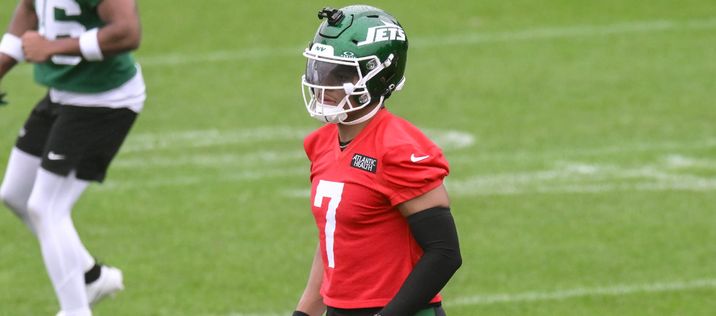
Justin Fields (QB – NYJ) | NFFC ADP: 99/ECR: 90
This one needs a lot of context. The first piece of information is that NFFC scoring awards six points per passing touchdown instead of the traditional four. This hurts the value of dual-threat quarterbacks like Justin Fields, who aren’t as productive passing the ball. Once we consider that, this nine-pick difference between Fields’ ADP and his ECR might seem logical. However, this is where the rest of the context comes in. Thanks partially to that rule change and partially to the format’s super deep rosters, quarterbacks are more expensive across the board in NFFC drafts. This, combined with the fact that he is right in the middle of a massive quarterback run, means Fields’ positional ADP shows a significant gap: He is QB10 in ECR, but the QB14 in NFFC ADP.
The four quarterbacks who leapfrog Fields in NFFC ADP are Jared Goff, Caleb Williams, Dak Prescott and Brock Purdy. All of these pocket passers project for more passing touchdowns than Fields, so they should benefit from the switch to six-point passing touchdowns. But the impact of that switch is being overstated.
In Mike Clay’s early 2025 projections, Fields is projected to throw for 17 touchdowns. That is by far the lowest among any quarterback who is being projected as an every-week starter. But it’s still only 10 fewer than Prescott, who leads the four relevant signal-callers with 27 projected passing scores. That means that the switch from four points to six points per touchdown is only a 20-point swing in Fields’ relative projection. That’s just over one point per game and easily fewer than 10% of any given quarterback’s season-long scoring.
Of course, if you had Fields relatively close to his less mobile counterparts in your four points per touchdown rankings, that difference could be enough to push him down. But I would argue he belongs in a clear tier above at least a couple of these other passers in traditional formats.
Fields hasn’t shown it as much in the last couple of years, but his ability as a runner still gives him the highest fantasy ceiling of any non-elite quarterback in the league. Unlike last year when he was a placeholder in an Arthur Smith offense built for Russell Wilson, the now-journeyman is the Jets’ only option this season.
If the Jets are smart (always a big if), they’ll build an offense catered to Fields’ strengths, which should mean tons of rushing fantasy football goodness. Fields’ rushing ability gives him a higher ceiling and a higher floor than someone like Goff, and the switch in touchdown scoring simply isn’t enough to make up that gap. Snagging him as your QB2 a round after Goff is off the board is an obvious way to help your NFFC team.
Chase Brown (RB – CIN) | NFFC ADP: 27/ECR: 27
No, that’s not a typo: Chase Brown’s NFFC ADP and his ECR are identical at 27 overall. But, once we look at the overall environment of NFFC drafts, the third-year back is a value pick. Specifically, we have to consider that NFFC ADP is much more running-back-heavy than ECR in the first few rounds of the draft. The top 12 running backs (aka RB1s) are being drafted on average 29% above their consensus rankings.
Things get even worse if we zoom in further, as the four backs directly above Brown in ADP are 37% overvalued on average. Once again, the key factor is a difference in positional ADP: Brown’s ECR is RB9, but his NFFC ADP is RB12. The three backs elevated above him are Jonathan Taylor, Josh Jacobs and Kyren Williams. Brown versus Jacobs is a close call in my eyes, but the Bengals’ bell-cow back is a better pick than both Taylor and Williams in full PPR formats.
From Week 9 of last season onward (aka without Zack Moss), Brown averaged a whopping 20.6 PPR points per game. The only players above that mark were Saquon Barkley, Jahmyr Gibbs and Bijan Robinson. Yes, Moss is now back healthy, but early indications are he is more likely to miss the 53-man roster than return to a lead role in the Bengals’ backfield. Cincinnati’s coaches can’t stop talking about how much they love Brown and want to keep getting him the ball.
With Moss back healthy, Samaje Perine back in the fold and even seventh-round rookie Tahj Brooks potentially getting involved, Brown isn’t going to have the absurd near-100% backfield shares he had down the stretch of last season. But that workload was so massive that it could be cut a solid amount and still leave Brown with one of the best usage profiles of any back in the league… on arguably the best offense in the league.
As for the backs just above Brown in NFFC ADP, Taylor is an elite talent but doesn’t see much receiving work and is on an offense that has “potential trainwreck” written all over it. Williams is very comparable to Brown, as they both relied on a massive workload to make up for so-so efficiency last season. But the Rams’ offense isn’t on the same level as the Bengals’, throws to their running backs the lowest amount of any team in the league and just added an explosive fourth-round rookie in Jarquez Hunter.
Even if you’re not sold on him above these other names, Brown’s NFFC ADP means you don’t have to make that choice. Simply wait to grab him in the late second or even early third round, right at his ECR, while the rest of your league massively “overpays” for other back-end RB1 options.

Subscribe: YouTube | Spotify | Apple Podcasts | iHeart | Castbox | Amazon Music | Podcast Addict | TuneIn
Ted Chmyz is a fantasy football contributor for FantasyPros.com. Find him on Twitter and Bluesky @Tchmyz for more fantasy content or to ask questions.