As we head into Day 2, who are the best fantasy football players remaining? The first night of the 2026 NFL Draft is officially in the books, and it was just as chaotic and fun as everyone was anticipating. The first few selections went about as expected, until Tennessee decided to throw a monkey wrench into the works with the fourth selection, opting for Carnell Tate from Ohio State. Plenty of offensive firepower landed on teams desperate for a spark on that side of the ball (looking at you, Jordyn Tyson to New Orleans and Kenyon Sadiq/Omar Cooper Jr. to the New York Jets), but a good amount of talent remains available.
Though the 2026 draft class wasn’t considered nearly as “elite” as prior incarnations, there is still plenty of startable talent, especially at wide receiver. Teams will resume filling out their rosters this evening at 7 PM EST, and expect plenty of wideouts to be called early.
Here is a quick rundown of the best talent remaining on the board, from a fantasy perspective.
- 2026 NFL Draft Guide
- 2026 NFL Draft Scouting Reports
- Best Fantasy Football Tools
- Dynasty Rookie Mock Drafts
NFL Draft: Top Day 2 Fantasy Players Remaining
Quarterback
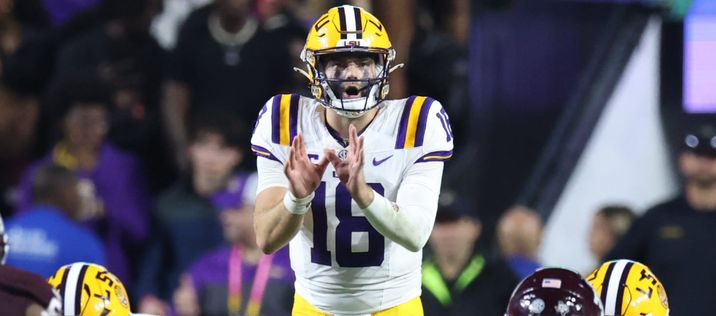
Garrett Nussmeier (QB – LSU) – Last year at this time, I was expecting to hear Nussmeier’s name already called, ahead of Jaxson Dart. Opting to return to the Tigers for another season in 2025 was a costly mistake for Nussmeier, who was forced to play through a core/torso injury suffered in August, before eventually being shut down. Unable to rip the ball downfield for long throws, Nussmeier instead had to settle for a dink-and-dunk approach, as he attempted to play through his injuries. When fully healthy, Nussmeier has shown the ability to make good decisions pre- and post-snap, and can progress through multiple reads and process information quickly. He has good anticipation on his throws, but doesn’t have the same level of arm talent as others within this class. He needs to improve his lower-body mechanics (especially his footwork) to the next level to become a true starter. For now, teams should treat him as a backup option capable of winning a football game if necessary, but improvement will be needed in order for him to become an every-week starter. He caught my eye during the Senior Bowl, winning the MVP award and demonstrating that he is finally on the road to recovery.
Drew Allar (QB – Penn St.) – Few players took a bigger hit to their draft stock during 2025 than Allar, who was a projected top-3 overall selection after the conclusion of the 2024 season. Opting to return to Happy Valley as the team had championship aspirations, Allar instead missed the final seven games of the season with a broken ankle and put up some pretty confusing tape when he was on the field. His physical intangibles are unquestioned, and he has the arm strength and size to be a prototypical pocket passer, with the ability to scramble in a pinch if necessary. However, Allar ran extremely hot and cold during his tenure with the Nittany Lions and struggled against top-tier competition (just 2-7 against top-25 teams in the Power Four/Five conferences). Allar has a cannon for an arm (perhaps the strongest in this entire class), but lacks touch and accuracy at times. He will need to work with a team that can offer him stability and mentorship before eventually being given a shot at starting in the league.
Running Back
Mike Washington Jr. (RB, Arkansas) – Washington is in a tier by himself as the top running back option remaining, and really the only one I’d consider selecting within round two. A 6’1, 223 explosive talent with plenty of “wiggle” for his size, Washington Jr.’s stock gained a lot of steam, following an outstanding Combine performance (an impressive 4.33 40-yard dash, and fantastic numbers in the broad and vertical jump), coupled with reportedly great interviews with teams that met with him. His burst is real and translates well at this level, with comparisons being made to former Razorback Darren McFadden. For his size, he plays like someone much smaller – in all aspects. He occasionally struggles to break tackles, and his pass protection skills are average at best – he will need to improve in both areas to become a “feature” back, rather than a complementary option in a committee situation. Expect Washington Jr. to be selected towards the end of Round 2 or the beginning of Round 3.
Emmett Johnson (RB, Nebraska) – Johnson was a First-team All-Big Ten player in 2025 and the recipient of the Big Ten Running Back of the Year award, leading the Power Four in total yards from scrimmage. A 5’10, 202 lb. player with dual-threat ability, Johnson is an outstanding receiver capable of running an expanded route tree, more than simple screens and dump-off passes. While not overly powerful, Johnson plays up to his size and runs with a physical style, capable of running through arm tackles or making defenders miss in open space with a juke. Johnson will give way to short-yardage and goal-line specialists in the NFL and will be reliant upon his receiving skills to produce points from a Fantasy perspective. A strong fit for him would be on a team like Baltimore, Cleveland, or Houston, which has an early-down thumper that will need an occasional breather.
Nicholas Singleton (RB, Penn State) – The heir apparent following Saquon Barkley’s departure from the program, Singleton was a dynamic four-year starter and a two-time All-Big Ten player. His upside in college was capped due to a committee situation with Kaytron Allen, as they formed one of the more formidable one-two punches across the country for the last three seasons. Even with the split, Singleton broke Barkley’s record for the most rushing touchdowns scored at the program, and proved to be a durable option, missing just one game during his tenure. Singleton has a thick frame at 6’0, 219 lbs., but still possesses enough speed to be considered a home-run threat in open space. Like Barkley coming out of college, Singleton often looks to create big plays with each touch, rather than running through holes that are provided for him. His change-of-direction ability is only mediocre, and he relies upon his straight-line speed to create major gains. Singleton’s stock is boosted by his kick-returning ability, especially with more teams opting to take kicks out due to recent rule changes. He should hear his name called towards the end of this evening.

Wide Receiver
Denzel Boston (WR – Washington) – I’ve been a big fan of Boston for the last few seasons, favoring his ability to box out defenders with his massive 6’4, 212 lb. frame, and win contested catches while providing his quarterback a huge target with a large catch radius. A true “X” receiver, Boston isn’t the fastest prospect at his position (he didn’t even bother to run a 40-yard dash at the Combine or his Pro Day), but he plays with strength and has a quickness at his size that is truly elite. He has a knack for getting open and consistently finds areas in zone coverage to exploit. As a short-yardage and red-zone threat, he can out-muscle defenders with his size, and he has incredibly soft hands. Matt Miller of ESPN provided a pro comparison of Courtland Sutton, and I can definitely see that – my own comp was Michael Pittman Jr. Boston isn’t a burner, but is incredibly reliable, and will be a quarterback’s best friend on third-down throws. Teams looking for a WR2/3 as an underneath complement (New York Giants, Minnesota, Indianapolis, Jacksonville, Cincinnati) should scoop him up early on Day 2.
Germie Bernard (WR – Alabama) – Bernard’s name was mentioned by Rich Eisen as one of the best players available after the conclusion of last night’s broadcast, and he was dead-on in that assessment. A three-year starter who bounced around schools (Michigan State, Washington, and finally Alabama), Bernard provided quarterback Ty Simpson with an ultra-reliable and versatile option to pepper with targets in 2025. He led the Crimson Tide in receptions (64) and receiving yards (862) last year, and primarily did his damage on short-to-intermediate routes. Bernard is average in stature (6’1, 206 lbs.) but plays like a man possessed with the ball in his hands, routinely breaking tackles and gaining a massive amount of yards after the catch. His ability to play physically also makes him a willing blocker, a trait that will quickly endear him to coordinators. His speed is middling, but he can line up both outside and in the slot to create separation. Think Deebo Samuel-lite.
Chris Brazzell II (WR – Tennessee) – Brazzell led the SEC in receiving yards last season with 1,017, and came away with All-American and first-team All-SEC honors. His straight-line speed is incredible (he ran a 4.37 40-yard dash), and his long strides make him a nightmare for most cornerbacks to cover without safety help over the top. His 80-inch wingspan gives quarterbacks plenty of area to target, and of the players still on the board, he is the best “deep threat” available. My question is – can he ever be anything more than a one-trick pony who just runs go-routes? For a taller receiver, he isn’t particularly physical, but his elite ball-tracking skills on deep throws are an undeniable plus. Teams that run a West Coast-style offense and take occasional deep shots on play-action passes could use Brazzell effectively. I’m keeping my fingers crossed that he isn’t the second coming of Jalin Hyatt once he reaches the NFL level.
Ted Hurst (WR – Georgia State) – I wanted to include Hurst on this list as a shout-out to an elite player on a smaller program. Hurst transferred to the FBS level after spending time at Valdosta State and was a two-time All-Sun Belt player. Similar to Brazzell above, Hurst is a tall, lanky player at 6’4 and 206 lbs., with dominant traits as a vertical weapon. His size/speed combination is especially intriguing, considering his potential ceiling once he has time to develop with an experienced coaching staff. Hurst can run the occasional shorter route when he is asked to come back to the quarterback, but he wasn’t asked to do that often at Georgia State, and he does have a tendency to run rather rigidly. Additionally, he comes with red flags based upon his maturity and work ethic, and he should be treated with kid gloves to start as he enters the league. In many ways, Hurst reminds me of George Pickens – a dynamic option who can make incredible catches downfield, but is best viewed as a second-fiddle to a more well-rounded player in front of him.
Tight End
Max Klare (TE, Ohio State) – Klare represents one of the best remaining tight ends available on the board, but there is a substantial chasm between him and Kenyon Sadiq, who was selected 16th overall by the New York Jets. After spending three seasons at Purdue, Klare transferred to Ohio State in 2025 and enjoyed his most successful collegiate season, attaining All-Big Ten honors. Klare is my “jack of all trades, master of none” player at tight end. Klare doesn’t possess the speed to truly threaten opponents down the seam, but his soft hands will make him a reliable third-down and short-yardage target for quarterbacks. He is an average blocker who still needs improvement in that area to not be pulled in short-yardage situations, but I’d hardly call it overly detrimental. With development, I can see Klare molding into someone like Jake Ferguson – a lot of YPR target that quarterbacks can target in a pinch, with the ability to be a threat in the red zone.
Eli Stowers (TE, Vanderbilt) – I wanted to end the article with a bang, and there is no one left at the tight end position who excites me quite as much as Stowers. A 6’4, 239 lb. athletic marvel who set Combine records with a 45.5″ vertical jump and 11-foot, 3-inch broad jump, Stowers is the best seam-stretching “move” option left, who can be used to create mismatches against linebackers. Despite his larger frame, Stowers is very fluid in his movements, and he has incredible burst. My major knock on him is his lack of physicality and his subpar film as a blocker. Fantasy managers should view him as someone in the same territory as Evan Engram or Harold Fannin Jr. – an oversized wide receiver who can contribute when on the field, but will cede snaps to superior blocking options, especially on run-first teams. Stowers would be a fun addition for a team like New Orleans, Dallas, or Cincinnati.

Subscribe: Apple Podcasts | Google Play | Spotify | Stitcher | TuneIn | RSS | YouTube