Typically, I use an average draft position (ADP) cut line to determine who qualifies as a fantasy football sleeper. In this look at fantasy football sleepers, I’m using positional ADP as the cut line for qualification. The following sleepers have an ADP after QB12, RB30, WR42 and TE12.
The rationale is that those players aren’t being selected as starters in 12-team leagues with starting spots for one quarterback, two running backs, three wide receivers, one tight end and one FLEX. The following three players have compelling cases to outperform their ADPs.
- Fantasy Football Research & Advice
- Fantasy Football Expert Rankings
- Fantasy Football Real-Time ADP
- Fantasy Football Trade Tools
Fantasy Football Sleepers
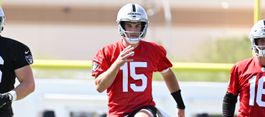
Kyler Murray (QB – MIN) | ADP: 109.7/QB17
Kyler Murray isn’t a traditional sleeper. He’s not a player in the first few years of his career. There’s also proof of concept with Murray.
The former Cardinal was a fantasy QB1 in 12-team leagues as recently as 2024, finishing QB12 in half-PPR points per game (18.1) among quarterbacks with at least eight games played that season. Murray was also a top-10 fantasy signal-caller in points per game in 2023 (QB8), 2022 (QB7), 2021 (QB4) and 2020 (QB3).
Murray should get a lift from playing for Kevin O’Connell in Minnesota. O’Connell has been the head coach of the Vikings since 2022. According to the Fantasy Points data suite, working from 2025 back to 2022, the Vikings have ranked 16th in pass rate over expectation (0.2%), third (5.9%), fourth (6.3%) and sixth (5.4%).
The Cardinals were in the top 10 in pass rate over expectation only once from 2021 to 2024 — tied for ninth (2.2%) in 2022. Murray should have more opportunities to pass than he has throughout his career.
Additionally, Justin Jefferson, Jordan Addison, Jauan Jennings and T.J. Hockenson are an appealing group of pass-catching weapons with a variety of skills, and Murray was at his best when he had DeAndre Hopkins as his No. 1 wideout earlier in his career.
Murray’s legs are also still an asset. His 34.5 rushing yards per game in five games last year were his most since 2022 and the third-most in his career, per Pro-Football-Reference. Murray is the rare low-risk, high-reward bet gamers dream of, and a worthwhile QB2 swing for upside for gamers who wait to draft a quarterback until the fringe-starter territory.

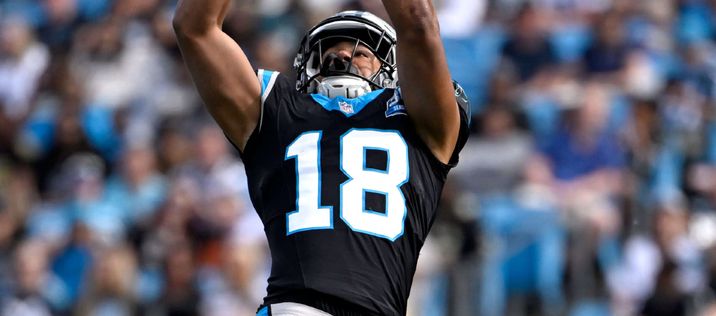
Jalen Coker (WR – CAR) | ADP: 143.3/WR55
Jalen Coker has already overcome the odds in the NFL. As an undrafted free agent (UDFA), the deck was stacked against him to stick on Carolina’s roster. Moreover, his rookie season coincided with the Panthers selecting Xavier Legette in the first round of the 2025 NFL Draft.
Predictably, Legette initially operated ahead of Coker. Through Week 7 in 2024, Legette had a 59.1% route participation rate versus 48.3% for Coker. From Week 8 through Week 18, Coker overtook Legette, with a 78.9% route participation rate compared to 72.4% for Legette.
Unfortunately, Coker began the 2025 season on injured reserve (IR) with a quad strain and didn’t make his season debut until Week 7.
Coker didn’t clear 40 receiving yards in his first four games in 2025. He shook off the rust and reeled in all four of his targets for 52 receiving yards in Week 11 and drastically outperformed Legette from that point on.
If Coker had recorded a 28.9% air yards share, 2.03 yards per route run (YPRR), 24.1% first-read rate and 0.096 first downs per route run over the course of the full season — the marks he sported in his final eight games last season — he would have ranked 32nd, tied for 20th, tied for 29th and 23rd among 91 wideouts who ran at least 250 routes through the Super Bowl last season.
Coker has measurable talent and should be viewed as Carolina’s No. 2 passing-game weapon, behind only Tetairoa McMillan, with an unimposing group of players as his target competition.
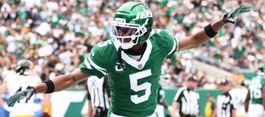
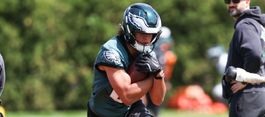
Jonah Coleman (RB – DEN) | ADP: 147.7/RB48
Sean Payton and the Broncos went back to the well at running back in the 2026 NFL Draft, picking Jonah Coleman with the eighth pick in the fourth round (108th overall). The draft capital doesn’t immediately jump off the page, but adding context makes it a bit more eye-catching.
First, the Broncos traded their first-round pick in a package for Jaylen Waddle, and they traded out of the second round, making their first pick of the draft in the third round. Coleman was actually the team’s second selection. Second, Coleman was the fourth running back picked in a class that most draft analysts admittedly panned.
Coleman shouldn’t be favored to headline Denver’s backfield immediately, but a strong training camp and preseason could shake things up. Additionally, RJ Harvey had an unimpressive season as a runner, and J.K. Dobbins had another season cut short by a significant injury, suffering a Lisfranc injury.
Among 55 running backs with at least 75 carries in the regular season and playoffs last year, Harvey was unimposing:
- 3.62 yards per carry (T-49th)
- 1.73 yards before contact per attempt (41st)
- 1.88 yards after contact per attempt (47th)
- 2.4% explosive-run rate (T-44th)
- 43.6% success rate (51st)
- 52.7% stuff rate (52nd)
Furthermore, per NFL Next Gen Stats, Harvey’s -91 rushing yards over expected were the fourth-worst among qualified running backs.
Dobbins was a far more efficient runner and should be favored to open the year as the club’s top ball-carrier. However, he’s suffered many significant injuries, which could sap his efficiency.
Dobbins has played double-digit games in only three seasons since entering the NFL in 2020, and he missed four regular-season games in 2024 and seven for the Broncos in 2025. Dobbins is also a non-factor in the passing game, where Harvey demonstrated competency.
According to Pro Football Focus (PFF), in eight games in his final collegiate season before suffering a PCL sprain against Wisconsin, Coleman had the following stats:
- 127 rush attempts (15.9 per game)
- 643 rushing yards (80.4 per game)
- 5.1 yards per carry
- 3.57 yards after contact per attempt
- 0.24 missed tackles forced per rush attempt
- 13 rushing touchdowns
- 161 routes
- 29 targets (3.6 per game)
- 0.18 targets per route run (TPRR)
- 27 receptions (3.4 per game)
- 316 receiving yards (39.5 per game)
- 11.7 yards per reception
- 1.96 YPRR
- 2 receiving touchdowns
Coleman has the requisite skills and size (5-foot-8 and 202 pounds) to handle a bell-cow role if he earns it. That’s not the likeliest outcome out of the gate or at any point in 2026, but it’s at least within his range of outcomes.
Moreover, his rushing and receiving ability gives him paths to usurp Dobbins as the primary ball-carrier or Harvey as the preferred pass-catching back. Coleman is an enticing bench option to see how Payton divvies up backfield opportunities.

Subscribe: YouTube | Spotify | Apple Podcasts | iHeart | Castbox | Amazon Music | Podcast Addict | TuneIn
Josh Shepardson is a featured writer at FantasyPros. For more from Josh, check out his archive and follow him @BChad50.