Each week in this report, I’ll be monitoring the performances of MLB rookies. I will emphasize those rookies who put up especially positive performances, while also taking care to mention rookies who are underperforming expectations. In both cases, I will dig into the underlying stats and attempt the difficult task of projecting forward.
Rookies are typically more unpredictable than their more experienced colleagues, and can, therefore, be a source of great profit in fantasy baseball; or great frustration. Stay tuned to this space every week to find out which newbies should be in the mix for your squad. I will try not to repeat players from one week to the next, so catch up on last week’s Rookie Report to keep up to date on all the hottest youngsters.
Import your team to My Playbook for instant Lineup & Trade advice 
Frisky Freshmen
Trey Mancini (DH – BAL)
Through the first 12 games and 39 PA of his major league career, Mancini owns a 1.410 OPS, including seven HRs, four of which have come this season. As his power bloomed in the high minors, so too did his K%, inching above 20% toward the 25.6% he has netted in the majors. As with most sluggers, Mancini will need to manage his strikeouts for his above-average power grades to play in games long-term.
Beyond projecting his future performance, the most critical factor in establishing Mancini’s short-term fantasy value is playing time. So far in 2017, Mancini has appeared at 1B, DH, RF, and LF, but he has only gotten multiple plate appearances in six of the team’s 12 games. He is blocked by Chris Davis at first, and Mark Trumbo at DH, but could steal playing time from Seth Smith and Hyun-Soo Kim in the outfield corners.
Mancini does not project as a good – or even average – defensive outfielder, so he will need to hit to justify playing time for the Orioles, who also have Pedro Alvarez lurking in the minors. Daily roster move leaguers and AL-only owners should keep an eye on Mancini’s playing time and outfield defense.
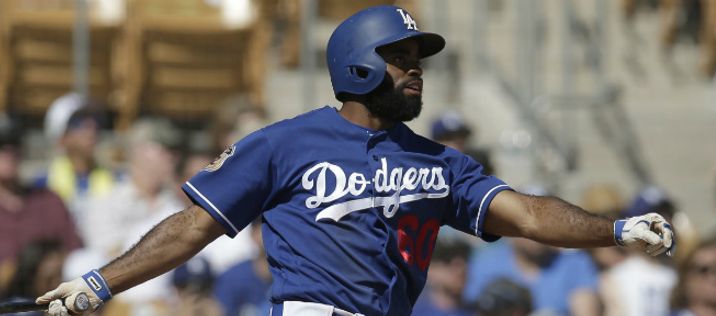
Andrew Toles (OF – LAD)
In 2013 in the minors, Toles stole 62 bases and hit two HRs. In 2016, across four levels including the majors, Toles stole 24 bases with 10 HRs, more than half of which came in Triple-A and MLB, despite having started the year in High-A ball. So far this season, Toles has surprised with three HRs and no steals.
On the negative side, Toles is only hitting .229, albeit with a .192 BABIP. On 28 batted balls recorded by Statcast this year, his average exit velocity is an anemic 83.9 mph, with a 14.2-degree average launch angle. Compared to 90 mph and 10.9 degrees in his 115 plate appearances last year, it appears Toles’ low BABIP thus far has been earned.
Owners should not panic about such a small sample size, but it seems very unlikely that Toles will hit above .300 with an OPS over .800 as he did in 2016. While he appears to be firmly entrenched in the Dodgers’ lineup against right-handed pitchers, he will likely sit against many lefties.
As he has yet to attempt many steals above Double-A, it also seems unwise to count on much more than the 11 his rest of season projections expect. Add it all up, and Toles can almost certainly be left on most mixed league waiver wires until he starts to show off his speed.
Jordan Montgomery (SP – NYY)
After a delayed fifth-starter announcement, the unheralded Montgomery put up seven strikeouts against two walks and two earned runs in 4.2 innings in his major league debut. He cruised into the seventh inning in his second start, but an infield single, a seeing-eye single, and a three-run homer ended his night on a sour note. His overall 4.22 ERA and 1.50 WHIP are uninspiring, but a 9.28 K/9 supported by a 14% swinging strike rate (SwStk%) are intriguing.
Listed at 6’6, Montgomery’s delivery is very over-the-top, with lots of glove-side spine tilt. This allows him to achieve the second highest vertical release point of any pitcher with more than 25 fastballs thrown in 2017. Combining this with his very central horizontal release point, Montgomery appears to throw from a very deceptive window, shared only with right-hander Josh Collmenter, and very far from the clusters of typical left or right-handed pitcher release points.
Montgomery’s four-pitch arsenal and reasonable velocity suggest that he may not be as dependent upon deception as the soft-tossing Collmenter. While expectations should be tempered, especially as Montgomery begins to see opponents for the second time, his decent minor league strikeout rates and encouraging early signs of swing-and-miss major league stuff should put Montgomery on the radar of AL-only owners as well as mixed-league streamers.
Reeling Rookies
Yandy Diaz (SS/3B – CLE)
Apart from frequent appearances in the Fringe Five, Yandy Diaz received little in the way of prospect hype. Undeterred, he put up solidly above average production in the minor leagues. If one thing jumps out about Diaz’s minor league track record, it is that he posted ground ball rates well above 50% at every stop.
While Yandy’s average exit velocity is in the top 10th-percentile of 2017 hitters, his average launch angle is negative, at -3.1 degrees. This appears in the traditional metrics as well, where Yandy owns a 66.7% GB% and a nearly nonexistent 5.6% FB%. For context, no batter with more than 250 batted balls in 2016 had an average launch angle below zero.
If he can maintain his exit velocity and raise his average launch angle, the closest comp to Diaz will be 2015-2016 Christian Yelich. While this simple view of averages can obscure differences in the shapes of each player’s batted-ball distribution, it is at least a hint that Yandy Diaz could hit for a higher AVG than he has shown thus far in 2017.
While it probably won’t come with many homers or steals, Diaz could reasonably hit .280 and be a useable fill-in infielder playing in an eventually potent Indians lineup. All of this likely becomes moot when Jason Kipnis returns, and Jose Ramirez resumes his normal third base defensive duties, but another Cleveland infield injury is always possible.
Josh Bell (1B – PIT)
Pittsburgh prospect Josh Bell came up last season and put up an above average batting line in 45 games, but with only three home runs and no steals. His most notable achievement was walking more often than he struck out, which is a fine achievement for a 23-year-old, but hardly useful in fantasy leagues. In the preseason, his real-life value seemed to bleed into his fantasy outlook, to the point where he was sneaking toward the top-250 of the expert consensus rankings.
So far this year, his strong plate discipline has endured, but his average has hovered around .200, and he has yet to homer. While he is probably a safe bet to reach his rest of season projections, a first baseman with 10 HRs and three steals is not useful in most leagues. While not as bad as he has been so far this year, Josh Bell is likely no more than a desperation fill-in or perhaps a back-end bench player in points leagues.
Robert Stephenson (SP – CIN)
Despite a Reds’ rotation that currently contains Scott Feldman, Bronson Arroyo, Tim Adelman, and, since the injury to Brandon Finnegan, nobody else, Robert Stephenson can do no better than a middle relief role. Stephenson has long been a top prospect but has had problems with homers since graduating from Double-A, and with walks since a glorious 20.2 IP stretch in High-A ball in 2013. In eight starts last year, Stephenson posted 7.54 K/9 with a respectable 9.4% SwStk%, but an ugly 4.62 BB/9.
In a small sample this year, he has turned up the dial out of the ‘pen, with a 17.55 K/9, 13.6% SwStk%, and a 10.8 BB/9. While Stephenson may get a chance to start in stretches this year, I believe he will have more value out of the bullpen.
He could truly be a 10+ K/9 pitcher in short bursts, and his success will be determined by his ability to limit walks. Standing in the way of high leverage situations, though, is the remainder of the crowded Reds bullpen, with Raisel Iglesias, Drew Storen, Tony Cingrani, and Michael Lorenzen all in the mix for saves and holds.
Kyle Freeland (SP – COL)
It seems that the Rockies have a never-ending supply of interesting, if uninspiring, young arms. Couple that with the eternal search for a pitching strategy that works at Coors Field, and Colorado pitchers tend to be discussed an inordinate amount. Despite appearing among most outlets’ top 10 Rockies prospects, Freeland’s numbers in the high minors were not particularly appealing: K/9 of 5.20 and 6.96 in Double-A and Triple-A with an ERA barely under 4.00.
And yet, in his first start, at home, Freeland held the Dodgers to a single earned run in six innings with six strikeouts. Coors exacted its revenge in his second start, however, as the Padres pummeled Freeland. After a third so-so start tonight at the Dodgers, Freeland sports a 4.91 ERA, 6.75 K/9, and 5.52 BB/9.
Worse, his SwStk% through two starts was a mere 4.9%. While his ground ball tendencies may help him avoid blowup starts, fantasy owners can surely do better.
Subscribe: iTunes | Stitcher | SoundCloud | Google Play | TuneIn | RSS
Andrew Dominijanni is a correspondent at FantasyPros. For more from Andrew, check out his archive and follow him @ADominijanni.