
Every year I get dozens of the same type of question. “If I get Bryce Harper in the first round and Aaron Judge in the second, is it stupid to draft Gary Sanchez in the third even if he is the best player on the board?” It comes in all flavors: Someone may have Jose Altuve and Freddie Freeman and wonders if they should add another high average guy like Dee Gordon. Or perhaps, they took Clayton Kershaw in the first and wonder if it would be a waste to draft another pitcher as early as the fourth round. My answer is always the same:
Take the best player available, regardless of positions or skill sets until the fourth round. At that point, assess your needs, and model the remainder of your draft around it. There is far more disparity in the first 50 picks than there are in the final 200 picks of a fantasy baseball draft, so it doesn’t make sense to pass up on Gary Sanchez if he truly is the best player on the board. While I love the Marmol Strategy, I never enter a draft intending to carry out any particular plan. Rather, I model my plan around what falls to me in the first few rounds. If the three best players on the board are power hitters then I may punt batting average and gather safe pitchers like Jose Quintana, Kyle Hendricks and Marcus Stroman to guarantee I can keep my head above water in the pitching categories. If I end up with three high average hitters who rack up the steals, then I can ignore stolen bases the remainder of the draft and load up on mashers like Matt Olson, Miguel Sano and Joey Gallo in the later rounds while everyone else is worrying about the damage they would do to their team batting average.
The same is true for me if I just happen to get two or three starting pitchers early. Today, I’ll show you an example of how that could happen and how the rest of my draft strategy morphs to overcome the holes I started with. I used our Draft Simulation Software to execute the strategy in a 12-team 5×5 league with the 12th pick.
Nail your draft this season with our Draft Simulation Software 
World-Class Rotation
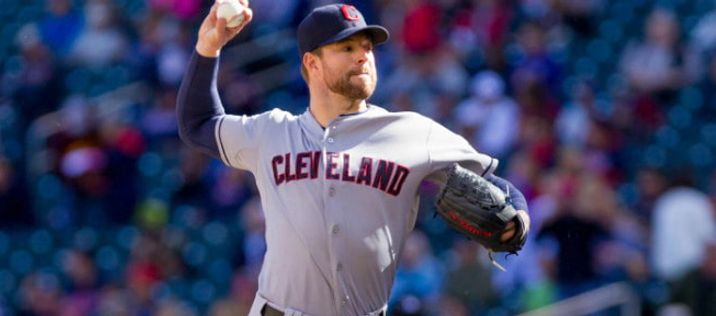
1st Rd: Corey Kluber (CLE)
2nd Rd: Chris Sale (BOS)
3rd Rd: Zack Greinke (ARI)
7th Rd: David Price (BOS)
9th Rd: Lance McCullers (HOU)
I don’t need to tell you that this is an unbelievable rotation. If you spend so much draft capital on the premier pitchers in baseball, you are essentially guaranteed to dominate four categories. The trio at the top is not only dominant, but they are among the most reliable arms in the game. This enabled me to spend on high-upside pitchers for my #4 and #5, because the innings, strikeouts and wins are virtually in the bag regardless of whether Price and/or McCullers stay healthy. Either way, it was important to make sure those end of the rotation pieces weren’t the type who might ruin the ratios, and that is precisely what Price/McCullers offer. Rich Hill was another piece who would have fit the bill, and if I had wanted to wait even later, Mike Clevinger, my favorite fantasy baseball pick this season, offers the same package as the aforementioned trio. Typically when I’m building my rotations, I load it with 7 or even 8 arms because there is so much volatility in pitchers that you want to make sure you have enough depth to overcome a long season. When you load up on starting pitcher’s early, you are able to use your bench elsewhere, namely in covering up the inefficiencies of the lineup.
Make-Shift Bullpen
16th Rd: Hector Neris (PHI)
17th Rd: Brandon Morrow (CHC)
18th Rd: Archie Bradley (ARI)
19th Rd: Blake Parker (LAA)
Generally, a bullpen’s primary purpose beyond saves is to enhance your team ratios. Since we used so many resources on our starting rotation, we don’t have to play by the same rules because our ratios are already locked in as the best in the league. This enables us to wait until the back-end of the draft to grab four quality, but scarcely known closers who will pile up the saves. I’m fairly confident we will perform better than 5th in saves with this crew, and may even carry first place in all five pitching categories.
Power, Power, Power
4th Rd: Brian Dozier (2B – MIN)
5th Rd: Khris Davis (OF – OAK)
6th Rd: Jonathan Schoop (MI – BAL)
8th Rd: Yoenis Cespedes (OF – NYM)
10th Rd: Adrian Beltre (3B – TEX)
11th Rd: Joey Gallo (CI – TEX)
12th Rd: Matt Olson (OF – OAK)
13th Rd: Nomar Mazara (OF – TEX)
14th Rd: Evan Gattis (C – HOU)
15th Rd: Andrelton Simmons (SS – LAA)
20th Rd: Todd Frazier (UTL – NYM)
21st Rd: Maikel Franco (BEN – OAK)
22nd Rd: Dexter Fowler (OF – STL)
23rd Rd: Jedd Gyorko (BEN – STL)
24th Rd: Logan Morrison (BEN – MIN)
We won’t be winning any races, but that is exactly the point. When you skip out on the first three rounds, there are significant deficiencies in your offense. Now, you’ve got two options: You can fight tooth and nail to finish 8th to 10th in all five categories, or you can entirely forfeit two categories and dominate the other three, since homers tend to line up with RBIs and runs. Seeing that 30 roto points are better than 20, I’ll opt for the punting strategy. It works out even better in head-to-head leagues because I’ve now got 6 incredible categories and 2 that should also fare quite well. I’ll be hard-pressed to ever compete in stolen bases or batting average, but if I were to try, the results would still be lackluster, yet I’d limit my team’s offensive ceiling. This squad might end up swatting 400 homers.
The Results


As you can see, it went quite well. My power hitters are a force to be reckoned with and my rotation practically guarantees I win at least 4 categories every week. While I don’t have quite as much confidence in this strategy as the near-certain championship the Marmol Strategy offers, I am more than comfortable letting this one play itself out if the first few rounds fall into place like this one did. In fantasy baseball, like anything else in life, you can’t fit a square peg into a round hole, so make sure you use our free Draft Simulation Software to prepare for every potential situation.
Subscribe: iTunes | Stitcher | SoundCloud | TuneIn | Google Play
