When preparing for your fantasy football drafts, knowing which players to target and which to avoid is important. The amount of information available can be overwhelming, so a great way to condense the data and determine players to draft and others to leave for your leaguemates is to use our expert consensus fantasy football rankings compared to fantasy football average draft position (ADP). In this way, you can identify players the experts are willing to reach for at ADP and others they are not drafting until much later than average. Let’s dive into a few running backs our experts avoid in 2026 fantasy football drafts.
- 2026 Fantasy Football Expert Rankings
- Fantasy Football Dynasty Rankings
- Fantasy Football Trade Analyzer
- Best Fantasy Football Rankings

2026 Fantasy Football Draft Advice: Running Backs to Avoid
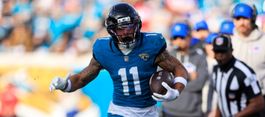
TreVeyon Henderson (RB – NE)
Rhamondre Stevenson isn’t going away anytime soon. Actually, the veteran RB averaged more PPG (11.6 vs 11.1) than TreyVeon Henderson did in 2025.
Stevenson returned to full-time action in Week 13 versus the Giants. Henderson missed the game against the Baltimore Ravens (just 19% of snaps).
In the other 4 games they played together, Stevenson out-snapped Henderson in 3 of them. In the last 8 games, Stevenson out-snapped Henderson in 7 of them.
Total opps in final 4 games during the regular season.
- Henderson: 64 (58%).
- Stevenson: 46 (42%).
Total opps in the final 8 games of the regular season/postseason.
- 100 for Henderson (46%)
- 116 for Stevenson (54%)
In the 4 postseason games:
Henderson – 35 touches (36 opps)
- WC – 41%
- DIV – 38%
- CC -6%
- SB – 39%
Stevenson – 70 touches (73 opps)
- WC – 62%
- DIV – 62%
- CC – 94%
- SB – 63%
Stevenson MORE than doubled the opportunities against Henderson in the playoffs.
He was also the RB7 in PPG after Week 13 throughout the postseason, averaging 15.4 PPG in half-PPR (RB1 production).
Now the usage wasn’t amazing – 10.4 XPPG (RB30) – but it remains to be seen how their roles will shift in 2026. Conventional wisdom (and ADP) suggests Henderson will take a step forward in Year 2, but Stevenson figures to be a thorn in his side for a decent chunk of the season. Stevenson had a massive turnaround in the second half of the season and was objectively better than Henderson across the board.
The rookie RB was bested by Stevenson in explosive run rate, missed tackle rate, yards after contact per attempt, yards per route run, and pass protection stats (the main driver in the stark snap counts).
Stevenson was fifth in explosive run rate, missed tackle rate, and yards after contact per attempt (per Fantasy Points Data). He’s a good running back who won’t just be tossed aside (first in rushing yards over expectation per attempt in 2025).
I’d expect we get closer to a pre-postseason split between these two RBs to start the year, where Henderson has closer to a 60-40 split – baking in a projection as a player entering his second season.
Hendo was the RB18 in xPPG in his last four games, compared to Stevenson as the RB33 in xPPG.
– Andrew Erickson
Rico Dowdle (RB – PIT)
As of this writing, there was only about a half-round difference in the ADPs of Jaylen Warren and Rico Dowdle, the top two running backs on the Steelers’ depth chart. Warren was at RB30, 80th overall. Dowdle was at RB32, 86th overall.
I know some people who prefer Dowdle, and the rationale seems to be that, because Dowdle became the Cowboys’ lead back in Mike McCarthy’s final season as Dallas’ head coach, he will be the lead back in McCarthy’s first season as Pittsburgh’s head coach.
Aaron Rodgers is the prism through which we should view the Steelers’ backfield. The 42-year-old Rodgers is now immobile and seems less willing than ever to stand in the pocket and get hit. He’s going to want to play with a running back who can block for him and be a safety valve as a receiver. Steelers RBs accounted for 25.4% of team targets last season – the second-highest percentage in the league behind only the 49ers, who have pass-catching RB extraordinaire Christian McCaffrey.
Warren has averaged 2.6 receptions per game and 1.41 yards per route run over his career. Dowdle has averaged 1.4 receptions per game and 1.05 yards per route run over his career.
Warren received a PFF pass-blocking grade of 72.0 last season, which is very good. Dowdle received a PFF pass-blocking grade of 24.6 last year, which is awful.
My money is on Warren as Pittsburgh’s primary running back this year, and it’s possible Dowdle has a smaller role than some expect.
– Pat Fitzmaurice
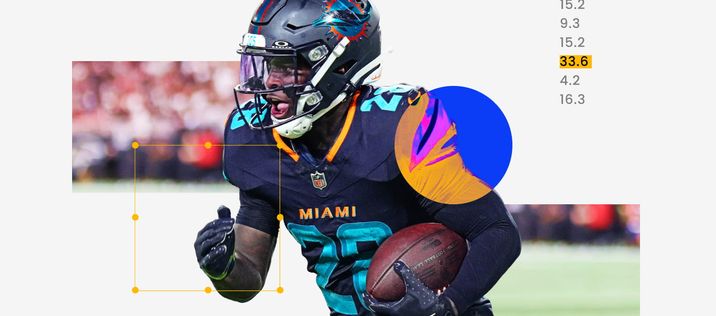
De’Von Achane (RB – MIA)
De’Von Achane has to be one of the most polarizing early-round picks in fantasy football this season. He got a contract extension this offseason from the Dolphins after showcasing his top-5 fantasy RB upside the last two seasons in less-than-ideal conditions. He has averaged five catches per year over the last two seasons while showcasing the ability to score from anywhere on the field.
However, without Tua Tagovailoa, his receiving numbers declined dramatically.
Last two years with and without Tua (8 games)
- 21.5 PPR pts versus 10.5 PPR pts/game
- Targets? 6 versus 2.5
Insert Malik Willis as QB1 in Miami, who will definitely rely on his legs a ton in 2026.
And I’ve researched the impact of mobile QBs on RBs in the passing game. Typically, the receptions and yardage dip when QBs are scrambling and moving the chains.
Last year, in Malik Willis‘ two starts, he went to RBs on just 12.2% of his attempts (six total). Same percentage in 2024 (12.5%).
These QBs lean a little heavily on their RBs in the passing game. Is De'Von Achane in trouble going from first to worst here? ???? @FantasyPtsData pic.twitter.com/uxy7ouwlsN
— Fantasy Points (@FantasyPts) July 3, 2026
Achane is also an undersized RB, slightly under 190 pounds. So there’s some concern about whether he can carry the load should he see a season-high in carries.
Mike Clay has him as his RB5 in the projections with a projected 16% target share.
Knock it down to 13% target share (closer to Willis’ RB target rate the last two seasons) – and Achane just joins a long list of RBs (nine) with projections between 279 and 271 points before the next RB tier drop.
The concern is that if Miami is run-heavy, Achane won’t see as many targets/touches as a receiver.
And if this offense is bottom-5 overall, then you probably won’t regret passing on Achane if he doesn’t score a ton of TDs.
Bobby Slowik is the new offensive coordinator (promoted from the Dolphins’ pass game coordinator job). They want to establish the run, which both the Packers’ and Dolphins’ offenses did at a top-six rate last season.
However, something that was brought to my attention was how Achane was actually used as a receiver in this offense last season. Achane caught 19 of 26 targets from the slot in 2025. 32 of his targets were screen passes (first among all RBs per PFF). A lot of the designed looks likely had some influence from Slowik, as he was the team’s head coach last season. I’d presume some of those designed-scheme touches for Achane continue in this offense in 2026.
Here’s a transcript from a Slowik presser earlier this offseason when asked about the topic (via MiamiDolphins.com).
Running backs were used big time in the pass game last year. You were here. You know what Achane can do. Is there still going to be that heavy emphasis on that, because there’s a tendency with Malik to run instead of check down. You had a tendency in Houston to throw downfield and not utilize the running backs as much. So I’m kind of curious how you balance that?
Bobby Slowik: I think it goes back to like the initial conversation we had way back when I first got introduced here. Everything I try to do is keep a defense off balance, so there absolutely is going to be part of that and then you’ll see some of it in walkthrough when we’re just trying to get a rep that won’t show up in practice and vice versa. But we want to do it all. Then we’re going to have these core things we want to hang our hat on, but there’s going to be times the back get out and we emphasize the back getting out. We’re going to use De’Von, we’re going to use Ollie, we’re going to use J. Wright (Jaylen Wright) to get out and they’re the primary read. There’s going to be other times they’re out as a checkdown. There’s going to be other times they’re out as window dressing and the other times they’re in in max pro. We’re going to mix it up pretty good.
Are you emphasizing that to Malik Willis to use those running backs in the passing game even more than he has in the past?
Bobby Slowik: Yeah, like everything, when it’s part of our progression, part of the play, part of where we want the ball to potentially go. He knows that’s a big part of what we’re doing.
Before joining Miami, Slowik played for the Texans and 49ers. In 2023, Houston’s offense had the second-lowest RB target share (12.6%). But that number rose to 17.4% in 2024 (probably because Houston acquired a capable pass-catching back in Joe Mixon). That offense also dealt with several WR injuries.
Across Miami’s offensive line, the guard position needed the most work this offseason. Cole Strange signed with the Chargers in free agency. Center Aaron Brewer and Austin Jackson will hit free agency in 2027. Brewer is an All-Pro center, so he really carries the interior of the OL. LT Patrick Paul is also solid.
But Jackson is coming off an injury. And according to PFF, rookie guard Jonah Savaiinaea earned a 14.1 PFF pass-blocking grade, which ranked dead last among all guards. Jamaree Salyer signed a one-year deal to compete for the starting guard spot. Miami also drafted Alabama’s Kaydn Proctor in Round 1, intending to play him at guard to start his NFL career. It’s not a great offensive line by any means, which puts a lot on Willis’ mobility to help open rushing lanes for his big-play RB.
I very much understand the downside/risks of Achane.
But I wanted to take a deeper dive into the mobile QB’s impact on him in the receiving game before finally reaching my conclusion on whether he truly warrants a full fade, given his ADP of RB9 (15th overall).
Here’s the main scoop after analyzing the impact of RBs in the passing game when paired with mobile QBs from 2019-2025.
- QB scramble yards and total QB rush yards have the largest negative correlation to RBs in the passing game (close to -0.4).
- The baseline tax. The regression says every 100 scramble yards (per 17) costs the RB1 about 4.7 targets. Tua’s scramble pace was 56-106 yards the last four seasons (his 2025 pace was bottom-five in the whole sample — Achane’s 85-target seasons were partly a checkdown-machine/screen-merchant subsidy).
- A full season of Malik Willis profiles like the Justin Fields/Jayden Daniels/Lamar Jackson tier, call it 450-550 scramble yards. That delta projects roughly a -19 target hit — from Achane’s 85-87 baseline down to the mid-60s. Which, notably, is still top-8 RB receiving volume. That’s the honest pro-case framing: even paying the full mobility tax, the floor is elite.
- 24% of top-quartile scramble QB seasons still produced a 55+ target RB1, and the beat-the-model cases share one trait — no target competition.
- Think 2022’s version of Saquon Barkley as Achane’s bull case. Barkley was the RB6 in the year with Daniel Jones at QB. Jones was a top-4 QB rusher across the board (yards, attempts, scrambles, and scramble yards). It was Jones’ best season as a rusher. Barkley led the Giants in regular-season targets.
This is the ideal scenario for those betting ON Achane at cost.
Again, the single biggest model-beater in six years of data: an alpha back who was unambiguously the best offensive player on a team with a barren receiver room and a top scrambling QB, and he led the roster in targets anyway.
Achane 2026 checks nearly every box in that profile.
Tyreek Hill and Jaylen Waddle are both gone; Malik Washington (317 career-high yards) tops the depth chart, and Slowik technically comes off the Shanahan tree, where they recently built much of their offense around CMC (129 targets last season). It’s not a coincidence that CMC’s targets skyrocketed when all the other 49ers WRs got hurt.
Scheme designers who manufacture RB touches have historically overridden the scramble tax (see also: Andy Reid’s Chiefs going 57/57/71 RB1 targets across 2020-22 despite Mahomes scrambling plenty).
As I wrote in the original article in 2019, if a running back is not in a timeshare, they can overcome the volume concerns that come with a mobile quarterback.
In layman’s terms: In half-PPR, the QB scramble tax is only about 1 PPG, and 1.5 PPG in full PPR. The projected ~19-target hit works out to roughly -14 receptions? – 19 half-PPR points over a 17-game season. That’s it. One extra rushing TD per month, or +25 carries at Achane’s efficiency, erases it. The tax that looks scary in a target’s column is nearly a rounding error in your scoring format — while the compensating factors (carry volume, box counts, being the only red-zone skill threat besides Willis’s legs) are worth multiples of that.
The entire scary “mobile QB kills RB targets” narrative, applied to the most extreme QB swap in the league, costs Achane about one point per game — and the market discounted him a full round for it.
FWIW, Barkley’s 2022 ADP was RB11 (back of Round 2), very close to Achane’s 2026 ADP. He was drafted as a top-5 consensus RB the following season.
– Andrew Erickson
View the Best Fantasy Football Team Names 
Fantasy Football Draft Rankings
Check out the consensus 2026 fantasy football draft rankings from our experts.

Subscribe: Apple Podcasts | Spotify | SoundCloud | iHeartRadio