When playing in an MFL10, you need to adjust the way you draft. There are plenty of mistakes made in best-ball leagues by those who dominate their season-long leagues all the time. Whether it be reaching for a player that you could’ve gotten two rounds later, drafting multiple quarterbacks inside the first eight rounds, or taking a defense before the final five rounds. But it goes beyond the fundamentals, too.
Today we’ll be discussing how the best-ball format in MFL10’s should impact certain players, because believe it or not, there are players that would need to fall a handful of rounds in order for me to even consider them just due to their lack of upside. In your weekly leagues, players who are consistently scoring inside the top-36 are useful at wide receiver, but in best-ball, that’s not enough.
Win cash playing fantasy at Draft. Get a 100% deposit bonus up to $600! 
Over the last three years, it’s taken roughly 2500 points in order to win an MFL10. So if you’re talking about 16 weeks, that’s an average of 156 points per week. From a “startable” standpoint, here’s what each position needed to average on a weekly basis in order to finish top-12, top-24, or top-36 at their position in a season-long PPR league.
| Position | Top-12 | Top-24 | Top-36 |
| QB | 18.1 | – | – |
| RB | 16.6 | 11.2 | 7.0 |
| WR | 19.9 | 14.6 | 11.8 |
| TE | 11.1 | – | – |
| D/ST | 7.4 | – | – |
If you were to add everything up, giving yourself all starting requirements in an MFL 10 (QB1, RB1, RB2, WR1, WR2, WR3, TE, FLEX, D/ST), you’d total 117.7 points, which is not nearly enough. You need players who are going to give you massive weeks. Forget the journeyman receivers who will score 10 PPR points per week and offer you no upside. Forget about the quarterback who maxes out at 20 points, because you need to aim higher.
What would you say if I told you that Carson Palmer has just two games over the last six years with 26 or more fantasy points? What about if I said that Tyrod Taylor has had five of those games in the last two years alone, or that Derek Carr has had four such games the last two years, but is being drafted almost four rounds before Taylor? These are the things that keep me up at night.
So who are these players that are highly affected by best-ball leagues? A lot of times, it’s players who are either (a) a veteran who is now a possession-style receiver with limited volume, (b) a speed-type player who relies heavily on the long ball, (c) players who may have limited playing time, or (d) players who may be in an offense that either raises or limits his impact on a weekly basis.
As the off-season progresses, we’re going to have plenty of MFL10 targets, but I wanted to at least give you a few examples of the players I’m talking about.
Veteran Wide Receiver with limited volume (stay away)
Anquan Boldin (WR-FA)
He’s a free agent now, but there will a lot of MFL players targeting Boldin in the later rounds once he signs. Though he was able to score eight touchdowns with the Lions in 2016, he scored more than 15.7 PPR points just twice all season. He is the aging veteran you don’t want in best-ball.
Player who relies heavily on the long-ball (a good thing)
Sammy Watkins (WR-BUF)
He’s much more than just a speed guy, but make no mistake about it, Watkins has added value in the best-ball format. With limited volume, he needs to make the most of his opportunities. When healthy in 2015, Watkins offered fantasy owners three games with 28 or more points, but also gave them four games in which he scored fewer than eight points. Coming back healthy in 2017 should mean more big plays for the Tyrod Taylor/Watkins combo.
J.J. Nelson (WR-ARI)
Nelson was a big waiver wire add in season-long leagues last year, only to be dropped a few weeks later. While he picked it up again towards the end of the season, Nelson is the type of player you do not want to draft in season-long, but he is precisely the type you target in best-ball, because you no longer have to guess when his “big” weeks are coming.
Players with limited playing time (approach with caution)
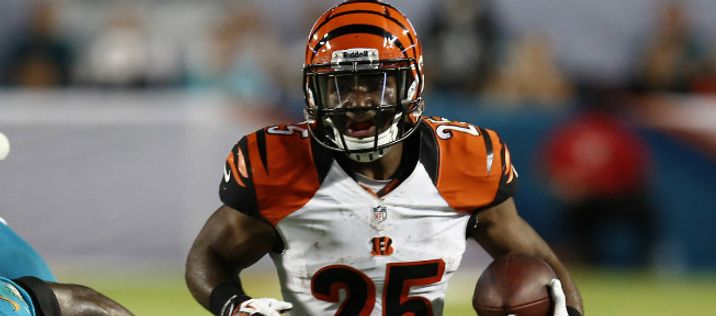
Gio Bernard (RB-CIN)
This may change considering how bad Jeremy Hill was this past season, but Bernard himself hasn’t been a best-ball target, either. Despite being labeled a better PPR running back, Bernard’s last 34 games have netted exactly zero games above 24 PPR points, and just two games with more than 19 PPR points. He’s not someone you should expect to have a breakout.
Darren Sproles (RB-PHI)
Not only is Sproles aging, but he’s not getting a workhorse role any time soon. Despite the injuries to the running backs in front of him over the last few years, Sproles has totaled just two 20 point performances over the last three years.
Players who are in an offense that limits their impact (try to avoid)
Todd Gurley (RB-LAR)
Regardless of how you feel about Gurley’s talent, it’s extremely unlikely that he’ll have a chance to score more than eight touchdowns next year. It’s like Steven Jackson all over again. While Gurley can very well finish as an RB1 due to volume alone, that doesn’t give him the weekly upside that someone like Jay Ajayi or Mark Ingram has. Both of those two are being drafted behind Gurley in early MFL10 ADP.
Subscribe: iTunes | Stitcher | SoundCloud | Google Play | TuneIn | RSS
Mike Tagliere is a featured writer at FantasyPros. For more from Mike, check out his archive and follow him @MikeTagliereNFL.