Third base is the deepest position on the infield right now – and it’s not even close! That expression is by far my favorite cliché in fantasy sports chatter right now. “Arenado or Donaldson or Bryant or Machado or Freeman? Arenado and it’s not even close!” Of course it’s close, but it’s still Arenado.
Complete a mock draft in minutes with our free Draft Simulator
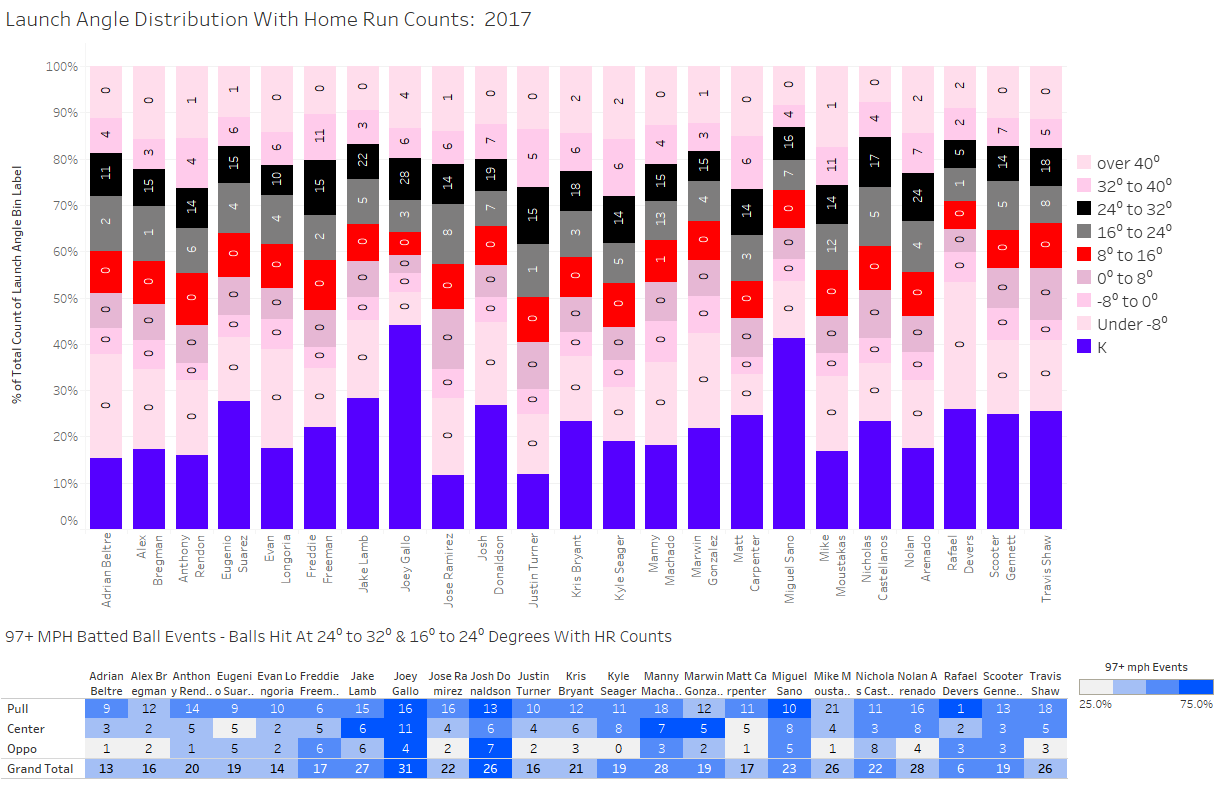
This is an overview of the third base position. You can quickly train your eye on the blue region to assess strikeout impact for each player, the red region for line drives (which drive BABIP and overall wOBA), the grey region which is where home runs begin and the black region where most home runs come from. The pink regions represent the lower wOBA outcomes. Some players with high exit velocity or favorable home parks may be able to homer out of the higher pink regions, while some speedy players may be better at turning the first two pink regions below the red into hits. In general, the bigger the red through black regions the more success a player is expected to have. You may access this fully interactive dashboard via my Tableau Public profile.
The Top Tier Third Basemen: Arenado, Donaldson, Freeman, Bryant and Machado
These are the big boys to run out there at third base. Arenado is your R+RBI king, but Donaldson isn’t far behind. The Coors Field effect keeps Arenado in the top spot with projection systems pushing him to the 220-225 R+RBI range. With Donaldson, the Blue Jays lineup isn’t quite as fearsome as it has been in the recent past, but he’s still projecting for ~200 R+RBI despite the fact that his projection includes missed time in 2017.
Bryant, Machado and Freeman are the bottom half of the top tier, and that’s no slight to them. In fact, Bryant’s strikeout rate has been decreasing over the past three seasons. That fact combined with Donaldson’s strikeout rate increase last year and perhaps Bryant is able to put the same amount of balls in play to do similar damage in the counting stat category. Where Bryant really shines, however, is in OBP leagues due to his lifetime .388 total. Bryant does run a slightly lower ISO than Arenado and Donaldson but it’s his batting average which keeps his TB and SLG strong for leagues which use those categories instead or in addition to HRs.
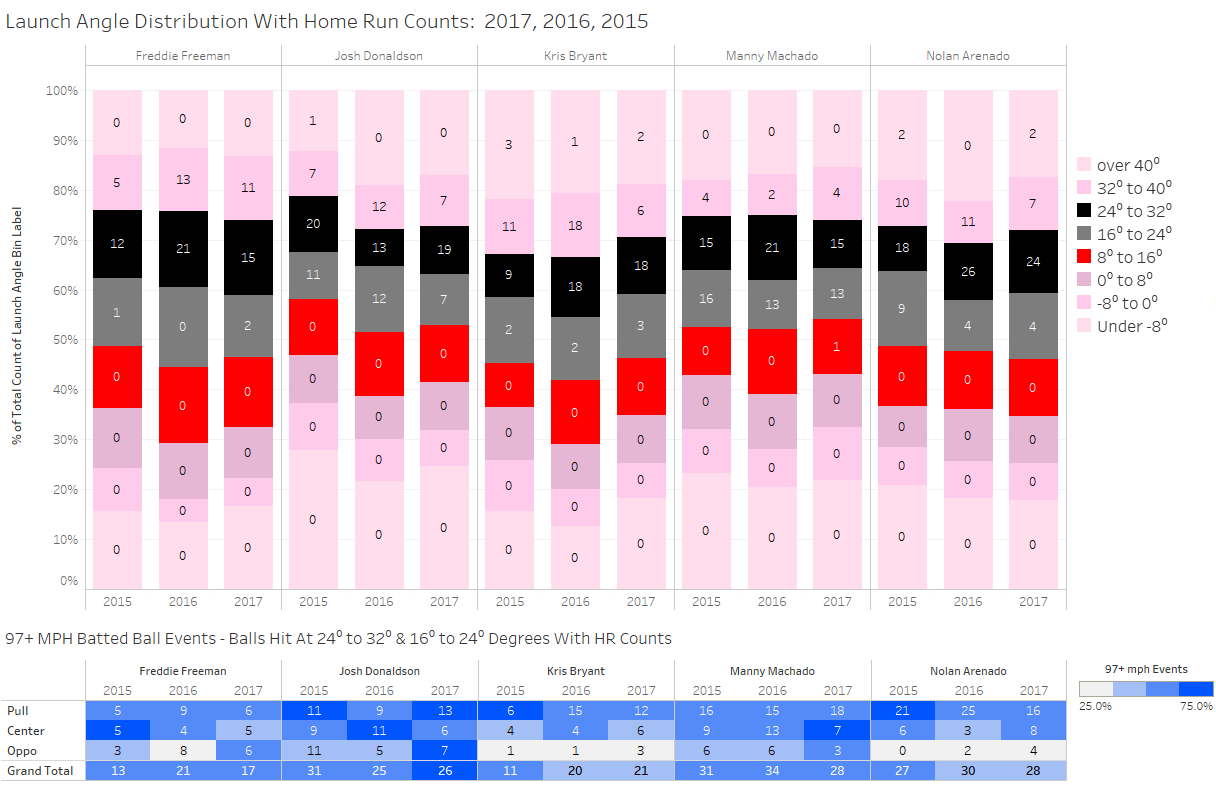
Bryant buoys his slugging percentage with a high BABIP and batting average. You should immediately wonder if this is chance or a skill. I’ll add another name to the comparison set to make a point.

For three years Kris Bryant has consistently had a BABIP on these line drives and “fliners” (cross between a line drive and fly ball) 100 points higher than his peers and 30 points higher than Joey Votto. That’s some accomplishment. Aside from his strikeout rate, take the batting average and BABIP to the bank on Bryant.
Freddie Freeman makes an appearance on the 3B lists this year thanks to his flexibility in allowing Matt Adams a chance to stay in the Braves lineup last year. The Braves rebuild and thus the lineup around Freeman are the only things that have been suppressing Freeman’s fantasy value in terms of his counting stats the past few years. Now the Braves are getting better, Freeman changed his batted ball profile two years ago to produce more power, Sun Trust Park is one of the best hitters parks in the NL and he still chips in 5-10 SBs just like Bryant and Machado. Freeman is as an elite a bat as exists today and will only get more valuable as the Braves lineup grows up around him.
Machado, soon to be only a SS (again), has his own unique profile. He walks less than the other players in this tier which keeps his OBP in the .320-.340 range, but also allows him to run high total base totals despite his lower AVG, SLG and ISO than the other players in this tier. His launch angles are lower than someone like Kris Bryant, but his power to all fields and approach at the plate plays well for home runs. He had an off year, but don’t let that make you think less of him heading into 2018.
Power And Speed Options At 3B: Bregman and Ramirez
These are your two options if you require the 15 SBs from your third base lineup slot to make up for deficiencies or to inflate your overall totals if you’re already set. The major difference between these two players are that Jose Ramirez has a premier lineup slot locked down on a top run-scoring team to boost his R+RBI totals. Meanwhile, Bregman has floated around the stacked Astros lineup logging a majority of his plate apperances in the two-hole (196) and eight-hole (195) last year while spending time hitting sixth or seventh as well. By the time September and Ocotber rolled around, Bregman was spending equal time between the second and sixth spots in the order. If he can maintain a majority of at-bats near the top of the Astros lineup hitting behind Springer and ahead of Correa and Altuve his value should increase.
Jose Ramirez hit 29 home runs in 2017 after hitting just 11 the previous season. While there are some positives regarding increased exit velocity, there are reasons to question the repeatability of the full total in 2018. Namely that the expected outcomes for approximately 8-10 of his HRs could have been just as likely to be doubles or fly ball outs depending which park and which part of the park he hit those balls to.
The Depths Of Third Base Depth
It’s nearly impossible to recommend options after the Big 5 and the Speed+Power tandem without understanding your team’s particular roster construction. Do you need immense power and can suffer a batting average drain? Let me introduce you to the Gallo and Sano pairing. They’ll both offer 35+ home runs over the course of a full season, though Sano does have that whole bionic-shin-bone-thing going on. How about middle of the order sluggers with favorable home parks for doubles and home runs? That’s Travis Shaw and Jake Lamb, each who should contribute 180-200 R+RBI while providing decent floors on OBP and AVG with little in terms of ceiling above .260/.330.
If you’d like to trade in some of the power for a higher batting average and a higher on-base percentage, then you may be more interested in rostering Anthony Rendon or Justin Turner. Rendon carries the risk of youth and the higher standard deviations around his outcomes, while Turner carries the risks that come with players in their mid 30s such as injuries and declines in batted ball performance.
Adrian Beltre still offers elite production when he plays. But there’s the catch for the 38-year-old – when he plays. Beltre still has easy 30-HR power over a full season and will contribute middle-of-the-lineup counting stat production similar to Travis Shaw or Jake Lamb on a per game basis. With all the depth available at third base this year you could afford to take Beltre later than some of the top options as your primary 3B and couple him with one of the vast number of other solid options at the position.
Eugenio Suarez, Kyle Seager and the unsigned Mike Moustakas represent options for the lower end of 12-16 team mixed rosters when filling out third base and corner infield positions. Seager represents the player with the most exit velocity on flyballs and still has power to both the pull-side as well as centerfield. Suarez benefits quite a bit from his home park, which helps sustain his ISO and SLG. Depending where Moustakas lands he could offer the most in terms of HR upside, though we should expect some regression due to the higher than expected number of flyballs that landed in the seats from the higher than ideal launch angles (32+ degrees) that showed less than ideal exit velocities.
Rafael Devers Is A Sleeping Giant
Rafael Devers destroys baseballs and his walk and strikeout rates in his age-20 season were already more than passable at the major league level. How hard does he hit the ball? To the pull-side, he averaged 100mph when he put it in the air at home run launch angles. It was a small sample size, but this was comparable to Joey Gallo or Aaron Judge and is in line with his scouting grades on his raw power (60/70). But it’s not just pull-side power for Devers, he has the ability to homer to all fields and did last year. He had five opposite field home runs and two to center. As Devers learns to elevate the ball he’s going to steadily rise up through the 3B ranks and could join the top five as early as next year. It certainly wouldn’t be out of the question for the young slugger to hit 25-30 HRs this year, but because he’s young, it’s also possible he goes through a sophomore slump as pitchers adjust to him and he works on the counter-adjustments. Devers and Beltre would make an interesting risk profile tandem for 2018.
Nick Castellanos‘ Second Half Was Amazing
This isn’t the first time we’ve seen Nick Castellanos enjoy a decent half season while scuffling through the other half. While this is likely his last year with 3B eligibility after the Tigers moved him to the OF late last year, Castellanos does offer some upside even with the Tigers awful lineup. He will bat cleanup or fifth for the Tigers and hit behind Miguel Cabrera which should still provide him with a decent number of RBI opportunities, though there is almost nothing at the bottom of the Tigers lineup which should keep his runs total quite low.
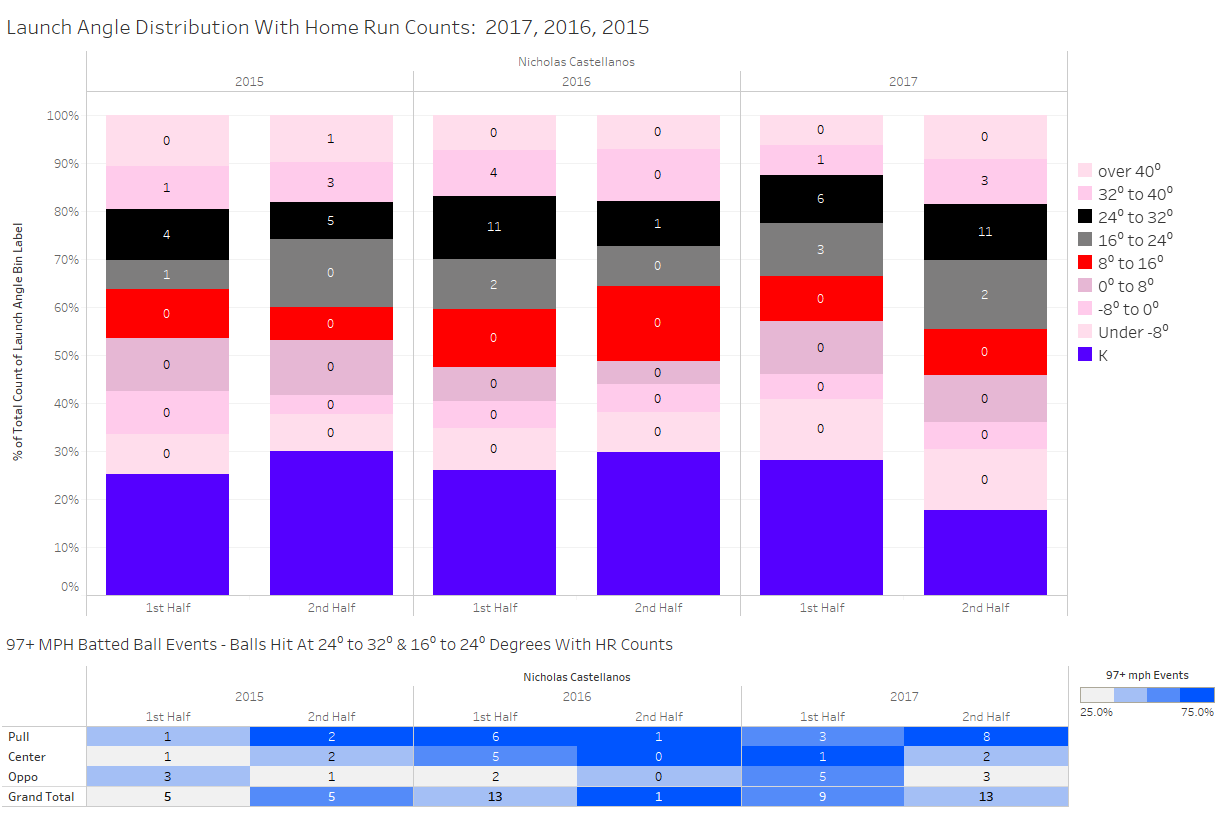
As I noted, in the second half of last year Nick Castellanos started to take off when he brought his strikeout rate down to 17% and started to hit over a quarter of his batted balls at home run launch angles. Remember that while he was scuffling in the first half of the season he was hitting far too many balls on the ground despite increasing his FB% for three straight seasons prior to 2017. His second half FB% was 43.8% and in line with the progress he made in 2016. Despite the fact that he still hits too many balls in the air to the opposite field (balls die in RF at Comerica), Castellanos has elite power when pulling the ball in the air to left field. If the changes stick, you’re looking at a 30+ HR season with a triple slash line in the neighborhood of .290/.330/.540.
2018 Shortstop Primer
2018 Second Base Primer
2018 First Base Primer
2018 Catcher Primer
Dominate with our best fantasy baseball tools
Subscribe: iTunes | Stitcher | SoundCloud | Google Play | TuneIn | RSS
Jim Melichar is a correspondent at FantasyPros. For more from Jim, check out his archive and follow him @JimMelichar7.