I’ve been putting together a series of my favorite draft strategies over the past month to help you dominate your leagues. In head to head and roto leagues, it often makes sense to punt a category or two so you can get serious value by focusing on specific types of players. The final strategy I wanted to share is what I call the Moneyball Method. In a standard 5×5 league, we will be punting saves and stolen bases while loading up on power hitters and safe ratio, starting pitchers with inning concerns. As you may have guessed, we’ll be avoiding closers and focusing on power-relievers who will rack up the K’s while helping our ratios. If this is executed the right way, you should finish in the top three in eight of the ten categories which will give you a major upper hand over your league.
Mock in minutes (free) with our fantasy baseball draft software 
If you missed the other articles in the series, I prefer the Marmol Strategy, Pocket Rockets and the Bichette Strategy if your league allows for it. With that said, some prefer this method and it works great as well. Plus, your league settings may force you away from those strategies, especially if you cleaned house with the Marmol last year and awakened the commissioner to the hole in your league’s settings. Today, I’ll give you the main goals of the Moneyball Method, explain when you should use it, and give you a sample roster drafted in our Draft Wizard Simulation Software. Spoiler, Draft Wizard projects the team to finish in first by a considerable margin.
What are the main goals of the Moneyball Method?
- Punt saves and steals
- Dominate the other eight categories
- Spend most of your draft capital on a great lineup
- Sprinkle in safe-ratio starting pitchers with inning concerns
- Grab about 8 of those and hope to strike gold on 4 or 5
- Round out your staff with a handful of non-closing alpha-relievers
When should I use the Moneyball Method?
I am, as always, all about using Pocket Rockets or the Marmol Strategy. The Bichette strategy is a great fallback too, but in many cases, league settings don’t allow for these strategies. If your league has an inning minimum (can’t use the Marmol), a waiver wire limit (can’t use the Bichette) or you aren’t able to draft Max Scherzer or Chris Sale in the first thanks to keepers or draft order (can’t use Pocket Rockets), then you’ll want to turn to the Moneyball Method which is easy to execute and a good bet to help you finish in the top three of your league. Now, if you play in a points league, scrap the strategies and focus entirely on value. Every points league is different, but it almost always pays to draft starting pitchers who qualify as relievers and loading up on power-heavy, walk-heavy bats at every position regardless of batting average or stolen bases. It also helps to upload your league’s settings into our action calculator then use the dollar values as your rankings for a points league snake draft.
Who should I target?
Safe Ratio SPs with IP concerns
- Walker Buehler (LAD)
- Stephen Strasburg (WAS)
- James Paxton (NYY)
- Charlie Morton (TBR)
- Yu Darvish (CHC)
- Rich Hill (LAD)
- Ross Stripling (LAD)
- Carlos Martinez (STL)
- Forrest Whitley (HOU)
- Alex Reyes (STL)
- Hyun-Jin Ryu (LAD)
- Kenta Maeda (LAD)
- Chris Paddack (SDP)
- Freddy Peralta (MIL)
- Jesus Luzardo (OAK)
- Matt Strahm (SDP)
- Brent Honeywell (TBR)
- Jacob Faria (TBR)
- Julio Urias (LAD)
Great Ratio RPs with no saves
- Josh Hader (MIL)
- Dellin Betances (NYY)
- Seranthony Dominguez (PHI)
- Andrew Miller (STL)
- Chad Green (NYY)
- Adam Ottavino (NYY)
- Ryan Pressly (HOU)
- Diego Castillo (TB)
- Carl Edwards Jr. (CHC)
- Zack Britton (NYY)
- Keone Kela (PIT)
- Taylor Rogers (MIN)
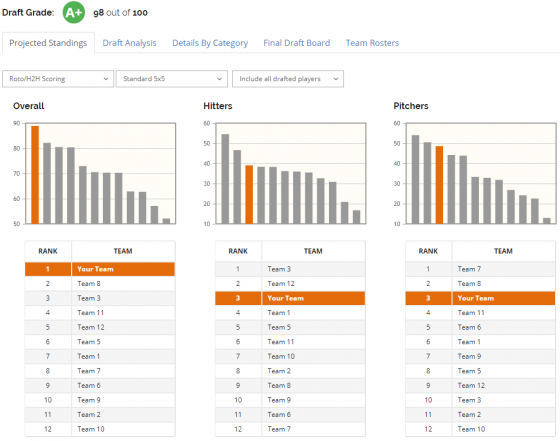

I drafted fourth overall because that range is the ideal spot to get three mashers to open up the draft. Unlike the Marmol and Bichette strategy, I don’t mind mixing in a starting pitcher or two in the first two rounds, but the ones you target should be high-upside, safe ratio pitchers with innings concerns. The idea is that by drafting eight of that type of pitcher, you’ll essentially come out of it with five second-tier pitchers. Drafting ratio-monsters and strikeout machines in your bullpen will help you round out the four pitching categories you are focused on. Likewise on offense, since you are spending most of your draft capital there and focusing only on four categories, you should be able to dominate the other four categories. Here are the players that put me at the top of the league.
- 1.4 Nolan Arenado (3B)
- 2.9 Aaron Judge (OF)
- 3.4 Giancarlo Stanton (OF)
- 4.9 Walker Buehler (SP)
- 5.4 J.T. Realmuto (C)
- 6.9 Daniel Murphy (2B)
- 7.4 Jose Abreu (1B)
- 8.9 Nelson Cruz (UTL)
- 9.4 Matt Olson (CI)
- 10.9 Robinson Cano (MI)
- 11.4 Josh Hader (RP)
- 12.9 Eloy Jimenez (OF)
- 13.4 Yu Darvish (SP)
- 14.9 Rich Hill (SP)
- 15.4 Nomar Mazara (OF)
- 16.9 Paul DeJong (SS)
- 17.4 Ross Stripling (SP)
- 18.9 Dellin Betances (RP)
- 19.4 Alex Reyes (SP)
- 20.9 Trey Mancini (OF)
- 21.4 Seranthony Dominguez (RP)
- 22.9 Forrest Whitley (SP)
- 23.4 Chad Green (RP)
- 24.9 Chris Paddack (SP)
- 25.4 Jesus Luzardo (SP)
- 26.9 Ryan Pressly (RP)
Thanks for reading and good luck!
Prepare for your fantasy baseball draft with our Mock Draft Simulator