Draft week has arrived, and I’m ready to dive into the 2025-26 NBA season, now just days away. There’s nothing like a mock draft to fine-tune my strategy. For this one, I tackled a 10-team, nine-category league, securing the third overall pick.
In nine-category leagues, every stat matters — points, rebounds, assists, steals, blocks, turnovers, field-goal percentage, free-throw percentage and three-pointers. Each category contributes equally to your weekly matchup.
In this article, I’ll break down each pick, share the reasoning behind my choices and explore alternative players I considered, giving you a roadmap to craft your own contender. Let’s get into it.
- NBA News
- NBA Projections
- NBA Player Futures
- Subscribe to our Fast Break Bets Podcast for Daily NBA & WNBA Bets
Check out the latest fantasy basketball expert consensus rankings

Fantasy Basketball Mock Draft: 10-Team Category League (2025)
Draft Strategy and Approach
My plan was simple, yet adaptable: Target Victor Wembanyama for his unparalleled rebounding and shot-blocking potential, with Shai Gilgeous-Alexander as my backup if Wembanyama was off the board. From there, I’d let rounds two and three shape my approach, staying flexible to capitalize on the draft’s flow.
If Wembanyama landed on my roster, the next step depended on the options in rounds two and three. Should the available guards and wings fail to stand out, I’d likely double down on size — going back-to-back bigs to dominate blocks, rebounds and field goal percentage. The idea would be to build a frontcourt fortress, pairing Wembanyama’s elite rim protection with another efficient interior scorer to create a categorical advantage few teams could match.
On the other hand, if Gilgeous-Alexander became the cornerstone, the plan would pivot toward balance and versatility. His elite efficiency, assist-to-turnover ratio and defensive stats make him the perfect anchor for a well-rounded nine-category roster. From there, I’d assess whether a true all-around build was viable based on draft trends. If not, I’d lean into a guard-heavy approach — targeting scoring, threes and assists while intentionally punting rebounds and turnovers to maximize value in the remaining categories.
Either path would keep the core strategy intact: Build around an elite foundational piece while staying adaptable to the draft board’s rhythm, ensuring each pick added complementary strengths rather than overlapping weaknesses.

Round-by-Round Breakdown
With my approach set, it was time to see how the strategy would unfold once the draft began. Each round presented different decisions — weighing positional needs, category strengths and value on the board. Here’s how the draft played out, along with the reasoning behind each selection and a few alternate options I considered.
1.03: Victor Wembanyama (C – SAS)
With Nikola Jokic and Shai Gilgeous-Alexander off the board, selecting Victor Wembanyama was an easy call. He averaged 22.5 points, 10.8 rebounds, 3.8 assists, 3.7 blocks and 1.2 steals per game last season — production that impacts every category. His efficiency also stands out for a player with that usage, shooting 46.9% from the field, 33.9% from three and 80.9% from the charity strip. Wembanyama doesn’t hurt you anywhere while providing a massive edge in rebounds, blocks and defensive stats, especially compared to other frontcourt options.
The only other players worth considering here are Giannis Antetokounmpo and Luka Doncic. Antetokounmpo’s free-throw struggles (career-low 61.7% last season) can drag down that category, while Doncic offers elite offensive numbers but less of a defensive impact. Wembanyama’s league-leading 3.7 blocks per game — far ahead of the next closest player, Walker Kessler (2.4) — made him too valuable to pass up.
2.08: Chet Holmgren (PF, C – OKC)
In this spot, I was hoping Donovan Mitchell fell to me. However, guards came off the board quickly in round two, with Devin Booker, James Harden, Steph Curry, Tyrese Maxey and Mitchell all gone in that order.
At that point, the decision came down to reaching for my next preferred guard, LaMelo Ball — more of a late third- or early fourth-round option in 10-team leagues — or doubling down on size with Chet Holmgren, Alperen Sengun, Jaren Jackson Jr. or Jalen Johnson.
I went with Holmgren, who offers major upside at just 23 years old. He’s already proven to be an elite shot-blocker with 2.2 blocks per game for his career, and his 78% free-throw shooting ensures he won’t drag that category down. Compared to Sengun, whose 69% mark from the line over the past two seasons can hurt efficiency builds, Holmgren was the better fit for my plan to dominate blocks while maintaining balance in other categories.
3.03: Jaren Jackson Jr. (PF, C – MEM)
Alperen Sengun, Jalen Brunson and Amen Thompson went off the board before the draft snaked back to me. Once again, I considered LaMelo Ball, but ultimately decided to triple down on size and select Jaren Jackson Jr.
Jackson is cleared for the start of the regular season after offseason toe surgery and brings a different dimension to my frontcourt. Unlike Victor Wembanyama and Chet Holmgren, Jackson is more of a scoring big, averaging 22 points per game over the past two seasons while maintaining a career 79.2% rate from the free-throw line and contributing 1.9 blocks per game.
After three rounds, my direction was crystal clear: Dominate the blocks category with bigs who won’t tank free-throw percentage, creating a foundation built on elite rim protection and efficiency.
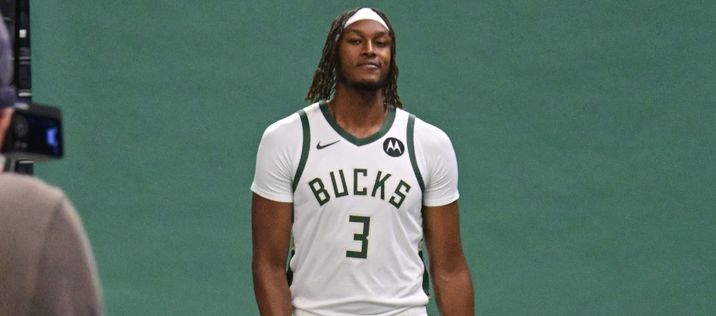
4.08: Myles Turner (C – MIL)
As expected, LaMelo Ball went late in the third round at pick 3.9, while my other potential guard targets — Derrick White and Jaylen Brown — were also selected in that range. That left me weighing Jamal Murray and Josh Giddey as backcourt options or reaching slightly for Myles Turner, who perfectly fit my build and would further strengthen my frontcourt depth.
Ultimately, I went with Turner because you really can’t have too many bigs for this strategy, right? He fits the exact mold I was aiming for, averaging 2.2 blocks, 6.5 rebounds and 77% from the line over his career. His combination of rim protection and solid free-throw shooting makes him an ideal complement to Victor Wembanyama, Chet Holmgren and Jaren Jackson Jr. Plus, Turner’s durability adds value, having appeared in 70+ games in each of the past two seasons — a stabilizing presence for a team built around young stars that’s a bit injury prone.
5.03: Ja Morant (PG – MEM)
At this stage of the draft, I felt comfortable with my frontcourt depth and wanted to add at least one guard and one forward — or possibly double down on guards. With Josh Giddey and Jamal Murray already off the board, I opted for Ja Morant.
While his career 31.6% from three isn’t ideal, Morant’s 45.4% field-goal mark and ability to fill up the box score more than make up for it. Morant averaged 23 points and 7.3 assists per game last season and should post similar — if not better — numbers with Desmond Bane no longer in Memphis. The only real concern is durability, but the upside at this stage of the draft was too good to pass up.
6.08: Darius Garland (PG – CLE)
In this spot, I was torn between Darius Garland and Zion Williamson. It was a tough call — Williamson offers tremendous upside and fits the foundation I’d built, but his 65.6% free-throw shooting from last season was a deal-breaker. After making free-throw percentage a key focus and avoiding anyone below 75%, I couldn’t justify taking that hit.
I went with Garland, who filled a clear need at guard and brought elite efficiency to my roster. He’s a proven scorer and playmaker with a career 38.8% mark from three and 86.7% from the free-throw line. While he underwent toe surgery in the offseason and is expected to miss a few games to open the year, Garland’s long-term value made him well worth the pick at this stage.
7.03: Mark Williams (C – PHX)
It may not be surprising at this point, but I went with another big. Typically, rounds 8-10 are when the remaining quality bigs start to disappear, so I wanted to secure one more while I could. Given my frontcourt-heavy roster, I targeted a player with significant upside — Mark Williams.
Williams’ talent is undeniable. He averaged 15.3 points, 10.2 rebounds and 2.5 assists in 44 games last season. The main concern is durability, as he’s appeared in only 106 games across his first three years. Still, with the frontcourt depth I’ve built, I felt comfortable taking that risk. I see a strong breakout opportunity for him with the Phoenix Suns, who lack consistent scoring beyond Devin Booker and Jalen Green, who will miss the start of the season.
8.08: Brandon Ingram (SG, SF, PF – TOR)
With this pick, I knew it was time to grab my first small forward. The choice came down to Brandon Ingram or DeMar DeRozan. DeRozan was the safer choice given his durability and consistency, but I’d already invested in several high-upside players with durability concerns — so I figured, why stop now? Not the smartest move on paper, but you’ve got to take risks to win it all, right?
While DeRozan mainly contributes scoring, Ingram offers a more well-rounded profile. He owns a stronger career three-point percentage, adds value on the glass and provides solid assist numbers for a forward. His versatility fit what my roster needed at this stage, making him the better long-term play.
9.03: Tyler Herro (PG, SG – MIA)
At this point, it was obvious I needed more guards, and I noticed Tyler Herro continuing to slip past the sixth round. I told myself, “If he’s still there in the ninth and I have fewer than three guards, I’m taking him.” Sure enough, that’s exactly what happened.
Herro is expected to miss at least the first three weeks of the regular season, but I’m comfortable stashing him in an injured reserve (IR) spot. He averaged a career-high 23.9 points per game last year, though I expect that to dip into the 18-21 range with Norman Powell now in the mix. Still, his efficiency holds strong — highlighted by an 87.4% career free-throw mark — and he brings scoring and shooting upside that my roster was lacking.
10.08: Shaedon Sharpe (SG, SF – POR)
With my next three picks, I knew I needed guards and forwards, so I was targeting players with high upside. First on my list was Shaedon Sharpe. He posted a team-high 25% usage rate last season, and with Anfernee Simons now in Boston, I expect that number to climb even higher.
Sharpe is coming off a career year, averaging 18.5 points per game, and I see that rising to around 20 this season. On top of that, his career free-throw percentage sits above 75%, making him a perfect fit for the type of roster I’m building.
11.03: Bennedict Mathurin (SG, SF – IND)
With Tyrese Haliburton out for the season due to an Achilles injury, I see Bennedict Mathurin poised for a big season. When Haliburton missed time last year, Mathurin posted a team-high 25.3% usage rate.
Mathurin also averaged 16.1 points and 5.3 rebounds while shooting 83.1% from the free-throw line and 34% from three, checking all the boxes I was looking for. If he’s still available at this stage of the draft, he’s definitely a player worth targeting.
12.08: Kevin Porter Jr. (PG, SG – MIL)
With Damian Lillard no longer in the picture, I expect Kevin Porter Jr. to have a breakout season. He showed flashes of his potential with the Houston Rockets but hasn’t had consistent opportunities in Los Angeles or Milwaukee, and injuries have limited his impact.
Now, it’s Porter’s time to shine. I took a gamble on Porter, as I’m thin at the guard position and looking for a high-upside player who can make a big impact if things break his way.
13.03: Tobias Harris (SF, PF – DET)
At this stage of the draft, I wanted one more small forward and aimed for a safe, consistent option — and there’s few better than Tobias Harris. While he had a down year scoring-wise with the Detroit Pistons, averaging 13.7 points per game, his durability is reliable, having played at least 70 games in each of the past four seasons.
Harris also contributes 6.2 rebounds per game on average and maintains strong shooting percentages across the board. For a late-round pick, there’s not much more I could ask for.
14.08: Brook Lopez (C – LAC)
I had a similar approach as the previous round with this draft pick: A consistent, durable player that fits what I’m doing. Since I have multiple injury-prone bigs, I wanted to get one that’s not that.
Brook Lopez has played in 75+ games in three straight seasons while averaging 30 minutes per game. While he’s now on a new team with the Los Angeles Clippers, he should still see plenty of playing time. Plus, he owns a career 1.9 blocks per game with a great field-goal percentage and can light it up from three.
Final Thoughts and Team Takeaways
After 14 rounds, my roster is built with a clear identity: Dominate blocks and rebounds while maintaining strong efficiency, especially in free-throw and field-goal percentages. By prioritizing high-upside bigs early — Victor Wembanyama, Chet Holmgren, Jaren Jackson Jr. and Myles Turner — I established a frontcourt foundation few teams can match. Complementing that with guards like Ja Morant, Darius Garland, Tyler Herro and Shaedon Sharpe provides scoring, assists and shooting balance, while late-round picks like Tobias Harris and Brook Lopez add durability, consistency and category coverage.
This draft reflects a flexible, risk-reward approach. I wasn’t afraid to take players with injury concerns or volatility when upside outweighed risk, and I supplemented those picks with safer options to stabilize the roster. Key lessons include the importance of positional balance, the value of free-throw percentage in a blocks-heavy build and the upside potential of targeting high-usage players who could see expanded roles.
Overall, this mock draft illustrates how a clear strategy — combined with adaptability and calculated risks — can help you assemble a competitive nine-category team capable of contending across multiple categories while staying efficient and resilient throughout the season.

Subscribe: YouTube | Spotify | Apple Podcasts | iHeart | Castbox | Amazon Music | Podcast Addict | TuneIn