Fantasy football is easy if you pick the right players. But to improve your odds of picking the right players, you need to avoid picking the wrong players.
Here are some of the players I’m bypassing in my 2026 drafts.
Pat Fitzmaurice’s 11 Fantasy Football Players to Avoid (2026)
Quarterbacks
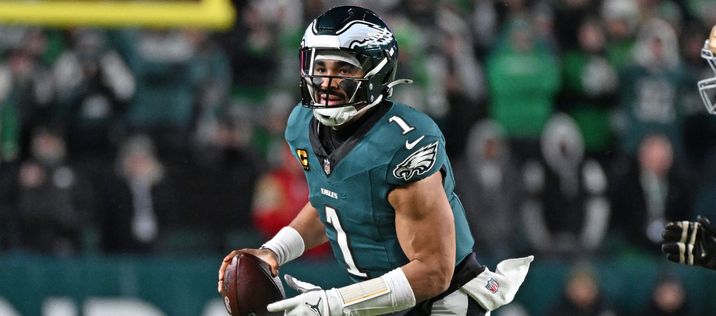
At his midrange QB1 price, Hurts has to deliver significant rushing value to give you a satisfying return on investment. Because let’s face it: Hurts has been a pretty average passer.
Hurts has never had a 4,000-yard passing season. He averaged 201.5 passing yards per game and 7.1 yards per pass attempt last year – modest numbers. His 25 TD passes last season were a career high.
Hurts’ top target for the last four years, AJ Brown, is now with the Patriots. WR Devonta Smith and TE Dallas Goedert are still around. The Eagles also drafted WR Makai Lemon and TE Eli Stowers, and they traded for Dontayvion Wicks. But many of the Eagles’ top pass catchers do their best work over the middle, and Hurts traditionally hasn’t thrown there very often.
Granted, the Eagles’ passing game could be better under new offensive coordinator Sean Mannion than it was under the much-maligned Kevin Patullo. But it seems unlikely that Hurts will suddenly become a prolific passer under the direction of a first-time NFL playcaller.
For Hurts to be a midrange QB1 or better, he’ll have to put up big rushing numbers, and we saw his rushing numbers decline last year.
After four straight years of double-digit TD runs, with an average of 13 rushing touchdowns a season over that stretch, Hurts had eight TD runs last year. The Eagles had faithfully used the “tush push” every time they got inside the opponent’s 2-yard line in recent years. But last year, the Eagles started mixing in a shovel pass to Goedert when they were near the goal line. Goedert scored six such touchdowns last season from the opponent’s 5-yard line or closer.
Hurts’ 421 rushing yards last season were a five-year low.
With sensational rushing yards no longer bankable, Hurts is a fade.
The 25th overall pick in last year’s NFL Draft, Dart made 12 starts for the Giants and played well despite a skeleton crew of pass catchers following WR Malik Nabers’ season-ending injury.
Dart completed 63.7% of his passes, averaged 189.3 passing yards per start and 6.7 yards per attempt, and threw 15 TD passes and five interceptions.
The swashbuckling Dart provided much of his fantasy-football value as a runner, with 487 rushing yards and 9 TD runs.
But Dart was something of a crash-test dummy as a runner. He took some big hits, including one against the Bears that resulted in a concussion and forced him to miss two starts. Dart was also a sack magnet. He was dropped for sacks 35 times and had a sack rate of 9.4%.
Dart’s aggressive running is obviously a double-edged sword. Fantasy managers love those juicy rushing stats, but Dart’s recklessness could very well lead to injuries.
But there are two other areas of concern:
(1) Nabers has reportedly been slow to recover from his knee injury. If Nabers isn’t ready for Week 1, Dart’s top receivers will be Darnell Mooney and Darius Slayton, and TE Isaiah Likely might be the top target earner.
(2) New Giants offensive coordinator Matt Nagy isn’t regarded as one of the NFL’s top schemers.
Dart is being drafted as a back-end QB1 and seems risky at that price.
Running Backs
There’s no denying that Achane is an abundantly talented player and a fun watch. He’s averaged 5.6 yards per carry for his career, he’s scored double-digit touchdowns in each of his first three NFL seasons, and he’s had 145 catches over the last two years. Achane finished RB5 in half-point PPR scoring last year.
But Achane will be sailing into some fierce headwinds this year.
The Dolphins’ Vegas win total for 2026 was 4.5 as of this writing – and it was juiced toward the under.
Miami’s offensive line is expected to be among the worst in the league.
The Dolphins’ new quarterback, Malik Willis, averaged 18 pass attempts per game across his three starts for the Packers over the last two seasons. Only eight of his 54 throws in those three starts went to running backs.
It’s possible Achane’s talent overcomes the adverse conditions he faces in 2026, but that’s not a bet I’m eager to make in the second round of fantasy football drafts.
Fantasy managers covet high-volume RBs, so why should we turn up our noses at a running back who might average 18 or more touches a game this season?
It’s possible that Judkins will be reasonably priced in August, but I fear that the siren’s song of big weekly touch counts will push his ADP into uncomfortable territory.
Judkins averaged 18.3 touches a game for the Browns as a rookie, even though he missed training camp, the preseason, and Week 1 due to legal issues resulting from an arrest for battery. He ran for 75 or more yards in six of his 14 games and scored seven touchdowns.
In Week 16, Judkins dislocated his right ankle and fractured his fibula. Not only is he coming off a significant injury, but Judkins will be playing in a Browns offense expected to be among the league’s most anemic, and he’ll be running behind a completely remade offensive line composed of guys who haven’t played together.
Judkins’ current ADP has him coming off the board in the middle of the fifth round, which isn’t egregious. But you’d probably be better off with one of the receivers available in that range – players such as Christian Watson or Rome Odunze.
As of this writing, there was only about a half-round difference in the ADPs of Jaylen Warren and Rico Dowdle, the top two running backs on the Steelers’ depth chart. Warren was at RB30, 80th overall. Dowdle was at RB32, 86th overall.
I know some people who prefer Dowdle, and the rationale seems to be that, because Dowdle became the Cowboys’ lead back in Mike McCarthy’s final season as Dallas’ head coach, he will be the lead back in McCarthy’s first season as Pittsburgh’s head coach.
Aaron Rodgers is the prism through which we should view the Steelers’ backfield. The 42-year-old Rodgers is now immobile and seems less willing than ever to stand in the pocket and get hit. He’s going to want to play with a running back who can block for him and be a safety valve as a receiver. Steelers RBs accounted for 25.4% of team targets last season – the second-highest percentage in the league behind only the 49ers, who have pass-catching RB extraordinaire Christian McCaffrey.
Warren has averaged 2.6 receptions per game and 1.41 yards per route run over his career. Dowdle has averaged 1.4 receptions per game and 1.05 yards per route run over his career.
Warren received a PFF pass-blocking grade of 72.0 last season, which is very good. Dowdle received a PFF pass-blocking grade of 24.6 last year, which is awful.
My money is on Warren as Pittsburgh’s primary running back this year, and it’s possible Dowdle has a smaller role than some expect.
Marks wasn’t supposed to be the Texans’ lead back in his rookie year, but Joe Mixon missed the entire season with a foot injury, and Nick Chubb appeared to be out of gas. Marks averaged 3.6 yards per carry during the regular season and ranked 50th in yards after contact per attempt among running backs with at least 80 carries.
The Texans signed David Montgomery to be their lead back, which means Marks can slide back into the third-down role to which he’s better suited. But a third-down role might not be especially lucrative in Houston. The Texans have arguably the best defense in the league and figure to have a lot of run-friendly game scripts.
There are better darts to throw at a running back than Marks.

Wide Receivers
It’s easy to understand the appeal of Rashee Rice in fantasy football. Over the last two years, he’s averaged 6.4 catches and 71.6 receiving yards per game, with eight touchdowns in 12 regular-season games.
Rice has terrible personal judgment. He was involved in a high-speed street-racing incident in Dallas in 2024 that caused a multi-car crash, resulting in injuries. He pleaded guilty to third-degree felony charges of collision involving serious bodily injury and racing on a highway causing bodily injury.
In May, Rice violated the terms of his probation by testing positive for marijuana and was ordered to serve 30 days in jail. He recently had cleanup surgery on his knee and had to do his rehab in a Texas jail.
There were drafts in which I took the discount on Rice last year, when everyone knew he would have to serve a six-game suspension at the start of the season. He had a late-sixth-round ADP, and I got him cheaper than that in a couple of home leagues.
Now, Rice has an ADP of WR12 (30th overall). I’m fleeing at that price.
The venerable Adams has enjoyed a splendid career, but he’s 33 now, he plays with target hog Puka Nacua, and a huge percentage of Adams’ 2025 production came from touchdowns.
Adams led the league with 14 TD catches last season. He scored a touchdown on 23.3% of his catches and 12.3% of his targets. In all likelihood, those percentages are unsustainable.
Adams averaged 4.3 catches and 56.4 receiving yards per game in 2025 – his lowest totals in those two categories since his second year in the league in 2015.
Rams QB Matthew Stafford averaged 35.1 pass attempts per game last season and might not need to throw as often this year now that the Rams have added superstar edge rusher Myles Garrett and some high-quality cornerbacks, which will help them smother opponents defensively and lead to run-friendly game scripts.
Let someone else chase last year’s touchdowns.
It could be a colossal mistake to fade a former first-round draft pick who had 1,282 receiving yards and 10 touchdowns as a rookie.
But Year 2 for BTJ was rough: 48 catches for 707 yards and two touchdowns. His drop rate was 11%. His yards per route run fell by a full yard, from 2.45 to 1.45. The passer rating on throws to BTJ went from 106.2 as a rookie to 81.2 last year.
And when Trevor Lawrence was really cooking down the stretch last season, averaging 265 yards and throwing 18 TD passes over the final seven games of the regular season, Thomas was not getting his fair share of the spoils. He played in six of those seven games and averaged 3.0 receptions and 47.8 yards per game, and he caught just one of those 18 TD passes.
In fairness, BTJ was banged up for much of last season. He had a wrist injury early on that he seemed to be favoring when he caught only seven of his first 25 targets in the first three weeks of the season. He injured his shoulder at midseason, although he didn’t miss any time. And he missed three games with a high-ankle sprain in the second half of the season.
The question is whether the promise of a healthier season is enough for us to buy back in.
For me, it is not.
For one thing, a lot of BTJ’s rookie-year production came with Mac Jones at quarterback, not Trevor Lawrence. With Lawrence at QB in the first nine games of the season, BTJ averaged 5.9 targets, 3.9 catches and 66.1 yards per game. Which isn’t bad. But from Week 10 on, when it was Jones at quarterback for all but 10 pass attempts in one partial game for Lawrence, BTJ averaged 10.0 targets, 6.5 catches and 85.9 yards per game.
The target competition is stiffer now, with Jakobi Meyers joining the team midway through the 2025 season and Parker Washington looking like a breakout star late in the year. The Jags say two-way player Travis Hunter will be deployed primarily as a cornerback this year, but he’s a potential wild card as a target thief.
This just doesn’t seem like an ecosystem that sets up well for a Brian Thomas Jr. bounce-back.
Tight Ends
McBride has a top-20 ADP after a season in which he had 126 catches for 1,239 yards and 11 touchdowns – more than double the number of touchdowns he’d had in any previous season.
The Cardinals led the league in pass attempts last season. That won’t happen again – not after Arizona spent the No. 3 overall pick in this year’s draft on RB Jeremiyah Love. The Cardinals are also highly motivated to get third-year WR Marvin Harrison Jr. more involved after two disappointing seasons.
McBride had 169 targets last season, 51 more than the next most targeted tight end. Only two wide receivers had more targets than McBride last season: Ja’Marr Chase and Amon-Ra St. Brown.
McBride’s target total will fall victim to the laws of gravity. The Cardinals could easily have 100 fewer pass attempts than they had last season. And some of those passes will probably be thrown by third-round rookie Carson Beck, who’s likely to get a multi-game audition. Beck’s first taste of NFL action probably won’t be pretty.
It’s not as if we should expect McBride to flop, but I worry he won’t produce the sort of numbers to justify taking him with a mid-second-round pick.
Dalton Kincaid played 302 snaps last season, according to Pro Football Reference – about 25 snaps a game.
Kincaid’s efficiency numbers were great: 14.6 yards per catch, 11.7 yards per target, 2.70 yards per route run. Those are terrific numbers for a tight end.
But because he was a part-time player, Kincaid had 39 catches for 571 yards and five touchdowns and was the TE18 in half-point PPR fantasy scoring, TE10 in fantasy football points per game.
Kincaid tore his PCL two seasons ago. He didn’t have surgery and apparently isn’t planning to. Bills GM Brandon Beane has talked about the team needing to manage his workload.
The Bills seemed to be managing his workload last year, and Kincaid was barely fantasy-relevant, even though he was wildly efficient as a pass catcher. What if he’s still playing limited snaps and the efficiency falls back to career norms?
Even if I pass on the top tight ends in my drafts this year, I won’t be considering Kincaid as an alternative.

Subscribe: YouTube | Spotify | Apple Podcasts | iHeart | Castbox | Amazon Music | Podcast Addict | TuneIn