Every year, there are players we will not draft in fantasy football. Some burned us the year before, while others could have simply failed to live up to lofty expectations.
In last year’s version of this article, I nailed plenty of landmines like Deshaun Watson, Zack Moss, Rachaad White, Marquise Brown and Jake Ferguson. This year’s approach is not only avoiding players whose analytical profiles scream stay away but also circumventing other players at their average draft position (ADP) cost because it will be unlikely they will pay it off.
Without further ado, here are my players to avoid in fantasy football for 2025.

Fantasy Football Players to Avoid
Yes, I know this is blasphemous. Could it burn me? Sure, but it hasn’t in the recent past with Patrick Mahomes. Over the last two years, Mahomes has finished as the QB10 and QB11 in fantasy points per game. Low-end QB1 production isn’t hard to find in fantasy on a weekly or yearly basis. The Chiefs’ passing volume has helped sustain him as a QB1 in fantasy, but his per-dropback numbers have been quite forgettable, if not wretched, in some categories.
Last year, among 40 qualifying quarterbacks, Mahomes ranked 26th in yards per attempt, 19th in completion percentage over expected (CPOE), 29th in highly accurate throw rate and 20th in fantasy points per dropback, per Fantasy Points Data. Over the last two seasons, he has been one of the worst deep ball passers in the NFL, with the fifth and ninth-lowest CPOE and the eighth and sixth-highest off-target rate with targets 20 yards or further downfield.
Last season, Kansas City ranked 10th in passing rate and third in neutral passing rate, so I don’t see the volume going up. Unless Mahomes vastly rebounds as a passer in 2025, he’s overvalued as a mid-range QB1, and his upside is capped as a low-end QB1.
Last year, Jared Goff’s 6.9% passing touchdown rate (third-best in the NFL) carried him to a QB7 finish in fantasy points per game. His previous best finish in fantasy points per game was QB11 in 2023. Goff could be a QB1 again in 2025, but he’ll have to continue to be a touchdown outlier. He doesn’t have the rushing equity to offset a downtick in the passing department. Goff’s previous best passing touchdown rate as a Lion was 5.0%.
This isn’t to say Goff hasn’t been and won’t again this year be a damn good starting NFL quarterback. Last year, among 40 qualifying quarterbacks, he ranked second in yards per attempt, 12th in CPOE, and fourth in highly accurate throw rate (per Fantasy Points Data). Goff is a player that I’m just hoping doesn’t take a step back for him to pay off. That’s not a player I’ll be highly interested in for any fantasy football season.
Sam Darnold was the QB9 in fantasy points per game last year. Let’s get this out of the way VERY QUICKLY…Darnold set career marks in every category imaginable last year, and I don’t see anything close to that production repeating in 2025. Yes, last season, among 40 qualifying quarterbacks, he ranked sixth in yards per attempt and passer rating and third in CPOE, but also, when we look closer, the real Sam Darnold can still be found.
Despite those rousing stats I mentioned a second ago, Darnold was also 22nd in highly accurate throw rate, 15th in catchable target rate, and he had the ninth-highest turnover-worthy throw rate. With his move to Seattle, he loses Kevin O’Connell, faces a downgrade at offensive line and skill players, and will likely operate in a more run-centric offense. All of this leads to Darnold falling back into low-end QB2 territory in 2025.
Last year, Barkley finished the season as the RB1 in fantasy points per game, finishing with 378 touches, 2,283 total yards, and 15 total touchdowns. This season, we have to have the volume conversation and the worries about that for Barkley’s outlook for 2025. It’s a similar conversation that we had with Christian McCaffrey, Derrick Henry, and Josh Jacobs before him. Is it a concern? Yep.
My bigger worry is Barkley’s quietly meh tackle-breaking metrics last year. Among 46 qualifying backs, he had the fourth-best explosive run rate, but he was also only 28th in missed tackles forced per attempt and 35th in yards after contact per attempt (per Fantasy Points Data). Barkley could take another step back in these departments in 2025, which would be a tough pill to swallow if you’re taking him as a top-three pick.
Betting against Barkley is also just a lean into variance at RB1 overall that we have seen. Todd Gurley in 2017-2018 is the last running back to repeat as the RB1 in back-to-back seasons. I’m fading Barkley this year.
Last year, Jonathan Taylor racked up another RB1 season (RB7 in fantasy points per game) while dealing with a high-ankle sprain. While Taylor could post another top-12 season in 2025, I do have some huge concerns. First, it’s his ability (or inability) to stay healthy. He hasn’t played a full 17 games since 2021. As the mileage cranks up for running backs, injury issues aren’t something that usually goes away.
Second, the quarterback play for the Colts is a worry with how often they could be in the red zone this year, as well as his lack of passing game involvement. Last year, Taylor ranked sixth in red-zone touches. I don’t know if he comes close to that number this season, but I could easily be wrong. I don’t see more check-down opportunities for Taylor this season with Daniel Jones or Anthony Richardson under center. It’s not like he’s demanding those looks either, with his per-route performance in 2024, anyway.
Last year, among 45 qualifying backs, Taylor ranked 37th in target share (7.4%) and 43rd in yards per route run and first downs per route run, per Fantasy Points Data. Taylor has all of these red flags, and we haven’t even discussed his efficiency drop-off last year. Among 46 qualifying backs last season, he ranked 42nd in missed tackle rate and 44th in yards after contact per attempt. Taylor could get enough volume in 2025 to pay off his draft cost, but there is too much downside for me to invest.
Last year, Kyren Williams pulled off his best yesteryear Rachaad White or Leonard Fournette impression. A volume gobbling inefficient back who turned in an RB1 season (RB10). Williams ranked first in snap share, second in opportunity share and first in red-zone touches.
With all that said, Williams was one of the most inefficient per-touch backs in the NFL. Among 46 qualifying backs, he ranked 44th in explosive run rate, 37th in missed tackle rate and 40th in yards after contact per attempt, per Fantasy Points Data. Williams has to retain his every-down role in 2025 to pay off his ADP.
If Blake Corum or Jarquez Hunter eats into his workload substantially, Williams’ RB1 status will come crashing down. He doesn’t have the passing game involvement or efficiency to save him. Last year, among 45 qualifying backs, he ranked 38th in target share, 41st in receiving yards per game and 45th in yards per route run. I can’t draft a player like Williams near (or above) his ceiling.
Hubbard blew away everyone’s expectations last year as the RB13 in fantasy points per game. He was the Panthers’ every-down workhorse. Last season, he ranked third in snap share, fourth in opportunity share, 12th in weighted opportunities, and 14th in red zone touches.
I don’t know if he has that type of workload in 2025 with the offseason additions of Rico Dowdle and Trevor Etienne. Last year in Weeks 1-9, with Miles Sanders active, Hubbard had only a 35.5% route per dropback rate (Sanders 27.1%). It wasn’t until Sanders was out in Weeks 10-17 that Hubbard’s route per dropback rate climbed to 64%. If we zoom in further, in Weeks 1-3 with Sanders, Hubbard had three red zone rushing attempts while Sanders checked in with two.
Hubbard remains an electric early down rusher. Last year, he ranked 11th in explosive run rate and seventh in yards after contact per attempt (per Fantasy Points Data). Hubbard could find himself in committee this season as he owns most of the early down rushing volume, but splits up the red zone and passing down work. This could drop him to low-end RB2 or high-end RB3 status in 2025. I’ll be avoiding him in drafts this year.

The odds aren’t in Aaron Jones’ favor in 2025. He is coming off a season where he played 17 games for only the second time in his career. He amassed a career-high 306 touches with 1,546 total yards and an RB20 finish in fantasy points per game. I have worries about his ability to stay healthy after that type of workload in 2024.
Minnesota also added Jordan Mason this offseason to take some of the load off Jones, as Ty Chandler wasn’t up to the task as Jones’ running mate. This could help his health prospects but impact him in the volume and touchdown departments. If Jones’ weekly volume and touchdown expectations take a dip, I don’t know if his efficiency can pick up the slack at this point in his career.
Jones has been lightning in a bottle during his career, but last season, we saw Father Time starting to catch up to him. Among 46 qualifying backs, he ranked 36th in explosive run rate and 40th in missed tackles forced per attempt. Jones is an easier click as a mid-range RB3, but at his RB2 price tag, I’m out for 2025.
Well, the Bears didn’t add any threat to Swift’s workload before they selected Kyle Monangai in the seventh round of the NFL Draft. Monangai could be a thorn in Swift’s side this season if he can eat into his early down and red zone usage.
Last year, Swift was the RB21 in fantasy points per game as he soaked up volume. He ranked tenth in snap share, seventh in opportunity share, tenth in carries, and 15th in targets among backs. Swift was inefficient every step of the way, ranking outside the top 32 running backs in explosive run rate, yards after contact per attempt, missed tackles forced per attempt, and yards per touch.
Swift looks like the picture-perfect version of a classic dead zone back. People are investing in Ben Johnson steam and Swift’s projected volume. I won’t be falling on that fantasy football landmine in 2025.
Mixon volume-hogged his way to an RB8 finish last year. Last year, he ranked 14th in snap share, fifth in opportunity share, 17th in weighted opportunity, and sixth in red zone touches. The efficiency aspect hasn’t been there, and I doubt that it will change in 2025 with another year of touches hitting the body odometer. Last year, he ranked 22nd in explosive run rate, 38th in missed tackles forced per attempt, and 29th in yards after contact per attempt (per Fantasy Points Data). The Texans added Nick Chubb and Woody Marks this offseason to help out on early downs and in the passing game. With Mixon continuing to deal with a foot/ankle injury that will sideline him until Week 5 of the NFL regular season, he’s off my draft board. There are plenty of risky players with lengthy injury histories to take a swing on in 2025, but Mixon won’t be one of them for me.
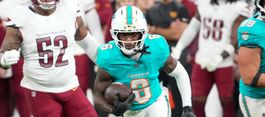
Drafting Tyreek Hill as a top-15 wide receiver… even a top-20 wide receiver in 2025? Nope, count me out at that price tag. Hill took a substantial step back in 2024, even if we disregard his frustrations with the team, the trade demands and his off-field issues.
Last year, with Tua Tagovailoa under center (Weeks 8-16), Hill was the WR24 in fantasy points per game while ranking 39th in yards per route run and 34th in target share. Among 112 qualifying wide receivers overall last year, he was 28th in separation and 48th in route win rate, per Fantasy Points Data. The per-route metrics aren’t damning, but expecting him to continue to hum along as a strong mid-range WR2 with WR1 upside is too much in 2025.
If Hill takes another step back, gets cut or traded, or Jaylen Waddle passes him in the Dolphins’ target hierarchy, he’s cooked for this season.
Zay Flowers is a WR2 in ADP right now. I just have one question: Why? I love Flowers’ talent, but what is vaulting him into this fantasy tier? It’s not his production. Over the last two seasons, he has finished as the WR32 and WR31 in fantasy points per game. Those finishes have occurred with Flowers outplaying his volume as the WR33 and WR38 in expected fantasy points per game. Do we think Baltimore will pass more in 2025? Doubtful with their offensive coordinator, Lamar Jackson and Derrick Henry all returning to Baltimore for this season.
Last season, Baltimore ranked third in rushing rate and ninth in neutral rushing rate. I don’t see that changing this season. So, could it be touchdown expectations fueling the Flowers’ hope? Nope. He has ranked 28th and 59th in red-zone targets over the last two seasons among wide receivers. With Rashod Bateman and Mark Andrews still on the team and the addition of DeAndre Hopkins in the offseason, we should have more worries about Flowers’ red-zone role decreasing than hope that it surges in 2025.
Flowers will remain a solid WR3, but I can’t expect him to vault into WR2 production. I can’t see it for 2025, and I won’t be paying for it in drafts.
Last year was the first time D.K. Metcalf didn’t finish as a top 24 wide receiver in fantasy points per game (WR30). Metcalf dealt with shoulder and knee injuries last year, which could also be contributing to his fall off. His per-route metrics don’t paint a rosier picture, as he was 78th in separation, 89th in route win rate, and 64th in first downs per route run (per Fantasy Points Data).
Yes, he did rank 36th in target share, 35th in yards per route run, and 20th in receiving yards per game, so it’s not all doom and gloom surrounding Metcalf. There are reasons to believe in a bounce-back here, but I won’t be investing in them.
A.J. Brown is the only primary receiver in an Arthur Smith offense that has paid off in recent memory. Just ask Drake London and George Pickens how Smith’s offense crushed them in recent seasons.
Add Xavier Worthy to the list of disappointing rookie wide receivers, as he finished as the WR40 in fantasy points per game. He can thank a strong finish to the season in the “Rashee Rice role” for even ranking that high in his first season. In Weeks 1-12, he operated as a field stretcher, as the WR51 in fantasy points per game with a 13.9% target share, 32 receiving yards per game, a 12.1 aDOT, and a 13.2% designed target rate (per Fantasy Points Data). It wasn’t until they shoved him into the Rice role that he took off. In Weeks 13-17, he was the WR21 in fantasy points per game, with a 21.3% target share, 57 receiving yards per game, an aDOT of 6.3, and a designed target rate of 25.6%.
Unfortunately for Worthy, Rice will be back in 2025 and reprise his underneath role, but with Rice’s impending suspension, Worthy should at least get a few games in the Rice role again. Worthy’s per-route metrics don’t offer a ton of hope, as he was 75th in separation and 86th in route win rate among 112 qualifying receivers last year.
Worthy could take a step in his sophomore season, but it’s tough to view him as anything more than a run-of-the-mill risky WR3/4. That’s obviously much lower than consensus, so if you’re following my ranks and analysis this season, you aren’t going to be drafting Worthy much (if at all).
Jayden Reed was a fantasy darling entering the 2024 season after posting a WR26 in fantasy points per game season and ten total touchdowns. His stock came crashing down last year (WR38) as Green Bay continued their stubborn usage of a wide receiver room by committee, and the passing volume dried up.
Among 85 qualifying receivers (per Fantasy Points Data), Reed ranked 15th in yards per route run, but he was outside the top 40 receivers in target share (52nd, 15.7%), receiving yards per game (41st, 50.4), first-read share (49th, 19.9%), and first downs per route run (51st, 0.080). Unless you’re a hyper-efficient receiver, like Reed was in 2023, it’s difficult to produce when you’re only running a route on 69.3% of dropbacks (64th).
His usage in camp suggests his slot-only role and capped route run rate aren’t changing this season. He’s also currently in a boot as he’s dealing with a foot sprain. This could linger into the regular season. It all leads to the fact that Reed is a risky pick who could revisit WR3 production in 2025 if he runs hot again with efficiency and touchdowns. I won’t be making that bet in fantasy football drafts this year.
Keon Coleman had a disappointing rookie season in which he missed four games with a wrist injury. He finished as the WR55 in fantasy points per game, operating as Buffalo’s man coverage option and deep threat (sixth-highest aDOT, 15.3). He ranked outside the top 40 wide receivers in target share (14.4%, 59th), yards per route run (1.87, 41st), first-read share (19.9%, 50th), and first downs per route run (59th, 0.074).
Coleman had a 27% target per route run rate (TPRR) versus man coverage while only a 14% TPRR versus zone coverage. Among 71 qualifying receivers, he ranked 37th in separation and 44th in route win rate against man coverage, which isn’t horrible numbers, but the addition of Joshua Palmer this offseason could push him out of this role. Palmer, in the same set of receivers, ranked fifth in separation and route win rate against man coverage.
Coleman could lose this role to Palmer. He wasn’t good enough against zone coverage to expect him to be fed in that realm, though. Among 128 qualifying receivers versus zone, Coleman ranked 125th in separation and 88th in route win rate. Coleman is a WR4/5 that I’m happily fading in 2025.
Cedric Tillman made some noise last year before he was forced to miss the rest of the season recovering from a concussion. In Weeks 7-12, Tillman was the WR12 in fantasy points per game with a 19.7% target share, 66.0 receiving yards per game, and a 23.3% first-read share (per Fantasy Points Data).
Tillman looks like fool’s gold, though, when we look at his deeper metrics during that stretch and for the entire season. In those five games, Tillman only had 1.71 yards per route run and 0.078 first downs per route run. Those aren’t amazing per-route numbers.
Tillman’s counting stats were inflated some by Cleveland’s play volume during this five-game stint, as they ranked third in passing attempts and second in passing rate. Another hit to Tillman’s resume is that overall, he also ranked 82nd in separation and 90th in route win rate last season (112 qualifying receivers). He’s a late-round receiver that I’ll be avoiding this season.
Loveland surprised some in the NFL Draft as the first tight end off the board. I’m not shocked by it, but I did think Warren would hear his name called first. Loveland’s top ten first-round capital is notable. Ben Johnson seemingly got his Sam LaPorta. I don’t think Loveland is on the same talent plane as LaPorta, and I don’t mean that as shade, but their skill sets are different.
Loveland has stellar per-route efficiency and the route-running chops to match, but he isn’t the same mauler after the catch, with only eight missed tackles forced in his collegiate career (per PFF). I worry a tiny bit about Loveland’s weekly route share with Cole Kmet, who is still on this roster. Loveland should be the Week 1 starter, but don’t be shocked if Kmet can be enough of a thorn in his side (ala Dawson Knox) to hurt his ceiling and floor in 2025.
I also haven’t even mentioned a crowded target hierarchy for this season with D.J. Moore, Rome Odunze, D’Andre Swift, and Luther Burden on the roster and Caleb Williams’ worrisome 2024 play. Right now, Loveland is a bet on talent that I’m not willing to make in the tight end landscape.
Jonnu Smith’s upside in fantasy was quickly vaporized for 2025 with his arrival in Pittsburgh. We’ve seen what this looks like before. In 2023, when Smith was with Atlanta, he was the TE20 in fantasy points per game despite logging five weeks as a TE1 in fantasy scoring.
He had a 57.9% route share (26th), a 13% target share (21st), 34.2 receiving yards per game (17th), and 1.67 yards per route run (12th, per Fantasy Points Data). Smith is a nice real-life addition for the Steelers, but he will likely only serve as a streaming tight-end option for fantasy purposes in 2025.
The Kyle Pitts hope and hype train is off the tracks. I can’t do it. Last year’s performance should scare everyone off, even at his depressed cost this season. Last year, Pitts was the TE20 in fantasy points per game.
Among 47 qualifying tight ends, Pitts ranked 24th in target share, 19th in receiving yards per game, 26th in yards per route run and 39th in first downs per route run, per Fantasy Points Data. There’s nothing statistically I can point to that gives me hope for 2025 and beyond. Pitts is off my draft board.
*All data utilized in this article courtesy of FantasyPros, Fantasy Points Data, PFF, and PlayerProfiler unless otherwise specified.*

Subscribe: YouTube | Spotify | Apple Podcasts | iHeart | Castbox | Amazon Music | Podcast Addict | TuneIn