Whether you’re new to fantasy football or a seasoned pro, our Fantasy Football 101: Strategy Tips & Advice page is for you. You can get started with 10 Mistakes to Avoid in Your Fantasy Football Draft or head to more advanced strategy – like When is it Okay to Reach on Draft Day? – to learn more.
The 2020 NFL Draft class has a host of interesting talent at the different skill positions. While some positions like quarterback are rich in higher-end talent, others are notable for the depth, or in the case of the wide receivers, the potentially historic depth, that this current class has to offer.
We will take a look at how the 2020 NFL Draft class stacks up to the last 10 draft classes at the quarterback, running back, wide receiver, and tight end positions. While pre-draft class ratings will play a factor in our analysis, comparing this current class to what we now know the past classes to be will have a higher correlative impact on our rating.
Draft Contest: Enter for FREE to win a FantasyPros subscription 
These ratings are based on three main factors:
- How talented are the top-end draft options relative to the last 10 years?
- How deep is the position relative to the last 10 NFL Draft classes?
- How much of an impact are the draft prospects expected to make in Year 1?
Here’s a look at my skill position ratings for the 2020 NFL Draft (scores out of 10):
Quarterbacks
Rating: 8
Top-End Talent: There are at least four starters in this draft class with Pro Bowl level potential. That is substantially more than we have seen in the other draft classes in the past 10 years. The 2012 class ended up with more than four Pro Bowl types, but three of them were drafted after the 75th pick. Joe Burrow, Tua Tagovailoa, Justin Herbert, and Jordan Love have higher combined upside than Andrew Luck, Robert Griffin III, Ryan Tannehill, and Brandon Weeden did, largely due to the talent of Herbert and Love. The rating for the top-end talent in this class grades around a nine due to the injury to Tua.
Depth: The quarterback depth 2020 NFL Draft class is underrated compared to years past. For the first time in what feels like a very long time, there is a glut of talented quarterbacks in the NFL. When the incoming rookies are taken into account, there are more above-average starter level quarterbacks than there are starting jobs. Names that do not qualify as top-end talents like Jalen Hurts, Jake Fromm, Jacob Eason, Anthony Gordon, and James Morgan would have been viewed as potential first-year starters for many organizations in years past. They are now viewed more as developmental prospects, who depending on where they land, may never win a starting job in their first contract. The 2012 class also had underrated depth and ended up producing six starters of varying degrees of success. The 2020 class is close in depth based on starter level grades.
2020 Fantasy Impact: Four quarterbacks from this draft class are expected to be starters by 2021. Joe Burrow is the only quarterback expected to open the season as the starter. This is a unique class in terms of the fantasy upsides of the quarterback prospects. Burrow has QB1 upside in specific matchups as a rookie, while Tua Tagovailoa, Justin Herbert, Jordan Love, and even Jalen Hurts all have future QB1 upside. They would also offer matchup based QB1 upside if they were to end up starting at some point in this upcoming season. The lack of projected year one starters, and thus fantasy contributors, affected the rating for this class.
Running Backs
Rating: 9
Top-End Talent: This draft class was tracking to be close to a perfect 10. This was expected to be one of the deepest and most talented running back classes ever, but no fewer than three of the top juniors decided to return for their senior seasons. Travis Etienne, Chuba Hubbard, Najee Harris, and Kylin Hill were all day two-level talents, with at least one of them having the chance to be drafted in the first round. Still, there are five running backs who project as having top end, immediate starter-level talent. The grade for this class is largely predicated on the top-end talent. This crop of top-end talents have been among the most productive college backs we have seen in quite some time.
Depth: There is solid depth in this class, but as mentioned above, the depth and talent of this class took a major hit with four day two types declining to declare the 2020 NFL Draft. There are still potential starters, or at the very least contributors projected to be available into the fifth round or beyond, but the depth of this class went from historically great to good. While it is unfair to hold what could have been against this class, it is impossible to ignore. With that being said, there is a chance that we see multiple starters drafted on day three, something that helped keep the rating up for this class.
2020 Fantasy Impact: With at least five running backs potentially landing starting jobs as rookies, the rookie season fantasy impact of this class could be significant. This is especially true when we factor in the other backs who will join committees or outright steal jobs themselves. The 2017 class had more immediate starter types, but the 2015 class also boasted over six players with immediate starter upside. Today’s NFL is different from what we saw even as recently as 2017, in that more and more teams are becoming increasingly comfortable with committees as opposed to deploying a true workhorse. This is likely going to hurt the potential 2020 fantasy impact of this class, as some rookies we have pegged to be immediate starters may be drafted by teams who are looking to utilize them in a two or three-man committee, thereby limiting their touches, and as a result, their fantasy upsides.
Wide Receivers
Rating: 9.5
Top-End Talent: While this class does not have the Julio Jones or A.J. Green level talents that the 2011 class had, it still has at least two receivers who project to be in the conversation as two of the top 10 receivers in the league for the next decade-plus. The 2015 class saw six receivers be selected in the first round, but the talents were not comparable to the players with first-round grades in this class. There are at least 10 receivers who would be considered first-round types of talents in most other draft classes. Despite the absence of a potential best receiver in the NFL type like the 2011 class had in both Julio Jones and A.J. Green, this class was still tracking to be rated as a 10. However, the decisions of players like Devonta Smith, Tamorian Terry, and Tylan Wallace to return to school hurt the top-end talent available in this class.
Depth: The 2015 wide receiver class had 14 wide receivers drafted in the first three rounds. The 2020 wide receiver class could see as many as 17 receivers selected in the first three rounds. The depth of this class is what has some considering this class to be of historically great nature. There are receivers projected to be available into the fifth or sixth rounds that would likely be day two picks in most of the other draft classes of the past 10 years. There may be more tier two depth in the 2021 class, but we are looking back, not forward here. This is hands down, the deepest wide receiver class in the past 10 years, and perhaps ever, but could have been even better if players like Jhamon Ausbon, Dazz Newsome, Sage Surrat, and more declared.
2020 Fantasy Impact: The wide receivers in this draft class are expected to make rookie year fantasy impacts like no other. Like the quarterback position, there is soon to be a glut of talented receivers in the NFL, but it has not happened yet. There will likely be more than a few day three receivers who not only work their way into starting roles as rookies but who are actually drafted to start. The starter level depth of this class makes it a great year to need a wide receiver not only in the actual NFL but in fantasy football as well. Waiting on wide receivers is likely to become a theme this offseason due to the strong talent, and incredible depth this class will provide.
Tight Ends
Rating: 6.5
Top-End Talent: Low on top-end talent, the tight ends in the 2020 NFL Draft class are nothing to write home about. I have Albert Okwuegbunam rated as a top-end talent, but that is not a sentiment shared by many in NFL circles. Only the 2012 and 2015 classes were viewed as grimly in terms of day one talent at the position.
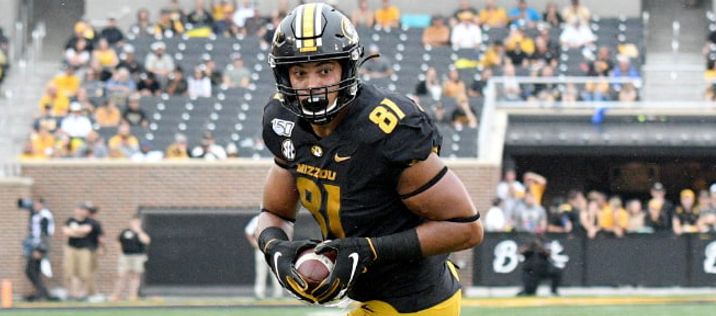
Depth: The depth in the 2020 tight end class is its strength. There are no fewer than six prospects with starter-level upside. Albert Okwuegbunam is considered depth by most and has no doubt starter upside. Guys like Hunter Bryant, Cole Kmet, Harrison Bryant, Adam Trautman, Brycen Hopkins, Dalton Keene, and of course Thaddeus Moss, could all end up as starters at some points of their careers. The depth of this class is rock solid but still pales in comparison to the depth we saw from the 2010, 2013, and 2019 NFL Draft tight end classes. With that being said, it has superior potential talent to most of the seven years not mentioned. The depth of this class helped keep the grade here above a five.
2020 Fantasy Impact: Projecting tight ends is often the most difficult thing to do for rookies. First-year players at this position in particular usually have a tougher, and thus a slower transition to the NFL. Whether this be due to spending snaps blocking, or teams often rotating the snaps of players at a position that is often three or four deep, banking on a sizable rookie season fantasy impact is a risk. This is true even when draft classes have one or more elite prospects at the position. For proof of this we need to look no further than last year’s draft class. T.J. Hockenson, Noah Fant, and Irv Smith Jr. were all considered elite prospects, but none of them made a true mark as rookies due to inconsistency (largely due to injury or splitting snaps). Cole Kmet and Albert Okwuegbunam are the players most likely to be on the redraft radar in 2020 fantasy leagues.
Draft Contest: Enter for FREE to win a FantasyPros subscription
Subscribe: Apple Podcasts | Google Play | Spotify | Stitcher | SoundCloud | TuneIn | RSS
Raju Byfield is a featured writer for FantasyPros. For more from Raju, check out his profile and follow him @FantasyContext.