Beyond our fantasy football content, be sure to check out our award-winning slate of Fantasy Football Tools as you prepare for your draft this season. From our Cheat Sheet Creator – which allows you to combine rankings from 100+ experts into one cheat sheet – to our Draft Assistant – that optimizes your picks with expert advice – we’ve got you covered this fantasy football draft season.
Best Ball league formats continue to grow in popularity among fantasy football players. A Best Ball league allows players to enjoy all of the draft-day fun with none of the in-season management work. The team you draft is your team for the entire season, and each roster’s highest-scoring players are automatically started every single week. Completing Best Ball drafts throughout the offseason is a fun, low-risk way to start understanding the value of certain players before actual redraft fantasy football drafts start.
For this exercise, I used FantasyPros’ Draft Wizard, which you can also use to prepare for your drafts this offseason. Below are specifics on the league format that I used for the mock draft from the 10th spot:
- 12 teams
- Half point per reception, 4 points per passing touchdown scoring
- 1 QB
- 2 RB
- 3 WR
- 1 TE
- 1 RB/WR/TE flex
- 10 bench spots
What follows is the team that I ended up with, including some thoughts and analysis of each pick that I made.
Mock draft vs. experts with our free Draft Simulator 
1.07 (7th overall): Alvin Kamara (RB – NO)
Alvin Kamara has been one of my favorite players to watch since he entered the league a couple of years ago. His 2019 season wasn’t what many expected, but that shouldn’t let us believe that he’s not an elite talent. Touchdown regression hit him hard, as he went from 13 and 18 total touchdowns the previous two seasons to just six last year. His touchdown regression wasn’t for lack of opportunities he was given, though — the New Orleans Saints weren’t as effective as a team in the red zone.
The #Saints were just worse as a team in the red zone this year.
First, the Saints' red zone TD efficiency (percent of red zone drives leading to a TD) dipped from 68% in 2018 down to 59% in 2019.
They also ran 0.7 fewer red zone plays per game in 2019 than they did in 2018.
— Sam Hoppen (@SamHoppen) January 22, 2020
We also shouldn’t forget that Kamara dealt with an injury for the second half of the season, and he even admitted to playing at 75 percent for most of the year. He went from averaging 108 total yards and 20 opportunities per game before his high ankle sprain to around 85 total yards and 17 opportunities per game afterward. I’m excited to have gotten a running back with such a high floor and high ceiling at a slight discount.
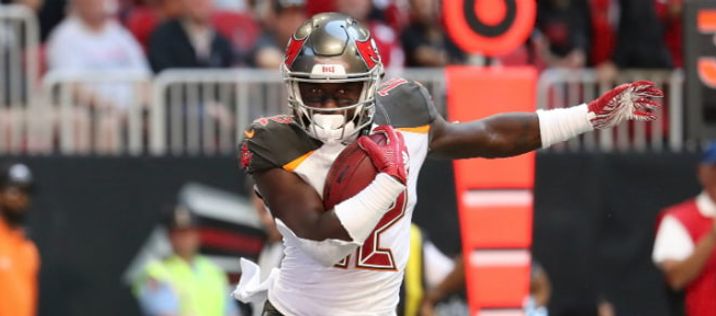
2.06 (18th overall): Chris Godwin (WR – TB)
For my second pick, I went with another personal favorite player in Chris Godwin. During his breakout season last year, he posted career-high stats in every major statistical category on his way to finishing as the WR2 in fantasy football. But one major thing is changing with the Tampa Bay Buccaneers this season: Tom Brady is now their quarterback.
Most football pundits believe Godwin has more to gain with Brady’s arrival than teammate Mike Evans, and rightfully so. First, Godwin played 55 percent of his snaps from the slot compared to just 24 percent for Evans. Over the past two seasons, Brady’s favorite target, Julian Edelman, has run the vast majority of his routes from the slot. Second, Brady’s 7.6 average depth of target (aDOT) from last year matches up much better with Godwin’s 11.6 aDOT than with Evans’ 15.3 aDOT. Godwin is in for another huge year and could enter elite territory with a second straight dominating season.
3.07 (31st overall): A.J. Brown (WR – TEN)
With this being a Best Ball draft, I took a shot in the third round on a player that demonstrated the ability to put up monster numbers week after week. A.J. Brown burst onto the scene last year by posting the second-highest yards per target mark (12.5) over the past six seasons. If you want to see his potential, just look to the final six games of the regular season.
Over that six-week span, Brown had four games with at least 100 yards receiving and a touchdown. He was the WR1 during that stretch (averaging 19.2 fantasy points per game) despite posting fewer than 50 receiving yards in the other two games. Sure, he has a tendency to drop off the map with major dud performances, but Best Ball offers me the luxury of not having to choose when to sit him for his off weeks while I profit from his boom games.
4.06 (42nd overall): Adam Thielen (WR – MIN)
Adam Thielen enters this year with a plethora of opportunities, which makes taking him in the fourth round feel like a steal. Stefon Diggs leaving the Minnesota Vikings opens up 94 targets for him to take a share of. Unfortunately, he hasn’t been the same since his eight-game hot streak to start the 2018 season. Since Week 9 of 2018, he’s averaged just under four receptions and 50 receiving yards per game. Ideally, the bump in targets will return him to his early-2018 dominance when he averaged 12 targets per game.
5.07 (55th overall): Marlon Mack (RB – IND)
Marlon Mack is quickly becoming a great sleeper candidate for the 2020 fantasy football season. Despite finishing as the RB20 in half PPR leagues last year, he doesn’t seem to be getting much respect among the fantasy community. The Indianapolis Colts brought in Philip Rivers to be their new starting quarterback this season, which is great news for Mack. Rivers is known for his tendency to target running backs — over the past three seasons, he’s targeted the position an average of 27 percent of the time.
Many will point to teammate Nyheim Hines as the major beneficiary of having Rivers under center, but he was able to sustain both Melvin Gordon and Austin Ekeler as pass-catching threats. If Mack is able to stay on the field in more pass-catching situations, he could easily outperform his current ADP.
6.06 (66th overall): Michael Gallup (WR – DAL)
Last year, Michael Gallup turned out to be one of fantasy football’s surprise stars. Even though he was listed as the second wide receiver on the Dallas Cowboys’ depth chart, he still recorded a top-15 finish among wide receivers in fantasy points per game. His 113 targets were only six fewer than the Cowboys’ leading receiver, Amari Cooper, and Gallup played in two fewer games. In fact, his 8.1 targets per game average was good enough to be among the top-20 wide receivers last season. He’ll continue to see a healthy dose of targets in 2020 as the offensive playmakers largely remain the same, which makes him capable of becoming a true WR1 in fantasy.
7.07 (79th overall): David Montgomery (RB – CHI)
Getting a starting running back with nearly-guaranteed production is a rarity this late in any sort of fantasy football draft. As little as some may believe in the Chicago Bears, David Montgomery saw a near-elite rushing workload as a rookie. His 15.1 rush attempts per game were good enough to land him among the top-15 running backs in the league. More specifically, his usage close to the end zone is especially encouraging. The Bears gave him 14 carries inside the five-yard line, which accounted for 87.5 percent of the Bears’ such carries (the second-highest rate in the league). Montgomery could thrive in 2020 if he maintains the high rushing workload and converts more of his goal-line attempts into touchdowns.
8.06 (90th overall): Josh Allen (QB – BUF)
As my first quarterback, I went with last year’s QB6 on the season, Josh Allen. His best asset as a fantasy football quarterback is his rushing ability. He ranked third in rushing yards among quarterbacks, but he made his hay by rushing for nine touchdowns, the most among quarterbacks (and eighth-most in the league). Eight of his nine rushing touchdowns came on the eleven carries he got inside the 10-yard line.
Not only does the rushing ability equip Allen with a great floor, but it gives him a decent ceiling as well. In fact, he was the only quarterback last year to record double-digit quality starts (games in which he scored between 15.3 and 23 fantasy points). Additionally, he was tied for second in quality plus great starts (games scoring at least 23 fantasy points) behind only Lamar Jackson. By adding a new weapon in Stefon Diggs, he should be able to rely slightly more on his passing to carry his fantasy value.
9.07 (103rd overall): Sterling Shepard (WR – NYG)
By no means is Sterling Shepard the belle of the ball at the receiver position, but he’ll provide some great value in the middle rounds of your Best Ball draft. He played well in the ten games that he started, and I’m only concerned about the games that he started in since I don’t have to choose when to plug him into my lineup.
Not only did Shepard see a large target share (23 percent in the games he played), but he converted his targets into a solid 5.7 receptions per game, which landed him among the top-12 wide receivers in that category. If he can manage to stay healthy throughout the season, this pick will become extremely valuable.
10.06 (114th overall): Evan Engram (TE – NYG)
Similar to Shepard, Evan Engram has had his fair share of injuries recently, but he remains an elite option at tight end when he’s on the field. On a fantasy points per game basis, he was the TE7 last year. Among all tight ends, he also ranked inside the top six in targets per game (8.5), receptions per game (5.5), and receiving yards per game (58.4).
6 players were targeted at least 6 times in every game they played last season (min. 8 games):
Michael Thomas
Julio Jones
DeAndre Hopkins
Jarvis Landry
Sterling Shepard
Evan Engram— Mike Clay (@MikeClayNFL) April 5, 2020
Last year, he also saw nine of the Giants’ red-zone targets. Surprisingly, that was still enough to put him among the top-20 tight ends in that category. It was also one fewer than Shepard had despite playing two fewer games. Unfortunately, he could only convert two of those targets into touchdowns, so a boost to efficiency in 2020 could do wonders for his fantasy value.
11.07 (127th overall): Noah Fant (TE – DEN)
Drafting two tight ends back-to-back is not typically a strategy I employ, but the value was too good to pass up for two players that I have in my top 10 right now. Although Noah Fant’s surge didn’t happen until the second half of the year, I’m hopeful that he can continue to build on the momentum he gained. Despite failing to reach 40 receiving yards until Week 9, he still recorded the fourth-most receiving yards by a rookie tight end in the last ten years. He demonstrated his ability to create extra yards as he forced as many missed tackles as Zach Ertz did (6) on 48 fewer receptions last year.
Here for any and all Noah Fant hypepic.twitter.com/ij45yJCKQc
— Ian Hartitz (@Ihartitz) April 1, 2020
Though his floor may be as low as any tight end in this area of the draft, he has clearly demonstrated the ability to put up some monster weeks.
12.06 (138th overall): Jamaal Williams (RB – GB)
As much as people want to crown Aaron Jones as the workhorse back in Green Bay, Jamaal Williams still has a role in the offense. Since last offseason, head coach Matt LaFleur has preached a running back by committee approach. Don’t get me wrong, Jones is the RB1, but Williams is not as far behind as people think — the table below shows a breakdown of the stats from the 13 full games that they both played together:
| Player | Average Weekly Snap Percentage | Carries Per Game | Rushing Yards Per Game | Targets Per Game | Receptions Per Game | Receiving Yards Per Game | Total Touchdowns |
| Aaron Jones | 56% | 13.8 | 65.8 | 3.6 | 2.6 | 24.5 | 14 |
| Jamaal Williams | 45% | 8.2 | 35.4 | 3.5 | 3.0 | 19.5 | 6 |
Jones is clearly the bigger threat to score, but if that evens out, then Williams will be far more valuable than people expect. He’ll be given the opportunities, so it’s just a matter of being able to capitalize on them.
13.07 (151st overall): Daniel Jones (QB – NYG)
Welp, here we are — I somehow found my way into having three members of the New York Giants on my team. Joke all you want about their team management, but you can find some fantasy football diamonds in the rough in East Rutherford. Daniel Jones is one of those potential diamonds, and he’s one of the best values in Best Ball leagues. As a rookie, he displayed an ability to put up monster numbers on par with some of the best in the league. Per Mike Tagliere, he had two of the top-10 single-game performances by a quarterback in 2019 — the only other quarterbacks who can say that are Russell Wilson and Lamar Jackson. The turnovers and fumbling are surely an issue, but I have Allen to cover for me during Jones’ messy games.
14.06 (162nd overall): Boston Scott (RB – PHI)
The Philadelphia Eagles are well-known for taking a running back by committee approach. While Miles Sanders is the incumbent starter, Boston Scott played his way into a nice role towards the end of the season and likely garnered more playing time in 2020. In each of the final four games of the regular season, he saw at least six targets. He displayed great hands as a receiver by hauling in 23 of his 25 targets and converting them into nearly 50 receiving yards per game. Over that same stretch, he saw 47.5 percent of the team’s snaps, which wasn’t that far off of Sanders’ 60 percent snap rate. Now that Darren Sproles is retired, Scott could very easily fill the pass-catching role that the Eagles enjoy using.
15.07 (175th overall): Ryquell Armstead (RB – JAC)
For all the talk about handcuffs in fantasy football, Ryquell Armstead is one of the least discussed. Though Leonard Fournette only missed one game last year, he has a rather extensive injury history, so him playing a full 16 games is not even close to guaranteed. Although it’s a limited sample size, Armstead performed well in the one game he started last year when Fournette sat out. He was given 19 total opportunities that he turned into 85 total yards and a touchdown. With how much of the Jacksonville Jaguars’ rushing workload is concentrated on one player, Armstead would be an immediate beneficiary if Fournette were to be injured for an extended period of time. I’ll take that kind of upside this late in a Best Ball draft.
16.06 (186th overall): Miles Boykin (WR – BAL)
With how prolific the Baltimore Ravens’ offense was last year, Miles Boykin was one of the few odd men left out of the fun. This comes as a bit of a surprise given how well he tested entering the NFL.
Miles Boykin
98th Percentile Speed Score ✅
99th Percentile Burst Score ✅
90th Percentile Agility Score ✅
99th Percentile Catch Radius ✅
———————————————-Miles Boykin is THAT DUDE in 2020 pic.twitter.com/Qlar6fBshb
— Derek Brown (@DBro_FFB) April 7, 2020
He only hauled in 13 receptions in all of 2019, but he turned those into 15.8 yards per reception. This mark led the team and is another clear indicator of his explosiveness.
Granted, the Ravens tend to focus on passing to their tight ends, but he’s currently listed as the second wide receiver on the depth chart — he has an opportunity to step up in his second year. Both Hayden Hurst and Seth Roberts are no longer with the team, opening up 74 targets in the offense.
17.07 (199th overall): Ian Thomas (TE – CAR)
Long-time Carolina Panthers tight end Greg Olsen is now out of the picture, opening up the door for Ian Thomas to become the team’s leading option at the position. When given that opportunity over the past couple of years, he’s been sure to take advantage of the extra playing time.
Over the past two seasons, he has averaged six targets per game, 3.8 receptions per game, and 38 receiving yards per game in the games that Olsen has missed. To put this in perspective, only eight tight ends averaged at least six targets per game in 2019 — if he can see that volume for a full year, he’ll turn in a great tight end season.
I chose to take a third tight end in this Best Ball draft knowing Engram’s inability to stay healthy as of late. Also, if my tight ends play well enough, one of them can fill in at my flex spot while a third quarterback wouldn’t be able to.
18.06 (210th overall): Bryce Love (RB – WAS)
For my final pick, I went with a complete shot in the dark at the running back position with Bryce Love. The Stanford product missed his rookie season due to recurring knee injuries following an ACL tear in his senior year of college. He’ll be in the fold to compete in a crowded running back room, but there’s reason to believe he offers some promise for fantasy football this season. Despite the knee injuries, Washington used an early fourth-round pick on him in the 2019 draft. Love is also seen as more of a threat to take over on passing downs, especially now that Chris Thompson is no longer with the team and since neither Derrius Guice nor Adrian Peterson has excelled as pass catchers.
Overall, I’m very pleased with the way this draft turned out. The Mock Draft Simulator graded me with an A- as the second-best team overall, leaving me with lots of hope that this could be a league-winning team!
Run custom mocks with your league settings with our Draft Simulator
Subscribe: Apple Podcasts | Google Play | Spotify | Stitcher | SoundCloud | TuneIn | RSS
Sam Hoppen is a featured writer at FantasyPros. For more from Sam, check out his archive and follow him @SamHoppen.