The calendar has flipped to April. And that means the 2026 NFL Draft and rookie hype season have officially reached all-new heights, especially for those invested in dynasty and pre-draft best ball fantasy football formats.
The first-year talent that has entered the league over the past few seasons warrants excitement because players are hitting the ground running for fantasy football. The list is impressive and continues to grow:
- Ashton Jeanty
- Omarion Hampton
- Cam Skattebo
- Colston Loveland
- Tyler Warren
- Tetairoa McMillan
- Emeka Egbuka
- Jayden Daniels
- Drake Maye
- Malik Nabers
- Brian Thomas Jr.
- Bucky Irving
- Brock Bowers
- Xavier Worthy
- Ladd McConkey
- Jalen McMillan
- Tyrone Tracy Jr.
- C.J. Stroud
- Zay Flowers
- Sam LaPorta
- Puka Nacua
- Bijan Robinson
- Jahmyr Gibbs
- Breece Hall
- Garrett Wilson
- Chris Olave
- Drake London
- Justin Jefferson
- Ja’Marr Chase
- Tee Higgins
- Jonathan Taylor
- Jaylen Waddle
- Najee Harris
- Amon-Ra St. Brown
But there’s still some ambiguity with every prospect entering the league that should be considered when generating their fantasy value. And how the NFL thinks/views certain prospects based on their projected draft capital — and real draft capital post-draft — should be factored in.
Leveraging projected draft capital (provided by NFL Mock Draft Database) and using the historical rookie track record data from the late great Mike Tagliere to devise a value strategy is the best way to approach the 2026 rookie class. It will prepare you for dynasty rookie drafts, best ball drafts, and season-long leagues after each newcomer finds their NFL landing spot. It will also provide an edge against early pre-draft best ball average draft position (ADP) on Underdog, DraftKings, and FastDraft (along with some of the Discord rookie mocks using FantasyPros’ rookie mock draft simulator.
Again, shout-out to Tags for the 2021 version of this article, which I will be referring to ad nauseam. He provided the backbone for the first version of this article and for each subsequent article since 2022. It’s one of my favorite pieces to dive into every year because it captures the perception versus reality of what the expectations are for this class — even before we know our NFL landing spots.
Before reading, be sure to also check out the dedicated piece on this year’s running back class and the wide receiver class.
- Fantasy Football Research & Advice
- Fantasy Football Expert Rankings
- 2026 NFL Mock Drafts
- Fantasy Football Trade Tools

How to Value Rookie Tight Ends in Fantasy Football (Pre-Draft)
Tight Ends
There was once a time when you could always look the other way in redraft leagues when it came to rookie tight ends. Kyle Pitts from five years ago looked like the lone exception to the general rule of thumb. He was used more like a wide receiver in the Atlanta Falcons offense, which is why he found success as the TE7 overall in his first season. The dude is also just a unicorn (emphasized even more after the 2025 season), and most rookie tight ends shouldn’t be compared to him. But give credit to Matt Ryan, who is no stranger to fueling fantasy success.
At the time, Pitts joined Evan Engram as the only rookie tight end to finish as a top-12 option over since 2022. Although Pat Freiermuth came close in 2021, finishing 2021 as the TE13, thanks to seven receiving touchdowns. The Penn State product is also the first rookie tight end selected in the second round to finish as a top-18 option since 2013.
I am burying the lede here, of course, because 2023 brought us another elite rookie tight end and the overall fantasy TE1 in Sam LaPorta. Fellow rookie Dalton Kincaid also finished as a TE1 (TE12). We have now had four rookie tight ends finish inside the top 12 as rookies. And they all played with good quarterbacks.
Tucker Kraft was also productive at TE28, as was fellow rookie Packers TE Luke Musgrave (TE31). Michael Mayer was the TE33 to round out a beyond-productive tight-end rookie class.
In 2024, we were presented with yet another elite rookie tight end in Brock Bowers. Despite shaky QB play, he finished as the fantasy TE2 overall through 17 weeks. That being said, Bowers was drafted as an elite TE prospect at 13th overall – the highest TE drafted since Pitts (4th overall) and T.J. Hockenson (8th overall) at the time.
A rookie tight end typically needs strong draft capital to produce in Year 1. 2022’s best-performing rookie tight end, Chigoziem Okonkwo, as a fifth-rounder/Day 3 pick, is out of the norm.
Simply put, a first-year tight end almost always needs to be drafted in round one for hopes of fantasy relevance in Year 1 with a respectable 78 target average (TE15 last season). Round two is much tougher to get behind for any tight end historically, at least before the 2023 season.
In 2024, Bower’s strong projected draft capital was a reason to be “in.” He was the TE9 as a sure-fire lock to be a high first-rounder and the No. 1 overall tight end selected. The Georgia product was not being slept on in any capacity compared to last year’s first-round projected TEs between Mayer (TE21) and Kincaid (TE25).
He was drafted as a locked-in fantasy TE1 and surpassed all expectations despite a poor landing spot.
Fast forward to 2025, and Penn State’s Tyler Warren had a strikingly similar pre-draft ADP to Bowers: TE9 in early best ball ADP. Based on his real-life projected NFL draft capital in the top 15, it lined up. Loveland was cheaper as the presumed TE2 in the class (TE14 overall), but he ended up being first tight selected off the board to the Bears (10th overall).
But they were both locked into the top of the Round 1 draft capital.
After them, there was a tier drop.
The next group was all projected second and third rounders between Elijah Arroyo, Mason Taylor, and Harold Fannin Jr.
And they were relatively cheap, going outside the top-30 TEs.
But this isn’t always the case. Ja’Tavion Sanders, at one point, was the TE25 in pre-draft best ball ADP back in 2024. He was a Day 3 pick (fourth round). But he was being boosted because he was viewed as the “next-best” tight end.
Rookie Tight Ends Since 2013
| Drafted | # | Targets (Avg) | FF Finish | TE1% | Top-18% | TE2% |
| 1st Round | 13 | 78 | 20 | 38% | 54% | 69% |
| 2nd Round | 26 | 37 | 40 | 4% | 8% | 23% |
| 3rd Round | 32 | 22 | 51 | 3% | 6% | 9% |
| 4th Round | 32 | 25 | 46 | 0% | 3% | 12% |
| 5th Round | 28 | 14 | 57 | 0% | 0% | 7% |
| 6th Round | 33 | 9 | 73 | 0% | 0% | 0% |
And that brings us to the 2025 season – yet another season where the rookie TEs made an immediate impact in Year 1.
Tyler Warren (14th overall) and Harold Fannin were TE5 and TE6, respectively. Colston Loveland was also a fantasy TE1 (TE12) in half-PPR after being drafted 10th overall (highest since Pitts). Oronde Gadsden flashed as the TE17 despite Day 3 draft capital. Mason Taylor even had his moments as the TE32 (65 targets) as a second-round pick by the New York Jets.
So not only have first-round TEs been hitting, but we are now getting late-round TEs producing as rookies.
But let’s be real for a second. 2025 does look like a bit of an outlier.
Two first-round TEs hitting and finishing as fantasy TE1s does not usually happen.
Fannin as a Round 3 pick…first Round 3 TE to finish TE1 since 2013 (1-in-32 odds).
Round 1 TEs: Best Odds, Still Low Probability
- 38% TE1 rate (5 of 13 since 2013)
- 69% TE2 rate (9 of 13)
- Only 13 Round 1 TEs drafted since 2013 = small sample, high variance
Comparison to rookie WR/RB:
- TE Round 1: 38% TE1, 69% TE2
- WR Round 1: 9% WR1, 25% WR2 (TE is 4x better)
- RB Round 1: 50% RB1, 69% RB2 (TE matches for TE2)
Still, the data is suggesting that volume is key – and 80 targets is the goal. Our 3 TEs that hit last year all surpassed this number.
And although I have highlighted the TE hits, there were plenty of misses from the 2025 second-rounders.
Elijah Arroyo and Terrance Ferguson failed in Year 1.
That’s the worst-case scenario for TEs that fall into Round 2…into crowded receiver rooms.
Less than a 25% odds to be a fantasy TE2. Worse value than Round 2 RBs when compared to those hit rates.
Round 2 TEs are much more like lottery tickets. And the upside argument has been virtually non-existent.
You need a LaPorta-esque landing spot where the path to volume is so beyond obvious, to go along with a strong college prospect.
2026 Rookie Tight Ends
| Player | Blended | FastDraft | FPros | UD ADP | UD Rank | DK ADP | DK Rank | NFL Rd | NFL Pick |
| Kenyon Sadiq | 8 | 9 | 6 | 132 | TE13 | 131 | TE15 | R1 | 16 |
| Eli Stowers | 12 | 14.63 | 9 | 183 | TE25 | 180 | TE25 | R2 | 59 |
| Max Klare | 32 | 33.66 | 30 | 240 | TE45 | 231 | TE43 | R3 | 68 |
| Justin Joly | 41 | 36.08 | 36 | 240 | TE57 | 232 | TE46 | R4 | 110 |
| Michael Trigg | 47 | 39.49 | 42 | 240 | TE49 | 231 | TE51 | R4 | 117 |
| Oscar Delp | 45 | 44.47 | 49 | 240 | TE50 | 229 | TE42 | R4 | 108 |
| Sam Roush | 56 | 47.1 | 53 | 240 | TE48 | 229 | TE59 | R4 | 109 |
| Jack Endries | 58 | 49 | 51 | 240 | TE61 | TE56 | R4 | 124 | |
| Tanner Koziol | 59 | 48.03 | 52 | 240 | TE61 | TE55 | R5 | 150 | |
| Joe Royer | 58 | 48.94 | 60 | 240 | TE61 | TE54 | R5 | 155 | |
| Eli Raridon | 60 | 48.76 | 71 | 240 | TE61 | 230 | TE58 | R5 | 135 |
| Dallen Bentley | 60 | 49 | 79 | 240 | TE61 | TE57 | R5 | 149 | |
| Marlin Klein | 78 | 49 | 107 | 240 | TE61 | – | R5 | 168 |
Round 1 TEs
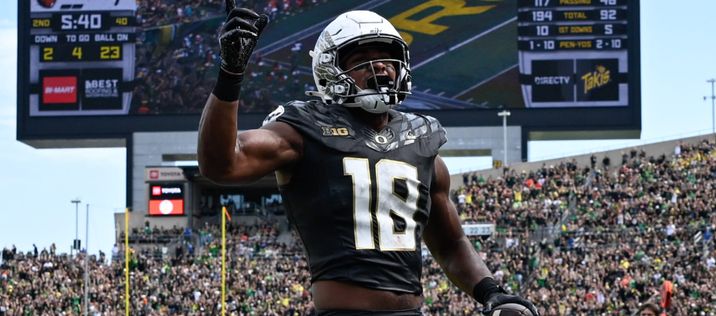
Kenyon Sadiq is the only sure-fire lock to be a Round 1 tight end this year. But the pre-draft capital (DC) is not as strong as it was even last year for Loveland. Although he is going higher in pre-draft best ball than Loveland was before he was drafted in 2025 (because he is the TE1 in a weaker class).
Not a total red flag – but somewhat concerning about his price as an inferior prospect in my opinion.
And without knowing the landing spot – so critical for tight ends – this seems very rich to pay for the Oregon tight end. But we do know he will be a Round 1 tight end, which gives him a fantasy TE1 ceiling (let alone his elite/freakish athletism is oozing with high-end potential).
I’m just not sure I’m ready to pay for that upfront with the risk he goes to a team either with a bad QB or one where it’s much more difficult to command 80-plus targets.
Sadiq’s projected teams are all over the place, given that he is expected to be selected in the middle of Round 1. And as I discussed with Joe Pisaspia on the FantasyPros NFL Draft Predictions Show, Sadiq is the ultimate “why not” pick. Not hard to sell any fan base on his long-term upside.
A “bad” landing spot for Year 1, in my opinion, would be somewhere like Minnesota. They have established veterans in place, such as Josh Oliver and T.J. Hockenson. They have an elite WR and a very solid No. 2. Then we have some QB uncertainty with Kyler Murray, who hardly felt it was his job to force-feed a rookie pass-catcher back in Arizona. Minnesota makes sense long-term for Sadiq, especially given Kevin O’Connell’s ties to Sean McVay – and the Rams’ shift to more tight-end-heavy personnel.
Frank Smith was hired as the Vikings’ new OC, coming from Miami. Big tight end production there from Jonnu Smith (similar comps to Sadiq).
Ryan Cordell (Vikings TE coach) has worked closely with Minnesota’s tight ends during each of the past two seasons (2024-25), helping Josh Oliver to a career-best four touchdown receptions during the 2025 season. Upon the return of TE T.J. Hockenson in Week 9 of the 2024 season, the team’s tight ends combined for 61 receptions for 690 receiving yards and led the NFL in yards per catch (11.8 yards/reception) among teams that targeted their tight ends at least 70 times in that span (Vikings.com).
In dynasty, it’s great, but Year 1 might be a slow burn (see Terrance Ferguson in 2025).
As for the rookie-only formats like Fast Draft… an argument to be made that Sadiq is slightly overvalued ahead of Jadarian Price – just based on the projected volume we should see from each player in 2026. There’s also no positional advantage to taking a tight end in Fast Draft.
As a reminder:
- Round 2 RBs average 159 touches in Year 1
- Round 1 WRs average only 70-81 targets in Year 1
- Round 1 TEs average 80 targets in Year 1
Round 2 TEs
Now on Day 2. The goal for these Day 2 tight ends is to find value based on the projected draft capital.
Vanderbilt’s Eli Stowers is seemingly locked in as a Round 2 tight end. But the overwhelming consensus he is destined for a Dalton Kincaid-type role at the NFL level (minus the torn PCLs), given that he isn’t adding much as a run blocker. Essentially, he’s a big slot receiver. So much so, some NFL teams have been working/evaluating him as just a WR. Now, his playing real-life WR with a fantasy TE designation (even for one year) would be a major boost. Much lower tight end bar for him to pass to be relevant in our lineups if he is being deployed as a true WR.
But if he’s just a tight end and pigeon-holed into a specific role that limits his playing time, then he needs to land on the absolute weakest WR depth chart for him to carve out a sizable enough role.
The fact that he is a Round 2 tight end versus a Round 1 also suggests a lesser commitment by whichever team drafts him (along with a lower ceiling fantasy hit rate). He is even more landing spot dependent than Sadiq.
Probably makes him a systematic soft “fade” in pre-draft best ball as the TE20 or higher. TE25 on Underdog is a bit more palatable (pretty close to free) in case this super athletic freak hits the nuts on his landing spot.
Note that the overall ADP on each platform is nearly identical, but the TE rank differs by platform.
His pre-draft price is pretty close to Dalton Kincaid and Michael Mayer before they were selected in the first and second rounds of the 2023 NFL Draft. But he is more expensive than last year’s second tier of rookie TEs (Arroyo/Taylor/Fannin).
Again, I say soft fade because it’s a rookie TE outside the top-180 picks. The production profile is strong. He has room to grow after starting as a college QB. Just three years at the tight end position.
In 2024, he led his team in all receiving categories. Graded out as PFF’s 5th-highest graded tight end. 9th in yards per route run.
In 2025, he was awarded the John Mackey Award as the nation’s best tight end. PFF’s 6th-highest graded tight end. 3rd in yards per route run, and 6.5 career yards after the catch.
And maybe because he has such a unique skill set…he is more likely to and favorably as certain teams/offenses simply won’t care for a one-dimensional TE who can’t block.
But the Round 2 draft capital just doesn’t project him super favorably in Year 1 against other veteran TEs in 2026 draft formats, or the other first-round WRs. Even Price is a better bet with his projected Round 2 draft capital if we are just betting on the draft capital/volume correlation.
Feels very boom-or-busty, especially without knowing his NFL team.
TE3-Plus
After the two top tight ends, there’s not much consensus. We have a cluster in the table above between five TEs with projected Round 3-4 draft capital.
Ohio State’s Max Klare has the highest projected draft capital, which is fueling his TE3 rank.
Fairly priced outside the top-40 overall tight ends for 2026, but definitely being slightly overvalued as “the” TE3 atop a very long tier.
Tony Pauline also noted that Klare never tested his supposedly strong athletics. Didn’t test at the combine or the Ohio State pro day.
Doesn’t mean he isn’t athletic, but it could hurt his draft stock. It could also mean we are getting a decent pass-catching TE prospect at a discount because he didn’t test like Sadiq or Stowers.
Klare spent his first three years at Purdue before transferring to Ohio State. His best season was in 2024 before he switched schools (injured in 2023). 31% dominator rating in his final year with the Boilermakers. Also, first in the class in positive win rate in zone coverage (67%) per Sports Info Solutions.
Even so, his slight fall has opened the door for another TE to emerge as TE3 or even TE2 in this class: Georgia’s Oscar Delp.
The college production for Delp does not jump off the page. The Bulldogs’ offense featured other guys instead of Delp, despite him being very productive when he got his opportunities. He averaged over 8 yards after the catch (8.2) – a mark that ranked top-10 in the nation during the 2025 college season.
And he is expected to get much higher draft capital than the consensus projects, especially after an extremely strong pro day. If he lands on a TE-needy team (Panthers, Patriots), he has instant fantasy appeal.
Sleeper Tight Ends
After the top 4-5 tight ends, we enter potential Day 3 territory. As I said at the top, there should be little expectation for any of these guys to produce fantasy relevance in Year 1.
Makes players such as Michael Trigg and Justin Joly as strong fades as the highest-ranked likely Day 3 guys, going ahead of Delp (despite strong odds, he is drafted much higher).
Trigg’s off-field stuff and inconsistency could really cause him to fall to Day 3 in the NFL Draft. NFL Draft insider Tony Pauline has been all over Trigg’s potential fall. Pauline was told by scouts that he was just totally checked out of his pro day after performing very poorly in the vertical jump (27.5 inches).
Understandably, I understand the allure of the Baylor tight end. Highlights littered over his tape. Former basketball player. First in yards per route run among this year’s class (Sports Info Solutions).
But he was suspended for disciplinary reasons at both Ole Miss and Baylor. Left Ole Miss after three games into the season.
Can take plays off if he’s not getting the rock.
He’s been in college for five years at three different schools. Tied for most drops in the class. Just seems like a headache that NFL teams (and fantasy football dynasty managers) should want to avoid.
Joly has a very strong and impressive production profile (20% career dominator rating), albeit through four years at UConn and NC State. He also did not test at the combine, which begs the question of how athletic he is (which matters for tight ends). Built and plays like a big wide receiver. 241 pounds (9th percentile). But absolutely massive mitts (91st percentile hand size).
YAC isn’t there (second-worst YAC/reception in the class).
However, there’s a chance that one of these projected Day 3 tight ends up sneaking into Day 2.
Some of my favorite “sleeper” tight ends in this class include Sam Rousch, Eli Raridon, and Dae’Quan Wright.
Rousch blew up the 2026 NFL Combine, posting in the 94th percentile in both the vertical and broad jumps. The Stanford tight end is built at 6-foot-6 and 267 pounds. Last year, he posted a 22% target share (second in the nation in routes run), which ranked third best in the class (behind Stowers and Tanner Koziol). Rousch is definitely more of the full package at tight end, offering blocking and receiving abilities (Y tight end) as an underneath/checkdown option.
Notre Dame’s Raridon battled through knee injuries to start his college career while fighting for snaps with future NFL tight ends.
But he made the most of targets, especially this past season. Averaged over 15 yards per reception – 8th highest mark in the nation. 11th in yards per route run at 2.23. 7th in broken tackles forced per catch (SIS).
When he was involved as a receiver, he was very productive. 59 receiving yards per game when he saw at least three targets.
Raridon also tested very well at the NFL Combine, and he’s built tall at 6-foot-6/245 pounds.
Wright is the least likely tight end I’ve mentioned to be a Day 2 pick (didn’t test), but I am a sucker for tight ends that are YAC gods (2nd in YAC/reception at over 10 yards). Over 8 yards after the catch for his career. 5th in win rate versus zone coverage per SIS. The guy has so much juice and played the entire season with a shoulder injury.
Michigan’s Marlin Klein is another candidate who could potentially sneak into Day 2 (84th-ranked player in Daniel Jeremiah’s top-150). Another guy without a ton of production, but there’s context behind the lack of box score stats. Came over from Germany and was a backup behind Colston Loveland until this past year. He was targeted on 21% of his routes run this past season (22% career target rate per route run).
He blew up in Week 1 of this season, but then suffered an ankle injury shortly after. Also got hurt in Michigan’s Bowl Game (forced to miss Senior Bowl). And he still declared early with one year of eligibility remaining (one for just four TE early declares, including Sadiq, Klare, and Endries).
In a 2024 article, future NFL tight end standouts Loveland and AJ Barner cited Klein as the most athletic guy in Michigan’s TE room.

Subscribe: Apple Podcasts | Google Play | Spotify | Stitcher | TuneIn | RSS | YouTube