Before the 2025 NFL Draft kicked off, I released an article titled ‘How to Value Rookies in Fantasy Football: Pre-Draft (2025)‘ to provide some insight into the approach for rookies in dynasty and pre-draft best ball fantasy football formats.
The first-year talent that has entered the league over the past few seasons warrants excitement because they are hitting the ground running for fantasy football.
The list is impressive: Jayden Daniels, Drake Maye, Malik Nabers, Brian Thomas Jr., Bucky Irving, Brock Bowers, Xavier Worthy, Ladd McConkey, Jalen McMillan, Tyrone Tracy, C.J. Stroud, Zay Flowers, Sam LaPorta, Puka Nacua, Bijan Robinson, Jahmyr Gibbs, Breece Hall, Garrett Wilson, Chris Olave, Drake London, Justin Jefferson, Ja’Marr Chase, Tee Higgins, Jonathan Taylor, Jaylen Waddle, Najee Harris and Amon-Ra St. Brown.
Let’s look at fantasy football rookie tight ends and how you should value them for 2025 redraft leagues.
- Fantasy Football Draft Kit
- Most Accurate Fantasy Football Rankings
- Fantasy Football ADP
- How to Value Rookies in Fantasy Football: Running Backs (2025)

How to Value Rookie Tight Ends in Fantasy Football
There was once a time when you could always look the other way in redraft leagues when it came to rookie tight ends. Kyle Pitts from four years ago looked like the lone exception to the general rule of thumb. He was used more like a wide receiver in the Atlanta Falcons’ offense, which is why he found success as the TE7 overall in his first season. He is also just a unicorn, and no standard rookie tight ends should be compared to him. But give credit to Matt Ryan, who is no stranger to fueling fantasy success.
At the time, Pitts joined Evan Engram as the only rookie tight end to finish as a top-12 option since 2022. Although Pat Freiermuth came close in 2021, finishing 2021 as the TE13 thanks to seven receiving touchdowns. The Penn State product is also the first rookie tight end selected in the second round to finish as a top-18 option since 2013.
I am burying the lede here, of course, because 2023 brought us an elite rookie tight end and the overall fantasy TE1 in Sam LaPorta. Fellow rookie Dalton Kincaid also finished as a TE1 (TE12). We have now had four rookie tight ends finish inside the top 12 as rookies. And they all played with good quarterbacks.
Part of the reason why highly drafted rookie tight ends have failed is that they go to bad teams with bad quarterbacks.
Tucker Kraft was also productive at TE28, as was rookie teammate Luke Musgrave (TE31). Michael Mayer was the TE33 to round out a beyond-productive tight-end rookie class.
We were presented with another elite rookie tight end last season in Brock Bowers. Despite shaky quarterback play, he finished as the fantasy TE2 overall through 17 weeks.
Rookie Tight Ends Since 2013
| Drafted | # | Targets (AVG) | FF Finish | TE1% | Top-18% | TE2% |
| 1st Round | 11 | 74 | 21 | 36% | 45% | 64% |
| 2nd Round | 23 | 37 | 40 | 4% | 9% | 27% |
| 3rd Round | 31 | 19 | 52 | 0% | 3% | 7% |
| 4th Round | 31 | 24 | 46 | 0% | 4% | 12% |
| 5th Round | 25 | 11 | 58 | 0% | 0% | 4% |
| 6th Round+ | 29 | 10 | 65 | 0% | 0% | 0% |
That said, Bowers was drafted as an elite tight end prospect at 13th overall — the highest tight end drafted since Pitts (fourth overall) and T.J. Hockenson (eighth overall).
A rookie tight end needs strong draft capital to produce in Year 1. The best-performing rookie tight end in 2022 was Chigoziem Okonkwo as a fifth-rounder. That is not the norm.
Simply put, a first-year tight end almost always needs to be drafted in round one for hopes of fantasy relevance in Year 1 with a respectable 74 target average (TE16 last season). Round two is much tougher to get behind for any tight end historically, at least before the 2023 season.
Last season, Bowers’ strong projected draft capital was a reason to be “in” on him. He was the TE9 as a sure-fire lock to be a high first-rounder and the No. 1 overall tight end selected. The Georgia product was not being slept on in any capacity compared to last year’s first-round projected tight ends between Mayer (TE21) and Kincaid (TE25). Bowers was drafted as a locked-in fantasy TE1 and surpassed all expectations despite a poor landing spot.
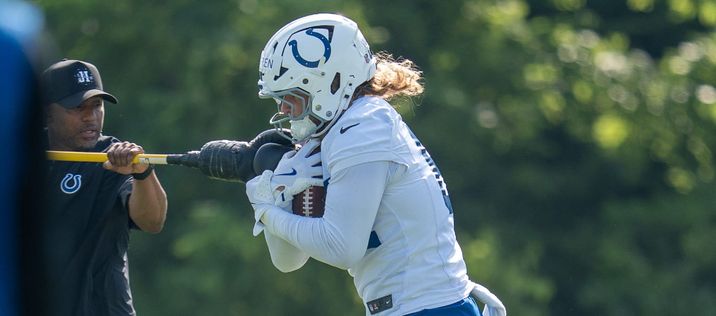
Tyler Warren (TE – IND)
Fast forward to this season, and Penn State’s Tyler Warren had a strikingly similar ADP to Bowers — TE9 in early best ball ADP. Interesting.
After the Colts selected Warren 14th overall, his ADP dipped slightly to the TE11, and well outside the top 100 overall picks. Warren is a super versatile rookie tight end that Colts head coach Shane Steichen could be super creative with. Both Steichen and general manager Chris Ballard acknowledged Warren’s “Swiss Army” knife skillset.
Even though Warren took some time to break out at Penn State (Penn State’s roster was littered with NFL talent, specifically at tight end, with Brenton Strange and Theo Johnson), he went nuclear in his final year with a 30% dominator rating.
Once he got his opportunities, he couldn’t be stopped. Warren took over as Penn State’s No. 1 TE and put up one of the best seasons ever for a Big Ten tight end — 104 receptions for 1,230 yards and eight touchdowns. He set Big Ten records for most catches and most receiving yards by a tight end in a single season.
Warren tied a college football record for tight ends with 17 receptions in a game against USC. He also won the John Mackey Award as the nation’s top tight end — the first ever in Penn State history. Warren also rushed for 218 yards and four touchdowns, and even threw a passing touchdown (he played quarterback in high school). He’s 23 years old and scored 20 total touchdowns the past two seasons.
Warren’s path to TE1 status could be through touchdowns in 2025, especially if the Colts use him closer to the red zone. He is a straight-up alpha and plays in an offense that maybe lacks a true alpha. I don’t want to discredit Michael Pittman Jr. for his past accolades, especially gutting out last year with the back injury, but there’s a lot of competition in this passing attack.
As I reflect on the NFL Draft coverage I absorbed pre-draft, Warren was always labeled as a straight-up alpha and would hit the ground running more so than Colston Loveland. Maybe that’s partially injury-related, but I don’t think it’s crazy to think the more experienced player will acclimate quicker to the NFL. Warren nearly tripled Loveland’s snaps in 2024.
“No rookie wall for Warren.”
Naturally, I think Warren is the dark horse bet to be the third straight rookie tight end to finish in the top three at the position in 2025, following in the footsteps of Brock Bowers and Sam LaPorta. Even a Kyle Pitts, Pat Freiermuth or Dalton Kincaid rookie season (mid to low-end TE1) is well within reach. The last three highest drafted tight ends have all been fantasy TE1s in Year 1 (Bowers, LaPorta, Kincaid).
Colston Loveland (TE – CHI)
Pre-draft, I much preferred Michigan’s Colston Loveland, who was mostly projected to be this year’s second tight end drafted. But some NFL teams had Loveland as their TE1 in the class, and that ended up being the case, as the Chicago Bears selected him with the 10th overall pick.
Loveland is currently the TE13 in ADP (an increase of one to two spots from his pre-draft ADP). I think his game is more similar to Bowers than Warren. Loveland experienced a breakout season at 19 years old in 2023, leading Michigan’s offense with a massive 38% dominator rating, despite battling injuries.
Loveland finished with 56 receptions for 582 yards (10.4 yards per reception) and five touchdowns, leading the team in targets by 45 more than the next closest player. For the second straight season, the Michigan tight end ranked inside the top five in yards per route run (2.67) among TEs.
The Michigan tight end declared early for the 2025 NFL Draft, foregoing his senior year. He earned elite draft capital as the first tight end drafted (10th overall). Loveland has battled a shoulder injury that has caused him to miss time so far this offseason, but he’s full-go by all accounts for the early start of Bears training camp.
I think Loveland might be the better long-term bet over Warren, but in Year 1, the Colts tight end might have the slight upper hand. Not exactly a 1-for-1 comparison, but Greg Dulcich out-produced Trey McBride in Year 1. That didn’t last.
Ultimately, I think in either situation, we are going to need to see elevated quarterback play for Warren/Loveland to hit right away. The Colts/Bears have hardly super-established passing games in place, but the paths for improvement are not hard to see in 2025. The upside quarterback play seems much more likely to happen in Chicago than in Indianapolis.
All in all, I am trying to learn from my mistake last season of not being high enough on Bowers.
Both of these first-round tight ends are cheaper than Bowers was last season. And they are probably just normal/streamer fantasy tight ends in the scenarios where they don’t hit. But if they do, you are capturing a boatload of upside you should be aiming for at tight end.
Chase the upside and draft these two heavily discounted first-round tight ends. The fact that they are both going after the middle tier of tight ends (typically bad bets to make at the position) justifies waiting on the position to grab one.
While I prefer Warren slightly for 2025, I think Loveland’s path could become clearer than most think. Chicago’s receivers and tight ends stayed very healthy last season. If that injury luck regresses in 2025, watch the target floodgates open up for the talented Bears rookie tight end.
If you waited in your fantasy draft and selected both Warren/Loveland, odds are pretty strong you’ll come away with a fantasy TE1.
Day 2 Tight Ends
After the top two guys, we have another tier between Elijah Arroyo (TE35), Mason Taylor (TE39) and Terrance Ferguson (TE43), as the remaining second-round tight ends selected.
We already have much more depth than last year’s class, which only saw one tight end selected in round two (Ben Sinnott). Sinnott was the TE24 last season, which felt appropriate based on the track records of tight ends. He didn’t hit thanks to Zach Ertz, but I don’t think his price was egregious.
Arroyo, Taylor and Fannin were are all projected to be second-to-third-round picks pre-draft. Ferguson’s draft capital was the most surprising versus the pre-draft market, but his commanding round two draft capital wasn’t too shocking based on how he tested at the NFL Scouting Combine. Ferguson also finished first in the nation in yards after the catch per reception (9.0) in 2024. Sorting out his deployment in Los Angeles for Year 1 is a bit tricky. Very possible he follows the Trey McBride path as Tyler Higbee closes out his career in Los Angeles.
Pre-draft, all of these tight ends were great values just based on their Day 2 draft capital. In 2024, Ja’Tavion Sanders was going as the TE25 before falling to Day 3 of the NFL Draft. Post-draft, he was the TE29. That’s cheaper than some second-round tight ends from this year’s class.
Twenty-seven percent of round two tight ends finish as top-24 options, so expect at least one of the three to be fantasy-relevant in Year 1.
Round 2 ADPs
The new prices are as follows:
- Mason Taylor (TE26)
- Terrance Ferguson (TE32)
- Elijah Arroyo (TE35)
Rounds 3-5 ADPs
The new prices are as follows:
- Harold Fannin Jr. (TE39)
- Oronde Gadsden II (TE41)
- Gunnar Helm (TE57)
- Mitchell Evans (TE65)
Elijah Arroyo was my favorite pre-draft, and I remained high on him after the Seahawks selected him 50th overall as the fifth tight end off the board. Arroyo was second in the nation in yards after the catch per reception (8.9) despite the seventh-highest average depth of target (aDOT) — 11.1. He averaged nearly 17 yards per catch, by far the most of any tight end in college football.
With veteran tight end Noah Fant removed from the picture, Arroyo has a path to push for the No. 2 receiving role in Seattle. With New Orleans last season, Klint Kubiak’s offense ranked sixth in target share to tight ends (28%). The Saints’ two top tight ends posted aDOTs north of 8.0 yards (Foster Moreau and Juwan Johnson).
Mason Taylor was rumored to be the third tight end drafted (also generating late-first-round buzz) for the high floor he could offer an NFL franchise. It’s easy to see him carve out an every-down role with the New York Jets, given their sheer lack of receiver talent behind Garrett Wilson. However, I do feel like Taylor’s ceiling might be capped in Year 1, given how run-heavy the Jets project to be.
Harold Fannin Jr. was the TE30 pre-draft, falling to the 67th pick (third pick in round three). He is now the TE39 in ADP, identical to Theo Johnson‘s ADP from a season ago. It was also close to Bengals tight end, Erick All (TE40). Both of those tight ends had moments as fourth-rounders before they missed time with injuries.
This suggests Fannin (high-end third-rounder) is being potentially undervalued. Oronde Gadsden has also generated solid hype from Chargers camp and brings a receiving profile that could help him stand out in the Bolts’ tight end room. Gadsden has deep NFL bloodlines related to his father, Oronde Gadsden Sr., but it almost goes beyond that.
PFF highlighted Gadsden’s high school practices featuring him against the likes of Patrick Surtain and Tyson Campbell. He also sought help from Terrell Owens and Chad Johnson.
Also, as I love to point out, there’s an interesting coaching pairing with Andy Bischoff. He’s the Chargers’ tight ends coach. He was with Baltimore when they had Darren Waller and reunited with Waller in New York with the Giants. Bischoff coached Mark Andrews as a rookie in Baltimore, Martellus Bennett in Chicago and Brevin Jordan in Houston.
2025 Rookie TE’s to average 2.00+ YPRR for their collegiate career:
– Colston Loveland (2.22)
– Harold Fannin Jr. (2.99)
– Oronde Gadsden II (2.04) ????Pay attention to the hype Gadsden’s getting. pic.twitter.com/TO4Y81pWkK
— David J. Gautieri (@GuruFantasyWrld) June 12, 2025
Keep in mind that the 2025 rookie tight end class was constantly praised. Don’t let the strong running back class distract from the fact that we should expect big things from this year’s rookie crop of tight ends, especially compared to the receivers.
The second-round tight ends between Ferguson and Taylor feel a bit pricy. Therefore, gravitate toward Arroyo as the second-rounder who makes the big impact in Year 1. Odds are that only one of these second-rounders will be a top-24 option, and take fliers on Fannin/Gadsden in the TE40 range.

Subscribe: YouTube | Spotify | Apple Podcasts | iHeart | Castbox | Amazon Music | Podcast Addict | TuneIn