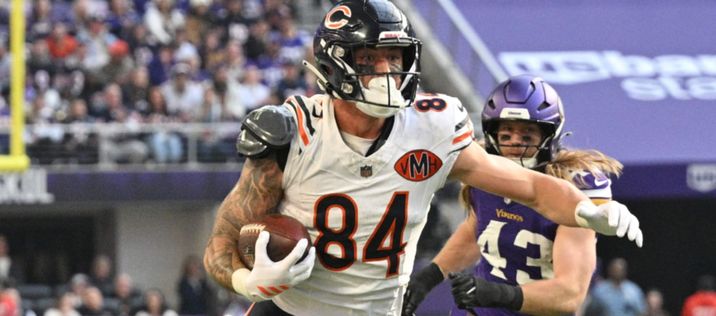
These are the days of wine and roses at tight end in fantasy football.
With the wave of young TE talent we’ve seen enter the league in recent years, the position should be well-stocked for the next few years at least.
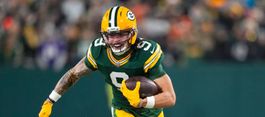
It’s hard to recall a time in the NFL when so many tight ends had a chance to be the top target earners on their respective teams. Trey McBride (Cardinals) and Brock Bowers (Raiders) are undisputed No. 1 targets. Colston Loveland (Bears), Tyler Warren (Colts), Tucker Kraft (Packers), and Harold Fannin (Browns) all have a chance to be the top dogs for their teams.
And there are quite a few tight ends with a reasonable chance to be the No. 2 targets on their respective teams.
- Fantasy Football Research & Advice
- Fantasy Football Expert Rankings
- 2026 Fantasy Football Draft Kit
- Fantasy Football Trade Analyzer
Fantasy Football Draft Strategy, Rankings & Tiers: Tight Ends
How to Play the TE Position in 2026
The question is how to attack the position now that it has become a buyer’s market with appealing draft targets at a variety of price points.
There are elite options such as McBride and Bowers. There are compelling midrange options such as Sam LaPorta and Kyle Pitts. And spending down at the position might mean drafting one of the tight ends who were the standard-bearers at the position just a few years ago – Travis Kelce, George Kittle, and Mark Andrews.
Pretty wild that punting tight end might mean drafting Travis Kelce, huh?
I’m not committed to a single TE strategy for 2026 fantasy football drafts, and I don’t think you should be, either. The behavior of your rivals during the draft should steer your approach to the position.
There will be drafts where the top tight ends fly off the board early. If that’s the case, you should probably wait, because the thirst for elite tight ends is letting top players at other positions slide further than they normally would.
There will be drafts full of avowed TE punters – fantasy managers who believe spending down at the position is the way to go. If you’re in such a draft, you might be able to grab an elite tight end below his average draft position.
It’s a good idea to be price-sensitive at tight end. My goal at tight end is simply this: to get one of the tight ends I like at a price I like. (More on my preferred TE targets in a minute.)
TE Premium Formats
Tight end premium has become a popular variation of fantasy football. In TE premium, tight ends are awarded more points per reception than wide receivers or running backs. In most TE-premium leagues, WRs and RBs get 1 point per reception, and TEs get 1.5. In some leagues, tight ends get 1.75 or 2 points per reception.
The format seemingly encourages you to spend up at tight end. With the greater rewards for TE receptions, there is an incentive to aggressively draft a top tight end in the early rounds.
But drafting a tight end early in a TE-premium league isn’t always an optimal strategy.
A lot of fantasy managers believe that in TE-premium leagues, where tight ends get 1.5 points per catch, tight ends are 50% more valuable than they are in non-TE-premium leagues. That’s not the case.
Yes, tight ends get 50% more for their receptions than wide receivers and running backs do. But tight ends aren’t only scoring points on receptions. They’re also getting fantasy points for yardage and touchdowns.
Let’s use last season’s leading TE scorer, Trey McBride, as an example. He scored 315.9 PPR fantasy points last season. In TE-premium, where he gets an extra half-point for each of his 126 receptions, McBride scored 378.9 fantasy points. That’s a 19.9% value boost.
Now, let’s try the same exercise with Dallas Goedert, who matched McBride’s 11 touchdowns but had only 60 receptions. Goedert scored 185.1 PPR points last season. His 60 catches gave him an extra 30 points in TE-premium for a total of 215.1. Goedert only got a 16.2% value boost in TE-premium formats.
I’m actually less likely to take a tight end early in a TE-premium draft because of the way my competitors overvalue the scoring boost.
Since tight ends come off the board so early in TE-premium drafts, good players at other positions are often available a half-round or a full round later than they would be otherwise.
You can often scoop up value at other positions while your rivals are overdrafting tight ends. If you can figure out a way to get adequate TE production later in the draft, you’ll be ahead of the game.
Fantasy Football Targets & Avoids
Here are some of the tight ends I’m targeting and avoiding this year:
Target: Brock Bowers (LV)
Bowers is capable of matching the reception and TD totals Trey McBride produced last year – perhaps with an even better yardage total.
As a rookie in 2024, Bowers was TE1 in fantasy scoring with 112 catches for 1,194 yards and five touchdowns. He was third among all pass catchers in receptions that season – tight ends and wide receivers – sixth among all pass catchers in targets, eighth in receiving yardage. Bowers did it with Gardner Minshew, Aidan O’Connell and Desmond Ridder as his quarterbacks.
A sprained PCL and bone bruise in his left knee thwarted Bowers last season, and the impotence of the Raiders’ offense was too severe to overcome. But there were certainly flashes of greatness, including a 103-yard game in Week 1, and a 12-catch, 127-yard, three-TD game in his first game back from the knee injury.
Bowers was arguably the best TE prospect of all time, and his healthy rookie season validated the acclaim.
This season, the Raiders get a new and better playcaller with Klint Kubiak coming in as head coach. The No. 1 pick in the draft, Fernando Mendoza, will take over at quarterback at some point. If the Raiders have Mendoza sit early in the season, Bowers’ quarterback will be the TE-friendly Kirk Cousins, who assisted on a 166-yard, three-TD game for Kyle Pitts in Atlanta last season and also fueled some big TJ Hockenson seasons in Minnesota.
The Raiders are also talent-starved at receiver. Bowers is the best pass catcher on the team.
Bowers is poised for a monster season. He’ll be taken late in the second round of most 2026 fantasy drafts, but it’s easy to justify drafting him in the early-to-mid second round.
Avoid: Trey McBride (ARI)
McBride is a made man at the TE position. He’s one of the elites, no question. McBride has piled up 237 receptions over the last two seasons. He led all tight ends in half-point PPR scoring by 86.1.
As good as McBride is, he’s facing fierce headwinds in 2026.
The Cardinals led the NFL in pass attempts last year. QB Jacoby Brissett averaged more than 40 pass attempts per game in his starts. Arizona spent the No. 3 overall pick in this year’s draft on RB Jeremiyah Love. The Cardinals are destined to throw less this season.
The Cardinals are highly motivated to get WR Marvin Harrison Jr., the fourth overall pick of the 2024 draft, untracked after two disappointing seasons. And it’s likely the Cardinals will give a multi-game audition to rookie QB Carson Beck at some point, since Brissett is a 33-year-old journeyman.
McBride should still produce big numbers by the standards of the TE position, but perhaps not big enough to justify his second-round ADP.
Target: Colston Loveland (CHI)
If Loveland can be had in the fourth round of 2026 fantasy drafts, he could be a value.
Loveland’s rookie year got off to a slow start, but by the end of the season, he had become a monster. From Week 9 through the end of the regular season, Loveland was TE2 in fantasy scoring behind only Trey McBride. In the Bears’ last four games (playoffs included), Loveland averaged 12.0 targets, 7.0 catches, and 94.5 yards, with a pair of touchdowns. In the Bears’ playoff win over the Packers, Loveland had 15 targets, eight catches and 137 yards.
The 6-foot-6, 241-pound Loveland is a matchup nightmare. He’s too powerful for defensive backs and too fast for linebackers. QB Caleb Williams is ascending, and Bears QB Ben Johnson is a playcaller who’s earned our trust.
Avoid: Dalton Kincaid (BUF)
Kincaid was wildly efficient in 2025, averaging 14.6 yards per catch, 11.7 yards per target, and 2.70 yards per route run.
The problem was that Dalton Kincaid played only 302 snaps last season – about 25 a game. He finished with 39 catches for 571 yards and five touchdowns and was the TE18 in half-point PPR scoring.
It would be challenging for Kincaid to match his 2025 efficiency, so in order to have a greater fantasy impact in 2026, he’d probably have to play significantly more snaps.
Kincaid tore his PCL two seasons ago and has not had it surgically repaired. Bills GM Brandon Beane has said the team needs to manage Kincaid’s workload.
What if Kincaid continues to play limited snaps and his efficiency falls back to career norms?
Target: Kyle Pitts (ATL)
Pitts is coming off a strong season in which he had 88 catches for 928 yards and five touchdowns, finishing TE2 in half-point PPR fantasy scoring. It was Pitts’ best season since his 1,026-yard rookie campaign in 2021.
New Falcons head coach Kevin Stefanski has been a TE-friendly playcaller. Over the last three years, tight ends in Stefanski’s Cleveland offenses averaged 164.3 targets per season, with at least 155 targets in each of those years.
Pitts was the fourth overall pick of the 2021 draft, and he’s still only 25. He’s had some disappointing seasons, which is holding down his price. I think Pitts is a worthy midrange TE target.
Avoid: Jake Ferguson (DAL)
Jake Ferguson is a competent pass catcher in a prolific Dallas offense, but the presence of star WRs CeeDee Lamb and George Pickens could limit Ferguson’s ceiling. The Lamb-Pickens duo combined for 250 targets and 168 receptions last season – and that was with Lamb missing time due to injury.
Ferguson had 82 catches for 600 yards and eight touchdowns in 2025. He finished TE8 in half-point fantasy scoring but was TE13 in fantasy points per game among tight ends who played at least five games. He averaged a career-low 7.3 tight ends per catch.
Ferguson is a catch-and-fall-down tight end who needs target volume to pay off, and it seems unlikely he’ll get substantial target volume if Lamb and Pickens are healthy.
Target: Mark Andrews (BUF)
If you cut corners at tight end, Andrews could be a worthy budget option
Isaiah Likely has left the Ravens for the Giants, leaving Andrews as the only established pass-catching tight end on the Baltimore roster. He had career lows in yards per game (24.8), yards per catch (8.8), and yards per target (6.0) in 2025, but Lamar Jackson‘s health issues were undoubtedly a factor.
Jackson has long favored his tight ends. Here’s where the Ravens’ tight ends have ranked in percentage of team targets since Jackson became a full-time starter: first, fifth, first, first, 10th, fourth, and fourth.
Baltimore’s new offensive coordinator, Declan Doyle, is a wild card, but Doyle is a disciple of Bears head coach Ben Johnson, who presided over a promising rookie season from Colston Loveland last year and helped Sam LaPorta finish as the fantasy TE1 in 2023.
It’s worth acknowledging the possibility that Andrews, who turns 31 in September, is simply cooked. But Andrews is going late enough in drafts that in most leagues, it would be painless to cut him and stream the TE position if he struggles in the opening weeks of the season.

Tight End Rankings & Tiers
Here are the top 30 tight ends in my redraft rankings, sorted into tiers, with thoughts on some of the players from each tier.
Tier 1
We’ve discussed all three members of this tier in the Targets & Avoids section above. This is the power trio of the position. It’s just a matter of whether you can get any of these guys at a reasonable price.
Tier 2
Sam LaPorta ranked TE5 in half-point PPR scoring as a rookie, finishing with 76 catches for 817 yards and four touchdowns (plus one TD run). Warren was much more productive over the first half of the season than the second half. Daniel Jones‘ late-season injuries might partly account for Warren’s slowdown, and Jones’ health status might still be an issue early in the season as he returns from a torn Achilles. But the Colts traded away WR Michael Pittman in the offseason and didn’t make any significant pass-catching acquisitions, bolstering Warren’s 2026 target outlook.
Tucker Kraft is coming back from an ACL tear and a small meniscus tear that ended what was shaping up to be a monster season. Kraft had 32 catches for 489 yards and six touchdowns before getting hurt against the Panthers in Week 9. He was TE2 in half-point PPR scoring when he went down. If Kraft is fully healthy, he could produce big numbers in 2026.
Third-round pick Harold Fannin was surprisingly impactful as a rookie, finishing TE6 in half-point POPR scoring with 72 catches for 731 yards and six touchdowns. The Browns’ QB situation looks bleak, but Fannin has a good chance to lead the team in targets.
Tier 3
Travis Kelce turns 37 in October, and he’s no longer the same player he was in his prime. Kelce has averaged 2.05 yards per route run for his career, but he’s been just under 1.50 YPRR each of the last two seasons. Still, Kelce caught 76 passes for 851 yards and five touchdowns last season to finish TE3 in fantasy scoring. The Chiefs didn’t add any significant pass catchers in the offseason, so Kelce still figures to be a prominent target earner.
George Kittle tore his right Achilles in the 49ers’ Wild Card win over the Eagles on Jan. 11. But Kittle says he expects to be back for Week 1, and reports about his recovery have been overwhelmingly positive. The injury and Kittle’s age (32) make him much less bankable than he’s been throughout his career, but the discount drafters will get on him makes Kittle an intriguing cost-cutting option.
Isaiah Likely has shared TE targets with Mark Andrews for years. Now, Likely could be a prominent target earner for the Giants and young QB Jaxson Dart. The Giants are thin at wide receiver behind young star Malik Nabers, and Nabers has been slow to recover from an ACL tear.
Tier 4
- Dalton Kincaid (BUF)
- Jake Ferguson (DAL)
- Juwan Johnson (NO)
- Dallas Goedert (PHI)
- Brenton Strange (JAC)
- Chig Okonkwo (WAS)
- Dalton Schultz (HOU)
- Hunter Henry (NE)
- Greg Dulcich (MIA)
Juwan Johnson had a career year in 2025, finishing with 77 catches, 889 yards, and three touchdowns. Rookie WR Jordan Tyson, a top-10 draft pick, could cut into Johnson’s target total. But Tyson and Saints veteran Chris Olave have both had injury problems in the past, and if either were to miss time, Johnson would likely see a target increase. The fast pace favored by Saints head coach Kellen Moore also works in Johnson’s favor.
Dallas Goedert scored a career-high 11 touchdowns in 2025, with six of them coming on shovel passes from the 5-yard line or closer. Goedert also had a career high with 60 receptions last season, although he averaged a career-low 9.9 yards per catch. AJ Brown‘s departure from Philadelphia could benefit Goedert’s target total. The big question is whether new Eagles offensive coordinator Sean Mannion will continue to feature Goedert near the goal line.
Greg Dulcich has been plagued by injuries and inconsistent usage during the early part of his career, but he’s a dark-horse candidate to be the target leader in a Dolphins offense that lacks proven pass-catching talent.
Tier 5
- Oronde Gadsden II (LAC)
- AJ Barner (SEA)
- TJ Hockenson (MIN)
- Kenyon Sadiq (NYJ)
- Gunnar Helm (TEN)
- Terrance Ferguson (LAR)
- Eli Stowers (PHI)
- Pat Freiermuth (PIT)
- Cade Otton (TB)
Oronde Gadsden was TE1 in half-point PPR scoring over a four-week run from Week 6 to Week 9 in which he had 24 catches for 377 yards and two TDs. But Gadsden’s production fizzled thereafter, and the Chargers’ signing of veteran TEs Charlie Kolar and David Njoku casts a shadow over Gadsden’s snap and target outlook.
It was only three years ago that TJ Hockenson had 95 catches for 960 yards and five touchdowns. But Hockenson tore the ACL and MCL in his right knee in late December of 2023 and has yet to regain his old form.
Terrance Ferguson is an intriguing TE sleeper. A second-round draft pick last year, Ferguson had only 11 catches as a rookie but averaged 21.0 yards per catch and 9.2 yards per target. Ferguson is an extraordinary physical specimen who ran a 4.63 and had a 39-inch vertical jump at last year’s combine. The Rams have a lot of TEs on the roster, but it’s worth noting that Rams tight ends combined for 150 targets, 103 catches, 1,128 yards, and 17 touchdowns last year.

Subscribe: YouTube | Spotify | Apple Podcasts | iHeart | Castbox | Amazon Music | Podcast Addict | TuneIn