Welcome back to my free agency preview. You know the drill. If not, check out the introduction of last week’s piece on quarterbacks and tight ends. The 2018 wide receiver free-agent class was excellent, headlined by Allen Robinson, Sammy Watkins, and Jarvis Landry. Marqise Lee re-signed with the Jaguars; Paul Richardson, Jordy Nelson, and Michael Crabtree all changed teams. While the 2019 crop isn’t as top-heavy as last year, there are some fantasy-relevant names hitting the open market that dynasty players should monitor. However, some of the players on this list aren’t as interesting as the ones who may replace them, so remember to consider the impact of a vacancy opened as well as the impact of a player landing on a new team.
Mock draft in minutes with our free fantasy football Draft Simulator 
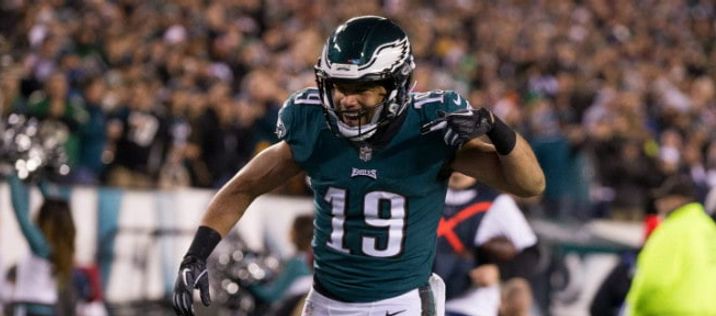
Golden Tate (PHI)
Tate is coming off of a bit of an enigma season. After posting strong numbers in Detroit to start 2018, the Lions traded him to Philadelphia mid-season. While still vacuuming up targets (he accounted for 21% of his team’s targets), Tate only managed to finish with 12.1 PPR fantasy points per game, outside of the WR2 range.
However, after finishing 2017 with the most YAC of any wide receiver—accounting for just under two-thirds of his total yardage—Tate posted 412 yards after the catch in 2018. This was still good for 11th in the league among wideouts but comprised just over half of his total yardage. The concern for dynasty owners is that Tate’s Air Yards (essentially the depth of target) did not suffer at all. Altogether, this means Tate’s production drop can be attributed primarily to not creating as much after the catch.
The most obvious explanation is that Tate’s above-average athleticism is fading as he approaches age 31. As the Eagles don’t have another strong slot receiver, his optimal value probably lies in Philadelphia, unless he can land on a team with a thin depth chart where he can rack up targets (e.g., Oakland). However, without a bump in targets, don’t expect the same Tate of years’ past. He’s fading more into the WR3 range than his usual WR2 range.
Tate becomes a buy candidate for win-now dynasty teams this offseason if he lands with a team that will feed him targets (including the Eagles, especially if Zach Ertz is a cap casualty). Otherwise, it’s best to avoid taking on a player with diminishing value.
Larry Fitzgerald (ARI)
Larry Legend has been a staple of fantasy football rosters for just shy of forever, but that time is likely coming to an end. Despite a target share of over 23% in 2018 (top-20 among WRs), he was unable to deliver in the fantasy points column. He churned out just 11.5 PPR points per game, barely finishing in the WR3 range. At just over 10 yards per reception and 6.6 yards per target, Fitzgerald was still near his 2017 efficiency marks.
His downturn can largely be attributed to inconsistent quarterback play by rookie Josh Rosen for most of the season. Less encouraging, though, is that Fitzgerald has essentially become a contested-catch receiver. He created just 1.03 yards of separation on average when targeted (outside the top-100 WRs), but he caught nearly half of his contested targets (14th-best among WRs). Without creating more separation, it’s hard to spin a scenario where Fitzgerald sees 150+ targets in 2019.
On Wednesday, the Cardinals announced that Fitzgerald signed a one-year deal to return for his 16th (and potentially final) season. If you’ve ridden Fitzgerald in dynasty, it’s likely been a good ride, but it’s probably time to cash out before his value completely disappears. He would have increased his remaining trade worth, however, by signing for a contender with a strong offense.
Devin Funchess (CAR)
Funchess has long been the butt of many fantasy jokes, but I’ve never understood why. He came into the league very young (he’s still not even 25), played college football with a glorified running back throwing him passes at Michigan, and landed on a team with an inaccurate quarterback in Cam Newton. At this point, Funchess has shown the ability to produce at both the college and professional level.
Funchess was responsible for over one-third of Michigan’s passing offense before declaring for the NFL Draft, and he racked up over 700 receiving yards starting as a young sophomore. He disappointed down the stretch in 2018, as his playing time dwindled away to nearly nothing. It’s likely a sign that the Panthers—who drafted Curtis Samuel in the second round of the 2017 NFL Draft and D.J. Moore in last year’s first round—are going to move on from Funchess.
In his first six games of 2018, though, Funchess scored three touchdowns and posted fewer than 50 receiving yards or seven targets just once apiece. Starting with a nightmare matchup against Baltimore in Week 8, when he saw primary coverage from Jimmy Smith, he was targeted more than five times just once from then onward. He did not play more than 50% of the offensive snaps after the Panthers played the Lions in Week 11. However, if we look back to 2017, where Funchess played 16 games and 84% of the offensive snaps, he was significant enough of a factor for the Panthers to trade away Kelvin Benjamin. Funchess was targeted 112 times, with an uptick in the red zone and end zone. He tallied 840 receiving yards and eight scores in that season, good for a back-end WR2 finish in PPR scoring on a per-game basis.
So, if you want a player with WR2 credentials and plenty of touchdown upside (he converted over 50% of his 33 attempted contested catches in 2017), Funchess is a prime target whose price tag should be well below where it was just a year ago. Try to acquire him before he signs a new deal. Almost anywhere is better than Carolina, and the Panthers are signaling in every way that he is not part of their long-term plans. He could well be the best value free-agent WR not just in dynasty league football, but in real football, too.
Donte Moncrief (JAC)
Despite playing on a team with a thin depth chart, Moncrief’s 2018 campaign did not inspire in any way. He amassed only 90 targets, which accounted for just over 17% of the Jaguars’ pass attempts, despite playing in all 16 games and over 80% of the offensive snaps. Moncrief totaled just under 14.0 yards per reception and was even worse on a per-target basis, as he only caught 73% of his catchable passes (good for 99th-best among WRs). He gained just 1.18 yards of separation on his average target and only caught five of his 26 contested targets.
It’s hard to imagine Moncrief making an impact in 2019 or beyond, so take the trade if there’s any value or hold tight until he lands if there isn’t a market at this point. Moncrief’s only bright spot in 2018 was eight end-zone targets, so it’s probably time to move on unless you want a touchdown-dependent wideout.
Randall Cobb (GB)
Cobb has now finished as the WR33 and WR50 in PPR points per game in the past two seasons, fueled by a sub-20% target share in both years. He was far from a model of efficiency in 2018, which suggests that a new team likely won’t sign him as a featured option.
Cobb ranked just barely inside the top 100 in metrics such as yards per reception, yards per target, and yards per route run. He also had six drops on only 61 targets in 2018. His potential departure, which looks more likely after the Packers drafted three wideouts last year, could mean more playing time for fifth-round pick Marquez Valdes-Scantling and sixth-round pick Equanimeous St. Brown. Valdes-Scantling, a strong producer at USF, came into the league as an old rookie—he is already 24 years old—but possesses great speed with a 4.37-second 40-yard dash time. He posted over 15 yards per reception in 2018 on 72 targets, making him a great counterpart to Davante Adams, who has become one of the league’s signature route technicians.
Expect Valdes-Scantling to see plenty of deep targets in 2019 from a healthy Aaron Rodgers, so the time to buy is now. St. Brown is also fast. The 6’5″, 214-pound wideout, however, is unlikely to overlap in a role with either Adams or Valdes-Scantling. St. Brown is more of an unknown, but he did post over 15 yards per catch in limited action as a rookie. His projected role is a bit murkier, but his price tag is probably free or close to it. That makes St. Brown a nice stash heading into 2019 for those using taxi squads.
John Brown (BAL)
Baltimore has become a dynamic offense for real football purposes, but Lamar Jackson made the Ravens the NFL’s most run-heavy team. Their offensive strategy has turned Baltimore into a wasteland for fantasy WR or TE value, so John Brown needs to move out of town in order to maintain any appeal.
Brown started 2018 off well with Joe Flacco under center, ranking as the WR20 in half-PPR scoring (just ahead of Landry and Keenan Allen) through Week 9. For a late-round pick, Brown was paying off in a big way. Once Jackson took over the offense, the deep playmaker ranked as the WR95 through the end of Week 16, posting just 3.4 points per game and ranking just ahead of Justin Hardy and Bennie Fowler during that stretch.
Brown still possesses great speed and big-play ability, and he saw seven or more targets in six of nine games with Flacco, so he can absolutely still be more than a role player. He can maintain fantasy value by landing in a better situation, but his brand equity is probably tarnished enough that he can be bought cheaply, even after signing elsewhere.
Ryan Grant (IND)
I’m not really interested in Grant, though he can be a decent producer in spots. The interesting part about Grant heading to free agency is the door that opens for Deon Cain, a second-year player out of Clemson who missed his entire rookie season due to an injury.
Cain, a 6’2″ speedster (4.43-second 40-yard dash), has a very strong chance to factor heavily for the Colts in 2019. While Andrew Luck found his primary red-zone target in Eric Ebron, the Colts lack a big-bodied wide receiver. However, Cain built some hype leading into the 2018 season and will compete with the likes of Dontrelle Inman and Zach Pascal to line up opposite of T.Y. Hilton (and perhaps RFA Chester Rogers) next season. Cain didn’t exactly set the world on fire at Clemson, but he totaled over 700 receiving yards in both his sophomore and junior years while scoring 15 touchdowns in 29 games. He also averaged an impressive 19.1 yards per catch in his sophomore year. The 22-year-old didn’t shy away from tough competition, posting five catches for 94 yards in Clemson’s 2016 National Championship victory over Alabama.
Cain is an obvious priority pickup if available. If not, send out trade offers and try to acquire him on the cheap. By this time next year, his value could have skyrocketed.
Chris Hogan, Josh Gordon (RFA), Phillip Dorsett, and Cordarrelle Patterson (NE)
With Gordon being a total unknown at this point due to his indefinite suspension, the only WRs guaranteed back in New England in 2019 are Julian Edelman, special-teams ace Matthew Slater, Damoun Patterson, Braxton Berrios (IR), Cody Hollister (IR), and Riley McCarron (IR). Slater plays primarily on special teams; Patterson was an undrafted rookie out of Youngtown State with an unexciting college profile. The undrafted Hollister was a complete non-factor at Arkansas, and Iowa alum McCarron (also undrafted) is nearly 26 after his rookie year.
With such a thin projected depth chart, picking up Berrios off waivers (or sending a trade offer if he’s actually owned) is a no-brainer. The sixth-round pick out of Miami (FL) was a solid contributor at the college level. He could slide into New England’s slot role in 2019, which would especially be an interesting assignment if Rob Gronkowski retires.
Of the others, McCarron is the only player of interest for teams with roster spots to spare. Both McCarron and Patterson contributed at the college level, but McCarron did so in a major conference and tested well in jumping and agility drills. Patterson, on the other hand, tested near the bottom of the athleticism charts across the board.
Adam Humphries (TB)
Humphries is another interesting candidate mainly because of his potential replacements rather than his own future value, which is limited to a low-upside slot receiver with marginal PPR value. If he leaves Tampa Bay and DeSean Jackson becomes a cap casualty ($10M cap hit with $0 dead cap if he’s released), the starting lineup next year would almost certainly feature Chris Godwin, who tested in the upper echelon athletically across the board. Godwin was a significant factor in Penn State’s passing offense despite sharing a field with Saquon Barkley and Mike Gesicki, both of whom were drafted earlier than their former teammate. There is no shame in playing the third wheel, a role Godwin also experienced in the NFL.
On just 95 targets, Godwin topped 800 yards receiving and tallied seven touchdowns in 2018, good for 11.4 PPR points per game and a finish barely inside the WR3 range. If he sees an uptick in snaps (68%) and targets (15.3%), he could fare very well on a Buccaneers team that passed the ball 39.1 times per game (fourth-most in the NFL). If the Godwin owner in your league has caught on—he’s worth a mid-to-late first-round rookie pick at worst—fear not, as there is a more unknown player to throw into the mix.
A fifth-round pick in 2018, Justin Watson did not see the field in his rookie season, but he has a very promising college profile. He accounted for over half (!) of his team’s passing offense at the University of Pennsylvania, topping 1,000 yards in each of his final three seasons and scoring 31 touchdowns across those 30 games. He also averaged just over 13 yards per catch for his career, above the team’s average mark in his senior season. After absolutely dominating in college, Watson tested well in speed and burst (vertical and broad jump) drills at his Pro Day. There’s very little not to like about the 6’2″, 215-pound prospect, who could get a chance in 2019. He could run away with an opportunity and can be acquired very cheap in dynasty leagues, so what are you waiting for?
Kelvin Benjamin and Chris Conley (KC)
Here is another duo that provides more value in the vacancy they leave than on their own. If both players depart, the Chiefs’ prolific passing attack will consolidate to Tyreek Hill and Travis Kelce (duh), but also to Sammy Watkins. A roller coaster of dynasty value since entering the league, Watkins could see a 2019 resurgence if the Chiefs opt to let Conley and Benjamin walk.
Benjamin offers little value regardless of his landing spot, as he proved by doing a fat lot of nothing in Buffalo as the only viable receiving option to start 2018. The 26-year-old Conley is still largely unknown, but he ran a 4.35-second 40-yard dash and fared well in the jumping drills. Generally speaking, most dynasty owners like a fast, athletic, 6’2″ receiver. Conley has the peripherals to play a true alpha-dog role, but he has never displayed that ability in practice, primarily (perhaps?) due to lack of opportunity. His best season featured 69 targets, with which he didn’t do much. In 2018, his only other season over 31 targets, he flashed a bit of upside by scoring five touchdowns.
Conley’s only hope is to land with a team in need of a target hog (e.g., Oakland or Miami). More importantly, however, now is the time to ask about Watkins’ price tag if his owner has soured on the inconsistent receiver. Watkins could see an uptick in targets on perhaps the league’s most dynamic offense in 2019.
Efficiency metrics courtesy of Player Profiler.
Mark Leipold is a featured writer at FantasyPros. For more from Mark, check out his archive and follow him @LeipoldNFL.